






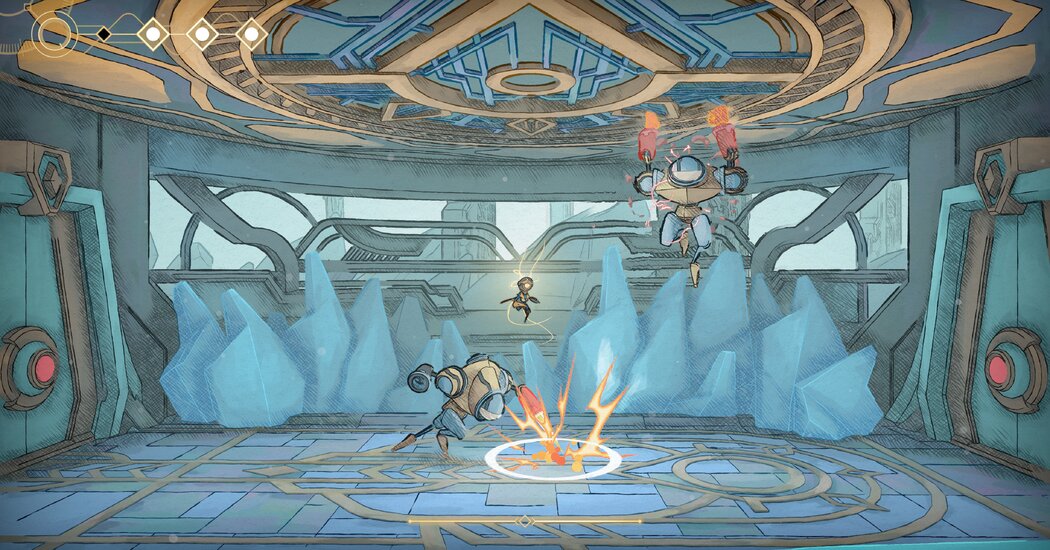
A few hours into MIO: Memories in Orbit, I wanted to bail. I didn’t think I had it in me to go on struggling with this deceptively cute and extremely challenging Metroidvania about a little robot in a labyrinthine spaceship.
Gnarly platforming gantlets? Check. Tanky bosses? Check. Permanent health loss? Yep. Oh, the vile things I muttered as I repeatedly failed to cross toxic, touch-it-you-die “gloomwater” simply to reach a boss.
More than 40 hours later, I am dazed by the trials I’ve overcome. That infuriating runback now strikes me as a piece of brilliant game design since it prepares you for the most dangerous phase of the boss fight. Maybe not since The Witcher 2: Assassins of Kings (2011) has a game produced a torrent of negative emotions that mellowed into warm affection.
“The game is meant to be played with a guide,” said Oscar Blumberg, the game’s director and a co-founder of the French studio Douze Dixièmes. “That’s how I play obscure cryptic games.”
Hollow Knight was a major influence on the development of Memories in Orbit, Blumberg said, particularly “not knowing how big the world is, and how it works.” We laughed after he joked about playing Dark Souls and not thinking to touch a painting to enter a hidden world.
MIO, the game’s titular robot, is tasked with saving what remains of the Vessel, an enormous spaceship whose artificial intelligence support systems are decaying. Once the home of a long-gone people known as the Travelers, the Vessel is a repository of fantastical biomes. Watercolor-esque visuals give a hand-drawn look to the psychedelic forestlike Feral Undergrowth, the elegant ice-encrusted buildings of Metropolis and the purplish jungle twilight of the Promenade.
The story is told in an elliptical way, in the service of an elegiac mood. An insectlike robot revives MIO early on before scampering away. With her single eye and hair of golden tendrils, MIO is left to explore a world that dwarfs her.
Though she encounters a few amicable robots, most want to destroy her on sight. Why this is so is a part of the mystery. But by killing them, MIO acquires a resource she can give a vendor to upgrade her frame. Alas, I have yet to discover any mods that make MIO feel markedly more powerful, though there are a few ways to permanently boost her attack power.
In classic Metroidvania fashion, MIO can expand her core set of moves by felling bosses. The first significant upgrade allows MIO to use the tendrils of her hair, which she deploys in combat, to grapple from hooks in the air.
What the game does notably well is present players with scenarios that seem obnoxiously difficult but are in fact manageable. It’s necessary to employ a bit of lateral thinking during the harder platforming sections and to memorize boss patterns. And while the bosses are expertly animated to make their tells legible, it’s still tough to capitalize on windows of opportunity.
Blumberg said the comparatively simple mechanics of his studio’s previous game, Shady Part of Me, meant the team had grown bored while playtesting it over and over again. So this time, it decided “to make a hard game, with a high skill ceiling so that we can have fun the whole time.” Even after playing for thousands of hours, he said, some of the bosses occasionally knocked him flat.
For those who have been chastened or repulsed by Hollow Knight’s challenges, Memories in Orbit offers accessibility options that show how an unabashedly hard Soulslike game can make a good-faith effort to respect everyone’s time.
An “eroded bosses” option results in them taking slightly more damage every time MIO dies, with a cap of double damage. My patience would have long vanished without a ground heal option that replenishes one of MIO’s hit points if she stays on the ground for five seconds, an invaluable help with the game’s parkour obstacles. A pacifist option makes all non-boss enemies refrain from attacking MIO until they are struck.
The game boasts a secret ending that requires jumping through a few hoops and facing its toughest challenges. It was difficult for the team to stick to its vision, Blumberg said, after several challenging playtests in which people vented their frustrations.
“Every time we were a hair away from spoiling it basically, like adding some piece of text or a tutorial,” he said. But ultimately, “We wanted to leave people marinating.”
MIO: Memories in Orbit was reviewed on the PC. It is also available on the PlayStation 5, Switch, Switch 2 and Xbox Series X|S.
https://www.nytimes.com/2026/02/14/arts/mio-memories-in-orbit-review.html


