






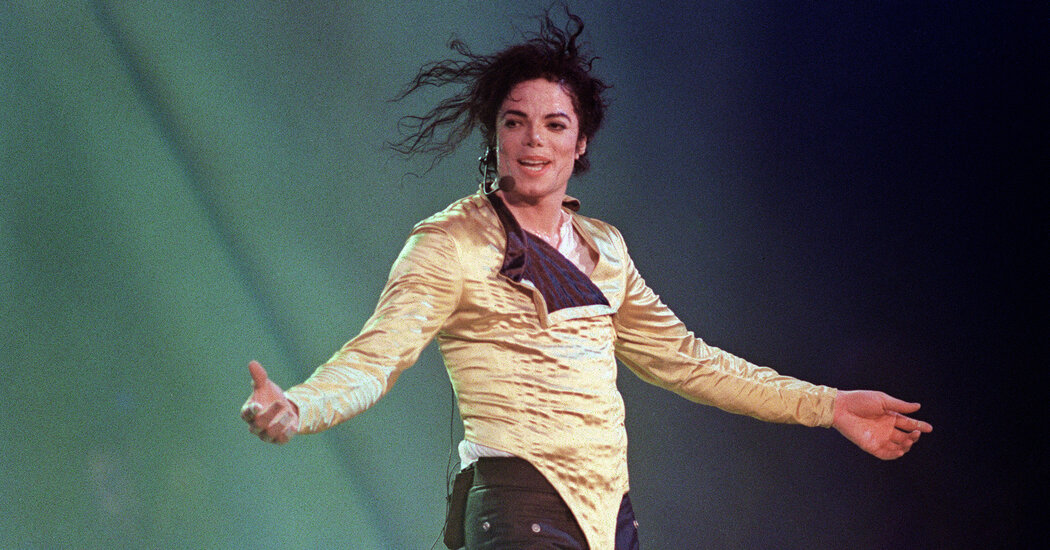
Seven years ago, when two men made detailed, unsettling accusations in an HBO documentary that Michael Jackson had sexually abused them as boys, the music industry pondered a striking question: Could Jackson, one of the most popular and beloved artists of all time, really be canceled?
The answer, it turned out, was a resounding “no.”
As the Jackson estate’s latest megaproject, the Hollywood biopic “Michael,” arrives this week, the King of Pop is more popular — and the business behind him more lucrative — than at any point since his 2009 death.
Streaming activity for his catalog of hits like “Thriller,” “Billie Jean” and “Bad” rivals that of contemporary stars like Kendrick Lamar and Sabrina Carpenter. A Broadway musical, “MJ,” once thought to be endangered by HBO’s two-part documentary, “Leaving Neverland,” has instead proved a sustained hit, selling 2.3 million tickets worth $328 million since it started performances in late 2021, according to the Broadway League.
And every Halloween, you can reliably hear the synthesized beat and spooky sound effects of “Thriller” booming out of school parking lots and trick-or-treat houses all across the United States.
Jackson’s name, and his business, are now being challenged once again. Members of the Cascio family, who lived in New Jersey and had a long association with Jackson, filed a lawsuit saying that the star repeatedly sexually assaulted them when they were children, and asked for unspecified damages. In a statement to The New York Times, a lawyer for the estate called their suit “a desperate money grab,” and noted that members of the Cascio family had long publicly defended Jackson and denied he had ever harmed them.
Jackson is far from the only music star to have their business threatened amid disturbing allegations, only to find a loyal, or at least curious, audience sticking by them.
After a documentary about R. Kelly in 2019 that featured extensive, personal accusations of sexual abuse of young women and girls, Kelly was convicted of sex trafficking and racketeering and sentenced to 30 years in prison. As the case against him was being built, a social media campaign, #MuteRKelly, urged record labels, streaming platforms and concert promoters to cut ties with the singer.
But his songs have remained widely available online, and even now his hits like “Ignition (Remix)” and “I Believe I Can Fly” rack up steady, substantial streaming numbers — about 11 million clicks a week in the United States, according to the tracking service Luminate.
“Sometimes controversy makes artists more visible,” said Larry Miller, the executive director of the Sony Audio Institute for Music Business and Technology at New York University. “And in the streaming era this translates directly into listening.”
Chartmetric, another company that tracks musicians’ popularity online, found more than 450,000 user-generated playlists on Spotify containing Kelly’s music, suggesting a core group of devoted fans who listen regularly.
Kenyette Tisha Barnes, one of the founders of the #MuteRKelly campaign, said the continued popularity of Kelly’s music “is not an indicator of failure in our movement.” She added, “Many other variables beyond streaming platforms indicate a social-cultural shift in public indifference to his crimes.”
After Kelly’s convictions, courts have ordered that earnings from his music royalties be paid as restitution to victims.
Ye, the rapper-provocateur formerly known as Kanye West, has had mixed success with a new comeback campaign after apologizing for years of antisemitic remarks and praise for Adolf Hitler. He sold out two nights at a stadium outside Los Angeles and his latest album, “Bully,” opened at No. 2 on the Billboard 200 chart, but he has canceled shows in Europe after Britain denied him a visa for a festival there.
Fandom has an entirely different meaning when it comes to Jackson, whose fame is too vast to be limited to fan armies (though he certainly has those).
Jackson’s songs are still regularly played on the radio, and “MJ” still draws near-capacity crowds after five seasons, with noticeably more diverse audiences than are typically seen at most Broadway shows. In 2022, Justice Ketanji Brown Jackson, newly appointed to the U.S. Supreme Court, saw “MJ” and met the cast and crew backstage.
Like the new film, the Broadway show “MJ” is set before the first allegations of child abuse were made public against Michael Jackson in 1993.
Jackson’s turnaround happened in the aftermath of his death at age 50, on the eve of an attempted comeback concert series in London.
Despite his acquittal four years earlier, Jackson’s reputation was in such tatters that the value of his name and likeness at the time of his death was just $4.2 million, according to a later ruling by a U.S. Tax Court judge. After years of profligate spending, Jackson had died more than $500 million in debt.
But savvy business decisions by his estate — managed by John Branca, Jackson’s longtime lawyer, and John McClain, a music executive — and an array of entertainment productions, like a concert film and Jackson-themed shows by Cirque du Soleil, turned his finances around. The estate, whose beneficiaries are Jackson’s mother and three children, along with a provision for charity, has collected more than $3 billion in earnings since Jackson’s death, according to court documents.
When asked about the continued popularity of Jackson’s music, the estate said in a statement that “each project, including the two shows with Cirque du Soleil to ‘MJ the Musical’ to the biopic, offers another generation an opportunity to experience the joy of the discovery of Michael’s music and reinforces the connection with Michael’s legacy for longtime fans.”
After the HBO documentary, in early 2019, radio spins of Jackson’s songs briefly dipped, and his streaming numbers were depressed for months. But by 2020, his clicks had fully recovered and resumed an upward trajectory, spiking each Halloween thanks to “Thriller,” according to data from Luminate.
On Spotify, Jackson is ranked the 26th-most-popular artist by monthly listeners, and his streaming numbers have been rising rapidly for much of the past year, perhaps in anticipation of “Michael.”
Some portion of those listeners may be from the communities of superfans who have long disputed any accusations that Jackson was an abuser.
But Jackson’s vast and continued popularity also suggests that his music is just too great a part of many people’s lives to abandon, said Touré, the writer and cultural critic.
“Michael Jackson is tied up in childhood for a lot of people, be it Gen Xers who grew up with him, or millennials who were watching him when they were kids,” Touré said. “He’s so deeply embedded in their cultural memory that changing their opinion about him is difficult or impossible.”
https://www.nytimes.com/2026/04/25/arts/music/michael-jackson-canceled-streaming-movie.html


