






In its Mar 31 statement, MITI said its approach is “not protectionist but developmental” and is underpinned by the National Automotive Policy’s Next-Generation Vehicle vision and the country’s New Industrial Master Plan 2030.
Under these goals, Malaysia seeks to move beyond basic assembly into higher-value activities such as advanced manufacturing, engineering and technology transfer to become a regional production and export hub for Next Generation Vehicles.
MITI said investments by automotive firms without “clear export commitments or localisation plans” bring limited benefits and make it harder to achieve “deep and sustainable localisation”.
The ministry said its framework is meant to encourage “long-term, high-value commitment” from investors.
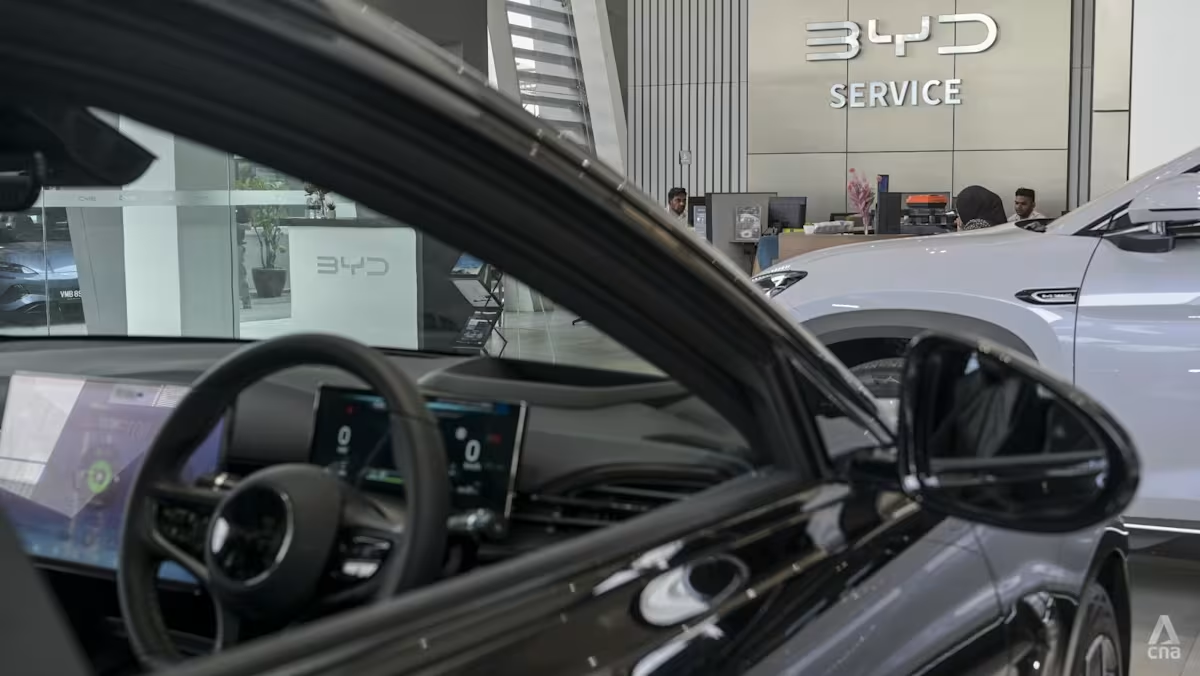
It said that both BYD and another Chinese automotive maker Chery had been granted interim manufacturing licences last year in September and June respectively.
The licence granted to BYD was on the basis of an export-oriented production profile, with a majority of output destined for international markets to leverage Malaysia’s free trade agreements and regional supply chains, MITI added.
“These conditions are not unique to BYD but reflect a consistent approach applied to all new automotive investments in Malaysia beginning September 2025 (except those using existing local assembly facilities).”
In line with this, MITI mandated “additional conditions” on BYD’s licence as follows: domestic sales limited to 10,000 units per year, which corresponds to 20 per cent of BYD’s total projected production capacity.
“This is a pro-export condition aimed at ensuring that investment contributes to Malaysia’s trade balance and global supply chain integration. It is not a restriction on total production but a strategic measure to encourage export orientation,” said MITI.
It added that the conditions were non-discriminatory and are applicable equally to all high-volume automotive assembly projects regardless of brands and countries of origin.
“This is designed to ensure local assembly capacity moves toward sustainable, higher-value market segments and to avoid displacement of the established vendor ecosystem. BYD is not singled out, the same condition applies to any new CKD (complete knock down) entrant,” it said.
A CKD vehicle is imported in parts and then assembled by Malaysia, while a CBU (completely built-up) vehicle is imported fully built and ready to drive.
MITI added that it “remains genuinely open” to Chinese automotive investment, saying that as of December 2025, out of 34 foreign automotive brands in the market, 14 are Chinese brands including BYD, Chery, Jaecoo, Jetour and Haval.
Chery has pledged an RM2.2 billion investment over five years for a 200-acre assembly plant in Hulu, Selangor, with plans to manufacture EV, hybrid, and internal combustion engine (ICE) cars.
“We are confident that once completed it will create high-value job opportunities, house a cutting-edge R&D centre, expand vehicle exports to neighbouring countries, strengthen Selangor’s role through a robust supply chain, and solidify Malaysia’s position as a leading automotive hub in ASEAN,” said Chery’s international president Zhang Guibing in a press release in Feb last year.
In Feb this year, Zeekr – Geely’s premium EV unit – also confirmed plans to make Malaysia its first market outside of China to assemble its vehicles.
Reports indicate that Zeekr vehicles will be locally assembled at Proton’s EV plant within the Automotive Hi-Tech Valley in Tanjung Malim.
MITI also noted in its statement that Malaysia’s national carmakers Proton and Perodua support an ecosystem of more than 700,000 employees, while contributing approximately 4 per cent of Malaysia’s GDP annually.
“The depth of their localisation is not incidental; it is the result of decades of deliberate investment,” it said.
MITI noted that in 2025, the Perodua-Daihatsu joint venture had a localisation rate of over 75 per cent, while Proton-Geely joint venture reached 76 per cent.
Localisation refers to the percentage of a vehicle’s parts and development that actually originates within the country.
https://www.channelnewsasia.com/asia/malaysia-ev-ambition-dilemma-protect-local-industry-car-makers-6033221


