


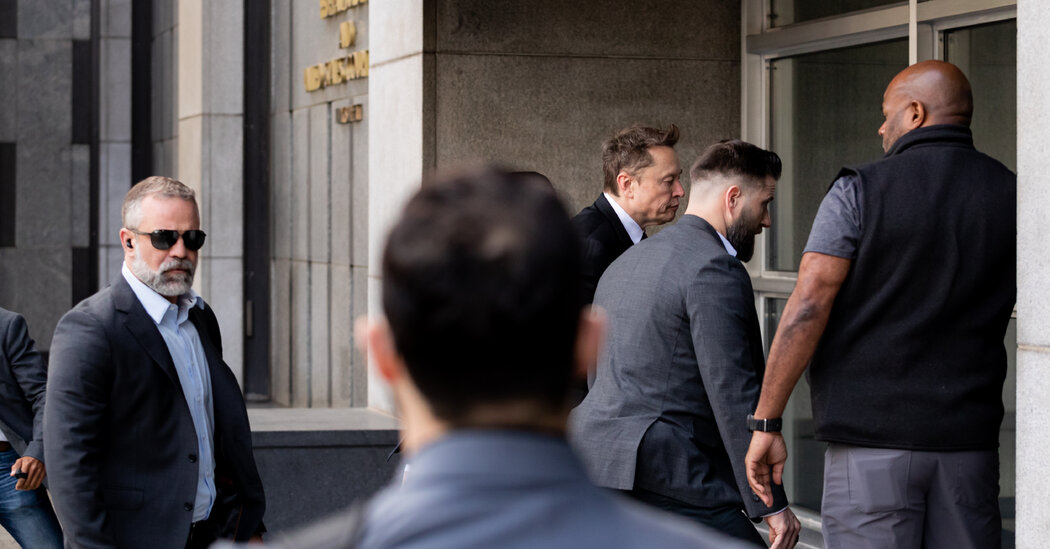


Elon Musk will take the stand for his third day of testimony on Thursday, in a blockbuster trial that could help determine the future of companies racing to dominate artificial intelligence.
Mr. Musk has already spent two days laying out and defending his lawsuit against OpenAI, the A.I. start-up that he helped found and spent tens of millions of dollars funding. Mr. Musk has claimed that OpenAI abandoned its founding promise to remain a nonprofit and that his co-founders, including the company’s chief executive, Sam Altman, took advantage of his donations.
Mr. Musk has spent hours of testimony describing himself as someone who was protecting humanity from the dangers of A.I. He painted Mr. Altman and another OpenAI co-founder and defendant, Greg Brockman, as merely hungry for money.
On Wednesday afternoon, the cross-examination became contentious as OpenAI’s lead lawyer, William Savitt, called Mr. Musk’s trustworthiness into question. Mr. Savitt tried to show that Mr. Musk behaved no differently from the OpenAI co-founders he is suing, pushing for the A.I. start-up to adopt a for-profit model. And Mr. Savitt pointed to evidence that Mr. Musk filed the lawsuit after he founded his own A.I. lab, xAI, in 2023, which has lagged OpenAI.
Judge Yvonne Gonzalez Rogers, who is presiding over the case in federal court in Oakland, Calif., interrupted Mr. Savitt and Mr. Musk multiple times during the cross-examination on Wednesday.
“The classic answer to a yes-or-no question is not so simple,” Mr. Musk said. “For example, if you ask the question, ‘Will you stop beating your wife?’”
Judge Gonzalez Rogers cut him off, saying, “No, we’re not going to go there.”
The sniping is likely to continue on Thursday, when Mr. Musk faces further questioning by lawyers for OpenAI and Microsoft, which is also named in the lawsuit.
Mr. Musk is seeking more than $150 billion in damages from OpenAI and Microsoft, OpenAI’s biggest financial partner. He is also asking the court to remove Mr. Altman from the board and to stop the start-up’s recent shift to operate as a for-profit company.
The trial could reshape the global A.I. race. OpenAI is a leading A.I. company, and a win for Mr. Musk would also be a win for its competitors, including industry giants like Google as well as young companies like Anthropic and xAI, which has now been absorbed by Mr. Musk’s rocket company, SpaceX.
A loss for Mr. Musk would mean that OpenAI, which is now valued at about $730 billion, would be free to continue its commercial course just as it appears to be heading toward one of the biggest initial public offerings in history.
(The New York Times has sued OpenAI and Microsoft, claiming copyright infringement of news content related to A.I. systems. The two companies have denied the suit’s claims.)
Here’s what to know:
-
High-profile witnesses: Mr. Altman and several other key industry figures, including Microsoft’s chief executive, Satya Nadella, and Mira Murati, OpenAI’s former chief technology officer, are slated to testify later in the trial.
-
Trial logistics: The trial is expected to take about four weeks before a nine-person jury at the federal courthouse in Oakland. If the jury rules in Mr. Musk’s favor, Judge Gonzalez Rogers, who also oversaw a high-profile lawsuit against Apple over its control of the App Store, will decide on monetary damages and other remedies.
-
Musk’s social media: Judge Gonzalez Rogers on Tuesday called Mr. Musk, who assailed Mr. Altman on X before the trial, to the bench to discuss whether there should be a gag order preventing him from posting on social media about the trial. “How can we get things done without you making things worse outside the courtroom?” she asked. The judge asked him and Mr. Altman to start with a “clean slate” and “keep things to a minimum” on social media. They all agreed, and Mr. Musk has thus far mostly complied.
https://www.nytimes.com/live/2026/04/30/technology/openai-trial-sam-altman-elon-musk/elon-musk-suffered-a-rare-loss-in-his-last-jury-trial
