









Web 3 Journalist
Tim Hakki
Web 3 Journalist


Share


Fact Checked by
CryptoNews Editorial Team
Author


The correlation between Bitcoin (BTC) and gold has snapped under the pressure of the Iran conflict, according to a note to investors by JPMorgan.
While geopolitical instability usually drives a unified bid for safe havens, the two assets are currently moving in opposite directions.
This decoupling reveals a significant shift in how capital is treating “digital gold” versus the real thing.
Instead of moving in tandem as crisis hedges, investors are aggressively rotating capital, creating a clear winner in the ETF market since late February.
Discover: The best crypto to buy now
What the JPMorgan ETF Flow Data Actually Shows About Bitcoin
Since the conflict escalated on Feb. 27, JPMorgan analysts report a stark divergence in capital flows. The largest gold ETF, SPDR Gold Shares (GLD), has bled outflows totaling roughly 2.7% of its assets under management.
In contrast, BlackRock’s iShares Bitcoin Trust (IBIT) absorbed inflows equaling roughly 1.5% of its assets during the same window.
JPMorgan analysts, led by Managing Director Nikolaos Panigirtzoglou, highlighted in their recent note to investors that this reverses the trend seen earlier in the year when gold funds held the advantage.
The data is unambiguous. While gold has traditionally been the default safety trade during Middle East tensions, capital is currently voting for Bitcoin exposure.
Institutional positioning generally reflects a shift away from bullion in favor of the spot Bitcoin ETFs, despite the higher volatility inherent in crypto assets.
Interestingly, IBIT inflows since the start of 2024 are now roughly double the total accumulation seen by GLD, further cementing the shift in dominance among exchange-traded products.
Is Bitcoin Replacing Gold as the Crisis Hedge?
The divergence goes deeper than headline flows. JPMorgan notes that while spot Bitcoin ETFs are seeing inflows, institutional derivatives markets paint a more cautious picture. Hedge funds appear to be reducing direct Bitcoin exposure even as ETF buyers step up.
Short interest in IBIT has actually increased since the conflict began, while GLD short interest declined. This narrows the gap between the two, suggesting that hedge funds are hedging their crypto bets while favoring gold for pure defensive positioning.
This creates a complex market structure. Retail and registered investment advisors (RIAs) are likely driving the ETF bid, treating Bitcoin as a risk-off asset alongside the dollar. Meanwhile, sophisticated desks are hedging downside risk as oil surges past $100, a macro factor that typically pressures risk assets.
Options activity supports this cautious institutional stance. The demand for downside protection in Bitcoin has risen, contrasting with the relentless buying pressure in the spot ETF market. However, the sheer magnitude of the rotation, selling gold to buy Bitcoin, suggests the “digital gold” narrative is holding up under fire better than skeptics anticipated.
Bitcoin Price Prediction: Can BTC Hold the $70,000 Level?
Price action remains resilient despite the mixed signals from derivatives markets. Even with war-driven inflation fears dominating the headlines, Bitcoin is trading above $70,000, showing strength where legacy assets have faltered.

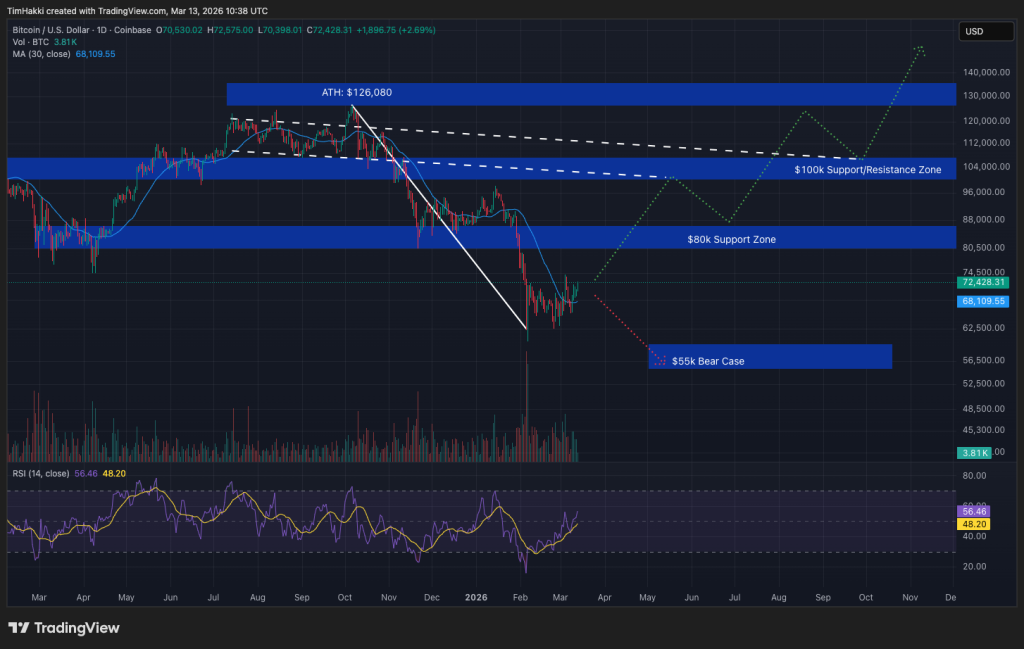
Bull Scenario: If ETF inflows persist at this 1.5% pace, Bitcoin targets the $80,000 resistance band. Clearing that level opens the path to retest all-time highs. JPMorgan’s own valuation models have previously flagged Bitcoin as undervalued relative to gold regarding volatility-adjusted capital, suggesting room for an upside squeeze.
Bear Scenario: Should macro liquidity tighten further, support sits firm at $64,000. A break below this level would validate the rising short interest and likely force a flush of the recent leverage. Traders must watch the $70,000 midpoint closely; losing it would signal that the safe-haven bid has exhausted itself.
The next major catalyst isn’t just on the chart; it’s at the Federal Reserve. If oil prices stay high, inflationary pressure could force central banks to keep rates elevated longer, testing the resilience of both gold and Bitcoin.
Discover: The next crypto to explode
https://cryptonews.com/news/jpmorgan-bitcoin-gold-etf-divergence-iran-war/


