






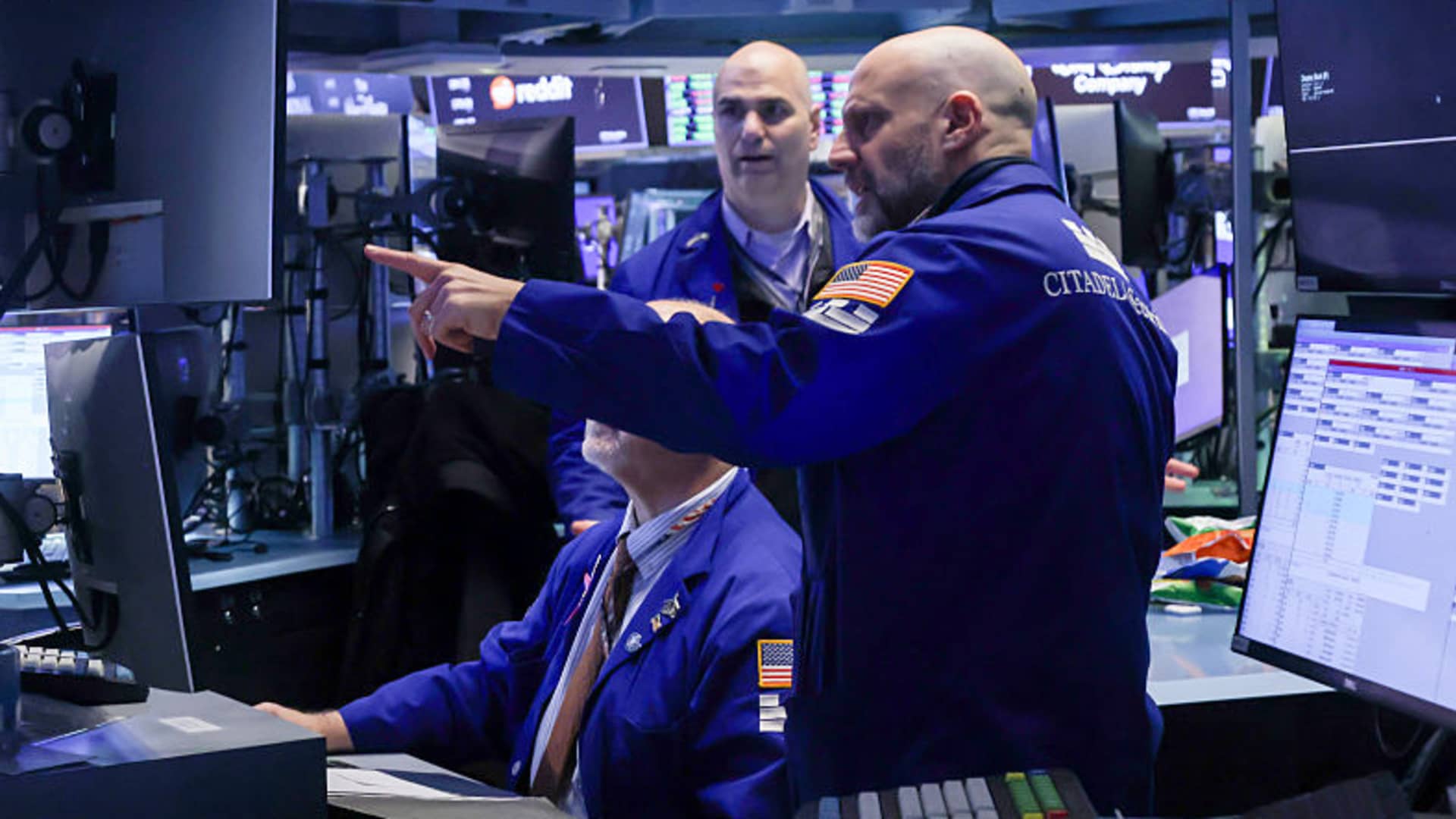
Wall Street’s main preoccupation this week could be summed up like this: Is the software sell-off overdone or does it signify the start of an unraveling AI bubble? Software stocks continued their rout on Thursday, with the iShares Expanded Tech-Software Sector ETF (IGV) down more than 9% week to date. Anthropic’s latest updates to Claude have stoked fears that agentic AI could prove an existential threat to an industry that relies on selling enterprise software packages to as many individual users as possible. Software stocks entered a bear market last week, but are now down nearly 30% from its most recent high. Investors turned against a trade deemed crowded and expensive after its exorbitant run the last few years. The IGV surged more than 58% in 2023, and 23% in 2024. It rose a bit more than 5% in 2025. Those who feel the sell-off has gone too far argue that agentic AI is unable to meaningfully hurt incumbents in the industry. They expect it could be as much a flash in the pan as DeepSeek AI was around this time last year. The Chinese company shook the industry last year by unveiling an open-source AI model that was developed at a very low cost. John Campbell, head of the Systematic Core Equity team at Allspring Global Investments is in this camp. “The selloff in software is overdone,” he wrote. “Many of the established players are not going to be easily disrupted by agentic AI. They are actively developing their own agents to improve the functionality and profitability of their existing software.” Software on sale If anything, many consider the pullback a buying opportunity. Some say they are waiting for a deeper drawdown before they step in, and urged investors to pick their winners carefully. Long-time tech analyst Fred Hickey brushed off the software rout. He said software stocks are on his list of potential buys if the broader sector is hit by a wave of trader capitulation as he expects. “I think that argument is mostly … hogwash and as a result, I considered buying some of the stocks,” Hickey wrote in a newsletter on Tuesday. “However, after looking at the valuations, I decided they were still too high,” especially when factoring in stock-based compensation. According to Jefferies, 73% of software stocks are oversold, an eight-year high. Indeed, Tyler Radke, U.S. software equity research co-head at Citigroup Research, told CNBC’s “Power Lunch” on Wednesday that investors can start selectively adding companies that will be “relevant as we get to the other side of this AI trade.” His preference is for companies exposed to hyperscale data volumes. Microsoft , MongoDB and Snowflake top his list. ‘The first victims’ To be sure, others worry the slide has further to go. Greg Swenson, co-portfolio manager for the Leuthold Select Industries Fund, said there could be more of a “washout,” even if there is a near-term bounce. He pointed out that the IGV is trading at a P/E just below 40-times trailing earnings, a level that is more attractive than it has been but could hardly be regarded as cheap. “Things don’t usually tend to bottom at, like, historical median or average levels,” Swenson told CNBC. “It tends to go quite a bit of a ways through it, like this, when there’s this type of emotional sell-off.” He also worried the rout could prove more lasting than investors expect. Unlike the temporary impact of DeepSeek, he said, this bout of selling could point to deeper troubles in the overall tech sector, even among the hyperscalers that have taken on more debt as they ramp up capital expenditures. “I think this is probably more of a durable move,” Swenson said. That could have ramifications beyond just software stocks. Companies with private credit holdings such as Blue Owl and Ares Management have tumbled . The pair are down 9% and 16%, respectively, week to date. Hardika Singh, economic strategist at Fundstrat Global Advisors, told CNBC she expects the sell-off has “gotten ahead of itself,” but will be watching to see how software companies proceed. If they’re able to adapt to the changing technology, that’s a healthy signal for the AI trade, she said. “If they can revamp here, pivot here, it’d be great. The sell-off would end up being like a ‘DeepSeek moment,’ where we forget about it a year later and this is just like a healthy correction,” she said. “But if they cannot revamp themselves, I think this is a rupture of the AI trade.” If that occurs, software would be the “first victims of the AI industrialization in this economy,” she added. Ongoing rotation More than anything, the action confirmed a bias toward other parts of the market this year. “Real economy” sectors such as energy, industrials and materials, which can benefit from the data center buildout, saw demand. Larry McDonald, author of the Bear Traps report, said he prefers global value stocks, which could outperform as money continues to rotate through the economy. After all, he pointed out, it won’t take more than a little of the $30 trillion shifting out of Nasdaq Composite to make a major difference in other parts of the market. That seemed to play out this week. Only the Dow Jones Industrial average is higher week to date, as of Thursday. The equal-weighted S & P 500 also outperformed, gaining 0.7%.
https://www.cnbc.com/2026/02/05/is-the-ai-bubble-popping-itself-software-rout-raises-concerns.html


