






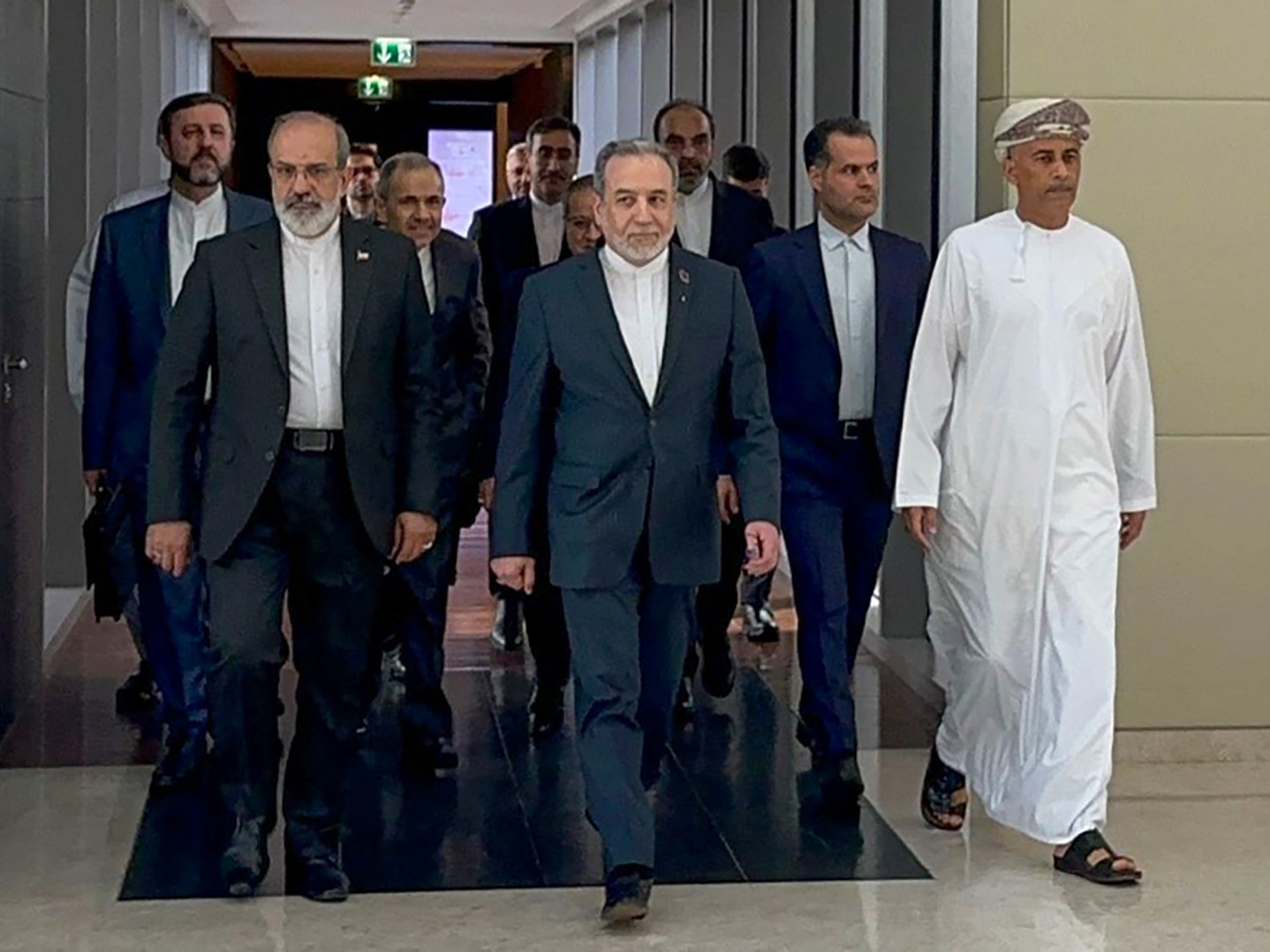
The first round of Iran-US talks in Muscat produced no breakthrough. The next few weeks will determine whether they laid foundations or merely bought time before escalation.
When Iranian and American negotiators concluded several hours of talks in Muscat on February 6, publicly, neither side signalled any shift from its opening position. Iran insisted the discussions focus exclusively on the nuclear file. The United States arrived seeking a comprehensive framework that would also cover ballistic missiles, regional armed groups, and more broadly, issues Washington has raised publicly, including human rights concerns. Neither prevailed. Both agreed to meet again.
On the surface, this looks like a non-event. It was not.
The Muscat round was the first high-level diplomatic engagement between the two countries since the joint US-Israeli strikes on Iranian nuclear facilities in June 2025, an escalation that Iran later said killed more than 1,000 people and involved strikes on three nuclear sites. That the two sides returned to the same palace near Muscat’s airport where previous rounds were held in 2025, and agreed to return again is significant.
But continuation is not progress. The distance between what happened in Muscat and what a deal requires remains vast.
Diplomacy conducted under military escort
The most striking feature of the Muscat round was not what was said, but who sat in the room. The American delegation was led by Special Envoy Steve Witkoff and Jared Kushner, President Trump’s son-in-law. It also included, for the first time, Admiral Brad Cooper, the commander of US Central Command, in full dress uniform.
His presence at the negotiating table was not incidental. It was a signal. The USS Abraham Lincoln carrier strike group was operating in the Arabian Sea as the talks unfolded, and days earlier, US forces had shot down an Iranian drone that approached the carrier.
An Iranian diplomatic source told the Reuters news agency that Cooper’s presence “endangered” the talks. Another, quoted by Al-Araby TV, warned that “negotiations taking place under threat” could impose strategic costs rather than advance them. For Tehran, the message was unmistakable: This was diplomacy conducted in the shadow of force, not as an alternative to it.
Washington, for its part, sees this as leverage. President Trump, speaking on board Air Force One after the talks, described them as “very good” and said Iran wants a deal “very badly”, adding: “They know the consequences if they don’t. They don’t make a deal; the consequences are very steep.”
This is diplomacy framed as an ultimatum. It may create urgency. It is unlikely to create trust, and trust is what this process most desperately needs.
The structural problem
The US withdrew from the 2015 Joint Comprehensive Plan of Action (JCPOA) in 2018, despite international verification that Iran was meeting its obligations. That decision shattered Iranian confidence in the durability of US commitments. Tehran’s subsequent incremental breaches of the agreement, steadily increasing enrichment levels from 2019 onwards, weakened its credibility, in turn.
This mutual distrust is not a negotiating obstacle that can be resolved with creative diplomacy alone. It is the defining condition under which any agreement must be built. The US has the capacity to impose enormous economic and military costs on Iran. But power does not automatically produce compliance. For commitments to hold, Iran must believe concessions will bring relief rather than new demands. That belief has been badly damaged.
Consider the sequence of events surrounding the Muscat round itself. Hours after the talks concluded, the US State Department announced new sanctions targeting 14 shadow fleet vessels involved in transporting Iranian petroleum, alongside penalties on 15 entities and two individuals. The Treasury Department framed the action as part of the administration’s “maximum pressure” campaign. Whether preplanned or timed for effect, the message was clear: Washington intends to negotiate and squeeze simultaneously.
For Tehran, which has consistently demanded that sanctions relief be the starting point for progress, this sequencing confirms precisely the pattern it fears. Iranian Foreign Minister Abbas Araghchi identified this dynamic explicitly, telling Iranian state television that “the mistrust that has developed is a serious challenge facing the negotiations.”
What actually happened in Muscat
Beneath the competing narratives, the outlines of the substantive discussion have begun to emerge. Iran reportedly rejected a US demand for “zero enrichment”, a maximalist position it was never going to accept in a first meeting. The two sides instead discussed the dilution of Iran’s existing uranium stockpile, a more technical and potentially more productive avenue.
Meanwhile, Al Jazeera reported that diplomats from Egypt, Turkiye and Qatar had separately offered Iran a framework proposal: Halt enrichment for three years, transfer highly enriched uranium out of the country, and pledge not to initiate the use of ballistic missiles. Russia had reportedly signalled willingness to receive the uranium. Tehran has signalled both the enrichment halt and uranium transfer would be nonstarters.
Perhaps the most important development was the least visible. According to Axios, Witkoff and Kushner met directly with Araghchi during the talks, breaking from the strictly indirect format that Iran had demanded for most of last year’s rounds of negotiations. Iran had previously insisted on communicating with the US only through Omani intermediaries. Crossing that barrier, even partially, suggests both sides recognise the limits of indirect talks once bargaining becomes technical.
Oman’s framing was arguably the most honest assessment of the day. Foreign Minister Badr al-Busaidi described the talks as aimed at establishing “appropriate conditions for the resumption of diplomatic and technical negotiations”.
What the next few weeks will decide
Trump said a second round of talks would take place soon. Both sides indicated to Axios that further meetings were expected within days. The compressed timeline is notable. During last year’s rounds, weeks separated each session. The pace suggests Washington believes the diplomatic window is narrowing, and Tehran is at least willing to test that claim.
Several tests will show whether urgency produces substance or merely speed.
First, the scope question. The fundamental dispute over what the talks are about remains unresolved. Iran won the first procedural battle: The venue moved from Turkiye to Oman, regional observers were excluded, and Araghchi claims only nuclear issues were discussed. Secretary of State Marco Rubio said before the talks that the agenda needed to include “all those issues”. If the second round begins with the same fight over scope, it will signal that even the basics remain unsettled.
Second, Iran’s enrichment posture. Before the June 2025 war, Iran had been enriching uranium to 60 percent purity, a short technical step from weapons-grade. Tehran has said enrichment stopped following the strikes. But Iran has also conditioned International Atomic Energy Agency inspections of the bombed sites on new inspection arrangements, raising concerns among non-proliferation experts. Conversely, reports of enrichment resumption or acceleration would likely end the diplomatic track.
Third, the military environment. The US naval build-up in the Arabian Sea is not decorative. The drone shootdown near the Abraham Lincoln and Iran’s attempted interception of a US-flagged vessel in the Strait of Hormuz in the days before the talks show how quickly signalling can slide into miscalculation. Whether the carrier group is reinforced, maintained or gradually drawn down in the coming weeks will reveal more about Washington’s assessment of diplomacy than any press statement.
Fourth, the sanctions rhythm. The same-day announcement of shadow fleet sanctions establishes a pattern. If Washington continues to layer new economic penalties between rounds of talks, Tehran will treat it as evidence that diplomacy is performance rather than process.
Fifth, backchannel activity. The most consequential diplomacy over the next few weeks may not occur in formal settings. Oman, Qatar, Egypt and Turkiye have been working behind the scenes to sustain dialogue. If those intermediary contacts remain active, space for de-escalation persists. If they fall silent, the margin for error narrows.
A managed deadlock is not a strategy
The most probable short-term outcome remains neither breakthrough nor war, but a managed deadlock in which both sides maintain maximal public positions while avoiding steps that would make future talks impossible. In practice, this is a pause sustained by caution rather than a settlement anchored in confidence.
For the broader region, the distinction matters urgently. Gulf states have no interest in becoming staging grounds for escalation. Public statements across the region have consistently emphasised de-escalation, restraint and conflict avoidance. But regional actors can facilitate, host and encourage; they cannot impose terms on either Washington or Tehran.
The Muscat talks did not fail. Neither did they succeed. They established that a channel exists, that both sides are willing to use it, and that direct contact between senior officials is possible.
But a channel is not a plan. The absence of war is not the presence of a deal. The period between Muscat and whatever comes next is a window in which miscalculation remains close to the surface, sustained only by the assumption that both sides are reading each other’s signals correctly.
The next round of talks will not produce an agreement. But it may show whether the two sides are building a floor beneath the standoff or simply postponing the moment when that floor gives way.
The views expressed in this article are the author’s own and do not necessarily reflect Al Jazeera’s editorial stance.
https://www.aljazeera.com/opinions/2026/2/8/iran-us-talks-in-muscat-bought-time-not-a-deal?traffic_source=rss


