







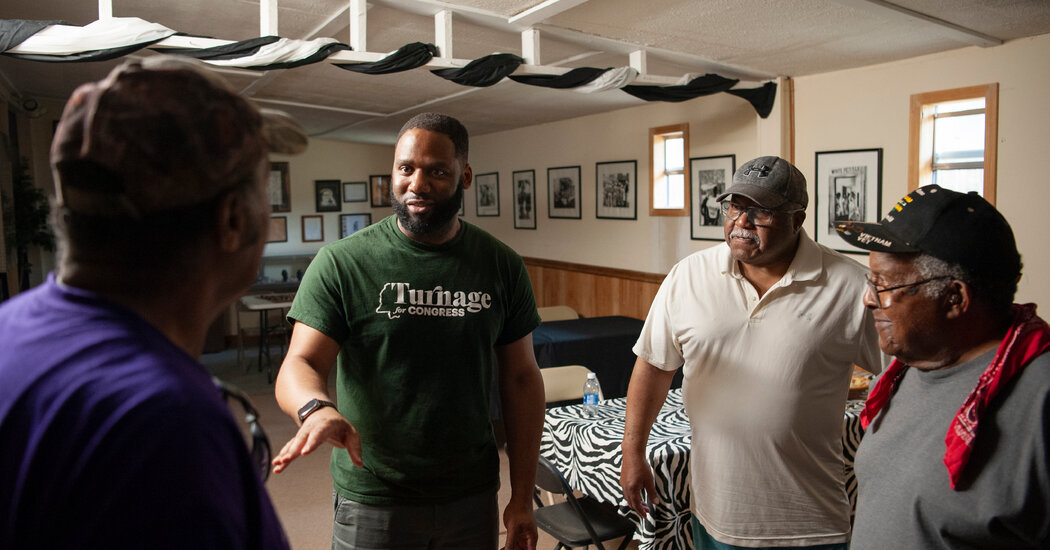
Evan Turnage left a job on Capitol Hill and returned home to Mississippi to run for Congress. It didn’t pan out; he lost a Democratic primary in March against a popular incumbent. But by crisscrossing the region and building name recognition, he thought he had laid groundwork that could pay off later.
Next time, though, he could face an even more formidable hurdle: His district, long drawn to have a majority-Black constituency, could be redrawn to become practically impossible for a Black Democrat to win.
Across the South, Republican officials are ready to quickly redraw legislative districts, seizing upon the Supreme Court decision on Wednesday that struck down a voting map in Louisiana and further weakened the landmark Voting Rights Act, which for decades helped usher in generations of Black leaders.
Critics of the decision expect that any reconfiguration will not only endanger Black incumbents, some of whom have held office for decades, but also threaten a rising generation of Black Democrats in the South, who already have few avenues for ascending in politics.
“It’s going to mean for a lot of people that they leave politics altogether, because there aren’t districts that make sense,” said Mr. Turnage, 34, who ran in Mississippi’s Second Congressional District, which is regarded as vulnerable to redistricting. “It’s definitely going to be devastating.”
Republicans have solidified their control in many Southern states, claiming virtually all statewide elected offices and building supermajorities in several legislatures. The congressional districts carved out for majority-Black representation have become rare and coveted platforms, lifting Black leaders to prominence in the Democratic Party and the broader political arena.
“This case has the potential to essentially stop Black political representation from advancing in the way that we know it,” said Emmitt Y. Riley III, a politics professor at Sewanee, the University of the South.
In recent years, frustration has stewed among some younger Black Democrats over older lawmakers who have held onto seats, even as some have reached their 80s and seen their health decline.
Still, there was a recognition that a generational handoff was inevitable and rapidly approaching.
The court’s decision has the potential to upend that transition. Strategists and political analysts have warned it could deny that rising political talent the opportunity to win seats in Congress, much less wield the influence of their predecessors.
The decision could reach deeper into the government, because it could also apply to state legislative districts and local bodies, including city councils and county boards, where the Voting Rights Act has influenced how maps are drawn.
“What do the next 10 years look like if we disrupt the pipeline?” asked Glynda C. Carr, the president and chief executive of Higher Heights for America, a political action committee that supports progressive women of color running for elected office.
Other career paths could be at risk, including staff positions and internships that often set up young adults for careers in government and public service. Research has indicated that elected officials of color, particularly in Congress, tend to have staffs — and aides in senior roles — that are more demographically reflective of the broader population.
“None of us working on Capitol Hill would have gotten there without that foot in the door,” said Representative Shomari Figures of Alabama, a 40-year-old former congressional and White House aide, who was elected as a Democrat in 2024 to a newly drawn majority-minority district created after a long legal fight that reached the Supreme Court.
In the majority opinion, Justice Samuel A. Alito Jr. cast the ruling as limited in scope and upholding the central tenets of the Voting Rights Act. But he said that Louisiana had violated the Constitution’s equal protection clause when it created a second majority-Black district to comply with the Voting Rights Act.
Justice Alito wrote that “vast social change,” particularly in the South, meant that giving such weight to racial considerations — including past discrimination and “present-day disparities” — was no longer necessary. Yet he also couched the decision as an update to the Voting Rights Act’s framework, not a dismantling of it.
But critics said that, in effect, the court’s decision gutted the law.
And an analysis by The New York Times from last year identified as many as a dozen majority-minority House districts across the South that Democrats could lose to redistricting if the law was severely diminished.
Activists and political observers argued that many prominent Southern lawmakers represented not only the interests of their districts in Washington, but also the experiences, values and priorities of people who do not have much voice otherwise. Now these lawmakers are at risk.
Those lawmakers could include Representative Bennie Thompson, once a small-town mayor in Mississippi, who has emerged as a high-profile opponent of President Trump, and Representative James Clyburn of South Carolina, who has been one of the highest-ranking House Democrats for decades.
“That sort of specific viewpoint really matters,” said Mr. Turnage, who served as a senior aide to Senators Chuck Schumer of New York and Elizabeth Warren of Massachusetts. “Having that voice in the room, I can tell you, does shape how your caucus or how the entire body thinks about certain issues.”
National Democrats have viewed some parts of the Southeast, like Georgia and North Carolina, as ripe for investment, thanks to population growth and increasing racial and ethnic diversity. Those factors played a role in Georgia’s transformation over the past decade from a Republican stronghold to a swing state.
Some Black candidates in Georgia have won in majority-white districts, like Representative Lucy McBath, who ousted a Republican incumbent in the Atlanta suburbs in 2018. Raphael Warnock of Georgia built an old-fashioned coalition of Black and white voters to win in the Senate. And political analysts believe some Black lawmakers, like those in and around Atlanta, are likely to be safe from redistricting efforts.
Yet elsewhere in the region, particularly in the Deep South, many expect an already forbidding political landscape to become even tougher.
Anthony Daniels, the Democratic minority leader in the Alabama House of Representatives, listed legislators and local elected officials he thought could be credible candidates to run state agencies or hold statewide office.
But, he said, their chances of attaining those positions are diminished in Alabama, where Democrats struggle to be competitive and racism remains a major barrier.
“I have some of the best minds in the state,” he said. But, he added, it can seem as though that talent has “no chance of being noticed.” Mr. Daniels suggested that even with sustained and incremental focus, it could take years, maybe even a generation, to yield results.
“You’ve got to build out a way to engage voters,” he said, “and to build out your pipeline from the city council to the school board, to the county commission, to the mayor’s office and to the legislature.”
Many Black politicians said they would now draw upon a certain strain of optimism threaded throughout Southern history — one that is jaded by experience but also buoyant.
Mr. Turnage finds solace in the example of his grandparents, who were born in the 1920s and could not vote until they were in their 40s. They were able to support Black congressmen, like Mr. Thompson and his predecessor, Mike Espy, and vote for President Barack Obama.
Mr. Turnage has not made any specific decisions about his future in politics. But he said that he, for one, was not retreating from public service.
“I’m in it,” he said. “I’m in the fight.”
https://www.nytimes.com/2026/04/30/us/politics/voting-rights-act-young-black-democrats.html


