






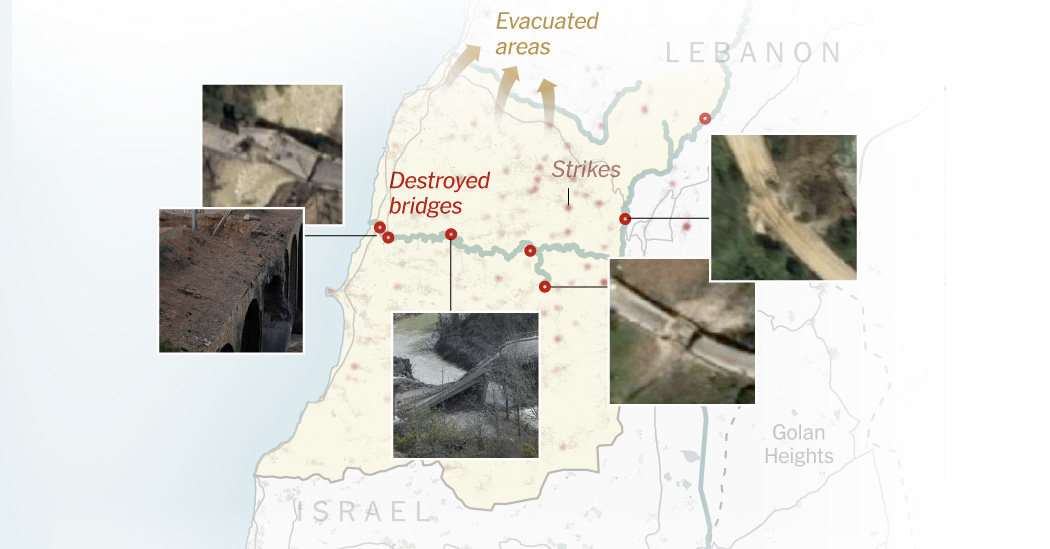
As fighting between Israel and Hezbollah reignited last month, Israel bombarded parts of Lebanon and sent thousands of ground forces into the country.
Now, Israel says it plans to seize control of Lebanese territory south of the Litani River, raising fears of a prolonged occupation and mass displacement.
Few parts of southern Lebanon remain untouched by the war.
Entire villages have emptied after Israel issued sweeping evacuation warnings for nearly all of the south. Israeli airstrikes have destroyed homes, severed bridges and razed parts of towns. Israeli ground forces have advanced deeper into southern Lebanon, clashing with Hezbollah militants in the rugged, hilly terrain.
The war has brought intense uncertainty to the south, a predominantly Shiite Muslim area dominated by Hezbollah for decades.
This week, Israeli officials offered their most explicit plan to date to occupy a swath of southern Lebanon from the border up to the Litani River after the ground invasion ends. That would amount to about 10 percent of the entire country. Israeli officials have said they aim to establish a “security zone” to prevent the territory from being used to attack Israel.
The hundreds of thousands of displaced Lebanese who fled the south will not be allowed to return to their homes until the “safety and security of northern Israeli residents is ensured,” the defense minister, Israel Katz, said on Tuesday.
Lebanon’s government has condemned Israel’s military campaign and appealed to the international community to intervene. Last week, Prime Minister Nawaf Salam warned the U.N. secretary general, António Guterres, about the risk of Israel annexing the territory south of the Litani River.
Razing border villages
Mr. Katz reiterated on Tuesday that Israel’s plan in southern Lebanon includes demolishing entire Lebanese towns on the border.
Many of Lebanon’s border villages were devastated in the previous escalation of fighting in 2024. At least six villages saw widespread destruction in that war. Israeli airstrikes that persisted after the cease-fire made it virtually impossible for residents to rebuild in those villages.
“There was nothing to return to” after the last war in 2024, said Alaa Suleiman, 40, who fled from his home Kfar Kila, a village along the border with Israel. “Even when people tried to put up prefabricated houses, they were targeted by strikes. It meant we had no hope of ever returning.”
Since the latest war broke out last month after Hezbollah fired rockets at Israel in solidarity with Tehran, Israel has appeared to accelerate its destruction of the border towns.
One video circulating on social media and verified by The New York Times shows several large simultaneous explosions on March 17 in Aita al-Shaab, which is about a mile from the border. Satellite images viewed by The Times from later that day confirmed the damage to the area. The town was already heavily hit in 2024.
The destruction of communities along the border is part of a deliberate strategy by the Israeli military, according to Mr. Katz, who said that the practice of flattening homes in southern Lebanon is “following the Rafah and Beit Hanoun model in Gaza.” There, Israel used bulldozers and controlled demolitions to erase entire neighborhoods.
Bombing bridges
In March, the Israeli military demolished most of the key bridges across the Litani River, in what it said was an effort to prevent Hezbollah from moving reinforcements and combat equipment to southern Lebanon. The waterway, which is as much as 20 miles from the Israeli border at its furthest point, has long marked the dividing line between southern Lebanon and the rest of the country.
Much of the Litani River is situated at the base of a ravine, making the bridges critical — both for civilians still living in the south to leave as well as for medical supplies, food and other essentials to reach those who have remained.
By blowing up the major bridges connecting northern Lebanon to the south, Israel has forced civilian traffic onto a handful of smaller crossings. Should Israel target those crossings, southern Lebanon would be almost entirely severed from the north.
Israeli officials have not made clear whether the military will reach the river itself or only control it from afar, nor how long the military intends to stay there.
A video filmed by Reuters and verified by The Times shows several fiery explosions across a large bridge in Qasmiyeh, in the south of Lebanon. Dark clouds of smoke can be seen rising into the air, along with debris.
Ground assault
After the previous war between Hezbollah and Israel ended in a cease-fire agreement in late 2024, the Israeli military occupied five outposts near the border inside Lebanon.
Since the start of a new war, Israel has sent in at least 5,000 ground troops, according to two Israeli officials who spoke on the condition of anonymity because they were not authorized to talk to the media.
Satellite images analyzed by The Times showed Israeli vehicles in new military positions in four Lebanese towns near the Israeli border. As of late March, vehicles were not visible much deeper into Lebanese territory than where Israeli troops previously reached during the 2024 ground invasion.
In the border town of Khiam, images reveal razed areas and destroyed buildings in various parts of the town.
A mix of Merkava tanks and armored personnel carriers are visible in the images, said Jeremy Binnie, Middle East defense specialist at Janes, a London-based defense intelligence firm.
News of the destruction in Khiam has stirred alarm among residents, nearly all of whom fled when the war broke out.
“After the last war, we rebuilt our home. We said it’s over. And now it’s all being destroyed again,” said Ali Akkar, 78, who was displaced from his home in Khiam. “In the last war, we had some hope to return home. Now we have none.”
Satellite imagery verified by The Times also suggests that there was an Israeli military presence at a hospital near Meiss al-Jabal, a town near the Israel-Lebanon border. Satellite imagery showed what appeared to be armored vehicles in various positions around the hospital complex.
While it has been possible to access satellite imagery from southern Lebanon, cloud coverage obscured the visibility of many areas after March 18, making more recent positions of Israeli forces in Lebanon harder to independently verify.
Targeting infrastructure
Israeli airstrikes have also hit homes, gas stations, money exchanges and other civilian infrastructure that the Israeli military says are being used by Hezbollah.
Israel struck in March at least four fuel stations run by the Al-Amana Petroleum Company, a major fuel distributor that was previously placed under U.S. sanctions for its alleged links to Hezbollah. Israeli officials say these stations are “significant economic infrastructure” for the group.
Video filmed by Agence France-Presse showed the damage to a gas station between the cities of Naqoura and Tyre, in southwest Lebanon. A sign hangs from the roof, which is partially damaged, and a large crater is visible on the pavement.
While Israeli officials say the gas stations help fund Hezbollah, they have also benefited many Lebanese. At times, they have sold fuel at subsidized prices, making them a lifeline for poorer people as the war in Iran drives up fuel costs.
The devastation has anguished residents of the south who have fled and watched from afar as their towns and villages have been destroyed.
“There’s so much more destruction, more fighting, the stakes of this war are much higher than the last one,” said Hooda Rajab, 28, who was displaced from her home on the outskirts of Khiam. “Now we’re asking: Will we ever be able to return home? Even if we can, will there be anything for us to return to?”
https://www.nytimes.com/interactive/2026/04/03/world/middleeast/israel-military-southern-lebanon-hezbollah.html


