


Leading up to this year’s Anzac Day, when Australia’s war dead are commemorated with a somber dawn service, several far-right, neo-Nazi-affiliated Telegram groups were abuzz with an action plan.
It would be an act of “patriots,” carried out in “defense of one’s homeland,” the posts claimed. “Take a deep breath, the moment of action has arrived,” one post said. “Then let out the sacred BOOOO.”
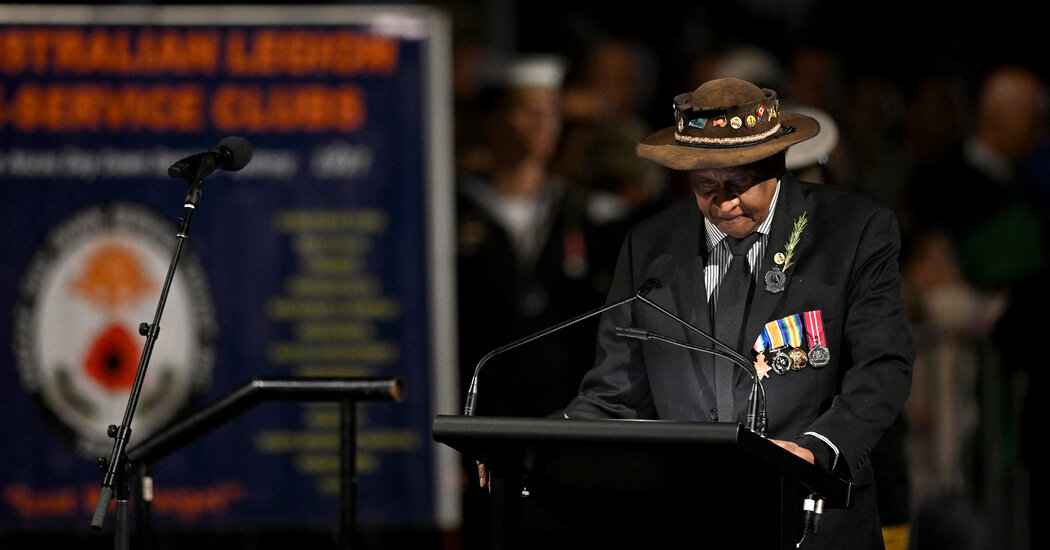
The booing — loud enough to register clearly on national broadcasts carrying the ceremonies live — disrupted the reciting of a brief statement that acknowledges Australia’s Aboriginal history. Known as the “Welcome to Country,” the statement has become an established part of many public events in Australia.
The disruption of solemn services in three major cities on Saturday was the latest and one of the highest-profile actions orchestrated to assail the practice, which opponents see as giving outsized weight to Indigenous groups.
In recent years, Pauline Hanson, an anti-immigration senator, has walked out or turned her back during the acknowledgments in Parliament. A conservative lobby with powerful donors has held petitions and raised millions in an attempt to combat the practice.
Jordan McSwiney, a researcher at the Center for Deliberative Democracy at the University of Canberra who closely monitors Australia’s far-right, said that, for some, paring back recognition of Indigenous populations was core to adapting neo-Nazi ideology to Australia.
“A key narrative of the white supremacist, anti-Indigenous racism in Australia is that the white man created Australia,” he said. “The 60,000-plus years of Aboriginal history is very inconvenient.”
Taking issue with “Welcome to Country” statements allows the fringe movement to tap into the broader culture war and gain support from a swath of the public who might otherwise be appalled by their extreme beliefs, Mr. McSwiney said.
An organizer behind “March for Australia,” an anti-immigration group that has held large-scale public rallies in recent months, denied involvement in orchestrating the disruptions in an interview with The Guardian. But he said there had been “grass roots public interest” among its members in opposing the practice.
Modern-day “Welcome to Country” ceremonies organically took hold as part of public life in Australia beginning in the 1990s, as the country began a process of reckoning with its history of European colonialism. More recently, land acknowledgments have also become more widespread in the United States and Canada, with a nod toward Australia’s experience.
Mark McKenna, a historian who has written about the emergence of “Welcome to Country” in Australia’s public life, said the attacks were continued fallout from the failed referendum in 2023 to enshrine representation for Aboriginal Australians in the country’s Constitution.
“It emboldened people on the right to air their longstanding suspicion of Indigenous Australians and any suggestion that their forebears were responsible for killing Aboriginals or taking their land,” he said.
Angus Taylor, the leader of the conservative opposition, criticized the booing during the weekend’s services, but said he “can understand the frustration” some Australians feel about the what he called the overuse of “Welcomes to Country.” A spokesman for Ms. Hanson and her party, One Nation, said the ceremonies were “divisive.” Deputy Prime Minister Richard Marles called the disruptions disgraceful.
Ray Minniecon, an Aboriginal pastor and veteran who delivered the acknowledgment at the service in Sydney and was targeted by hecklers, said it was clear to him what the motivations behind the booing were.
“Sadly, it’s part of this new wave of people who want to make Australia white again,” he said in an interview.
Mr. Minniecon, 75, said he and his brothers joined the military around the time of the Vietnam War, hoping for better treatment by Australian society. At the time they faced severe discrimination and, even after returning from tours in Vietnam, his brothers weren’t treated equally, he said.
When non-Indigenous Australians began normalizing the “Welcome to Country” rituals, it had felt like the country was recognizing people like him as a part of the fabric, he said.
“Until these kinds of events push it back to the Dark Ages again,” he said. “It’s almost become legitimized, we’re like open season for them now.”
Marcia Langton, an Aboriginal Australian writer and academic who was heavily involved in the reconciliation movement, said the incorporation of “Welcome to Country” was a small but effective step that forced Australians, especially those who live in cities who may not otherwise think about pre-European history, to briefly reflect on it.
Indigenous Australians make up less than 4 percent of the country’s population, and many live outside major cities.
“It is the one measure that has worked to bring everybody together to an understanding that Aboriginal people exist and have a right to exist,” she said.
The practice is based on an Aboriginal custom that is meant to ensure safe passage on another people’s land. For that ritual to come under attack, especially on a holiday that many Australians consider to be sacred, was shocking and unthinkable, Ms. Langton said.
Booing during Anzac Day services first took place in 2025 in Melbourne. Prime Minister Anthony Albanese at the time condemned it as “an act of low cowardice on a day when we honor courage and sacrifice,” according to the Australian Broadcasting Corporation. Three members of the neo-Nazi group the National Socialist Network, which has since disbanded, are facing criminal charges for behaving offensively in public and indecent conduct during the service.
This year’s disruptions had a broader reach, taking place in Sydney and Perth in addition to Melbourne.
Mr. McSwiney, the researcher, said the stir caused by Saturday’s disruptions was being celebrated among far-right groups.
“It’s such an easy, low-cost, effective way to create this massive sense of tension and undermine community cohesion,” he said.
https://www.nytimes.com/2026/05/01/world/asia/australia-indigenous-aboriginal-welcome-to-country.html
