







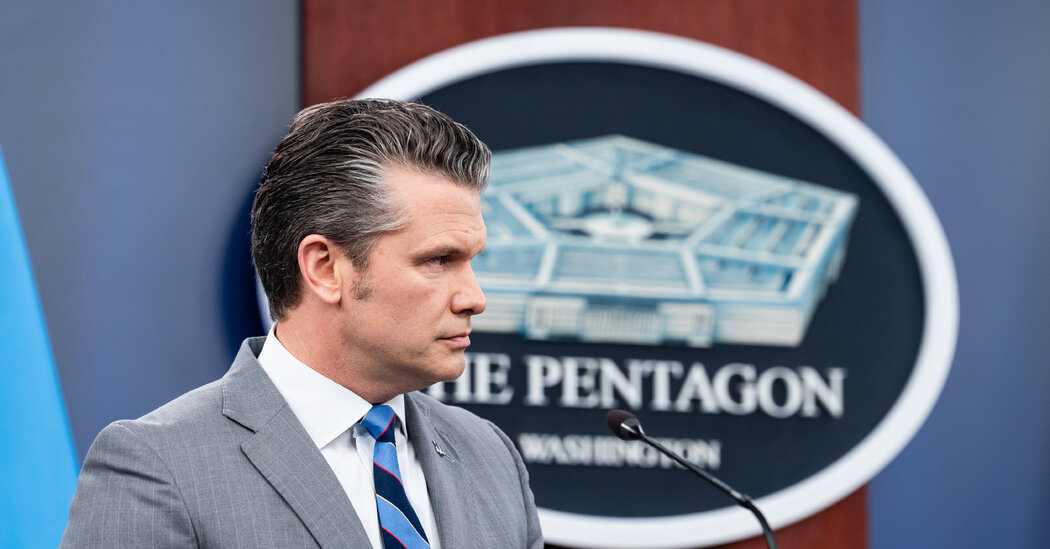
The defense secretary and the Democratic congressman had, in many respects, led parallel lives.
Pete Hegseth and Representative Seth Moulton of Massachusetts both graduated from Ivy League colleges and volunteered to fight in Iraq. Both pushed for more troops and a better strategy for that war in 2006 as violence spiked and Americans turned against it.
Now they were sitting across from each other in a House hearing room debating the war with Iran.
Mr. Moulton pressed Mr. Hegseth to consider that the unpopular war, now entering its third month, could drag on for years and cost taxpayers hundreds of billions of dollars.
Mr. Hegseth dismissed the notion as absurd.
“On the battlefield, it has been an astounding military success,” he said at the Wednesday hearing.
“But are we winning the war?” Mr. Moulton asked skeptically.
“Absolutely,” Mr. Hegseth replied.
Both men were debating the Iran conflict through the prism of Iraq, a war they supported on the battlefield and in newspaper editorials before they concluded that it had all been a tragic waste. Mr. Moulton commanded a Marine Corps rifle platoon on the march to Baghdad and later served as an embedded adviser to Iraqi troops. Mr. Hegseth led an Army infantry platoon in Samarra as Iraq descended into civil war.
“I recoiled the first time I heard then-candidate Donald Trump call it a ‘stupid war,’” Mr. Hegseth wrote in 2024. “But objectively he was right.”
“It was a massive failure of leadership and intelligence,” Mr. Moulton wrote on the war’s 20th anniversary in 2023.
Why had the U.S. military, despite its huge firepower advantage, been unable to meet its goals in Iraq? What did those failures predict about the outcome of the new war in Iran?
To Mr. Moulton, the lack of planning that had bedeviled the Iraq war was painfully present in the Iran conflict. In the weeks before the war started, Mr. Hegseth’s Pentagon had sent the only minesweepers in the region to Singapore. This was proof, he said, that the Trump administration had not expected Iran to close the Strait of Hormuz, a powerful blow to the U.S. and global economy.
Even after the Iranians closed the strait, they continued to export oil, taking in about $14 billion. “How many Chinese missiles can they buy for $14 billion?” Mr. Moulton asked Mr. Hegseth on Wednesday. “Does that sound like winning?”
In both wars, Mr. Moulton maintained that the United States had underestimated the enemy’s will to absorb punishment and keep fighting.
The Iran war could “go on for 20 years, like Iraq and Afghanistan,” he said.
Mr. Hegseth had drawn a completely different set of lessons from the failures in Iraq that he was now applying to the war in Iran.
“Unlike foolish previous administrations, it won’t go on for years and decades,” he told Mr. Moulton. “Sitting in this position, it is hard to imagine how we allowed those things to happen. You were a part of that war and so was I.”
Mr. Hegseth blamed restrictive rules of engagement that prevented the U.S. military from unleashing its full firepower. Under his leadership, he said, the Pentagon was allowing troops to be “as effective as humanly possible.”
In Iraq, he argued, U.S. troops had been saddled with ambitious and ever-shifting goals. “I never had an understanding of what the end state clearly was,” he told Mr. Moulton. In Iran, he maintained, the U.S. military was focused on preventing Iran from acquiring a nuclear weapon.
As he surveyed the battlefield there, Mr. Hegseth saw an enemy with “very few options,” and a Pentagon, under his leadership, that had learned from the mistakes of the past.
“The Department of War,” he said, using his preferred name for the Defense Department, “fights to win.”
One of the biggest differences between the Iran and Iraq wars has been the cost to the average U.S. citizen. Americans were never really asked to sacrifice for the wars in Iraq or Afghanistan. Less than 1 percent of the population deployed, and the conflicts were financed by increases to the national debt instead of tax hikes.
The combination had allowed the two wars to drag on for decades.
But the average American has paid for the Iran war at the pump, after the closure of the Strait of Hormuz caused fuel prices to surge. At some point, U.S. taxpayers will also have to pay directly for the war. The Pentagon this week said it had spent $25 billion so far, but offered few details to back up the figure.
Mr. Moulton on Wednesday suggested the war would eventually cost at least $100 billion, a fraction of the $2 trillion spent in Iraq and Afghanistan.
“I am just asking if you know what your war is costing the average American taxpayer,” he said to Mr. Hegseth.
“What is the cost of Iran having a nuclear weapon that they wield over us?” Mr. Hegseth responded.
As his five minutes of questioning drew to a close, Mr. Moulton called on the biography he shared with Mr. Hegseth. Upon returning from Iraq, both had run for seats in Congress. Mr. Hegseth had mounted an unsuccessful campaign in 2012 for a Senate seat in Minnesota. In 2014, Mr. Moulton was elected to the House.
At $100 billion, Mr. Moulton said, the war would cost the average taxpayer about $600.
“So for the American taxpayer, my constituents, some of the constituents you wanted to represent in Minnesota — I am just wondering if they have 600 bucks lying around to pay for your war?” Mr. Moulton challenged.
He did not give Mr. Hegseth an opportunity to answer.
https://www.nytimes.com/2026/05/02/us/politics/hegseth-moulton-iran-war.html


