






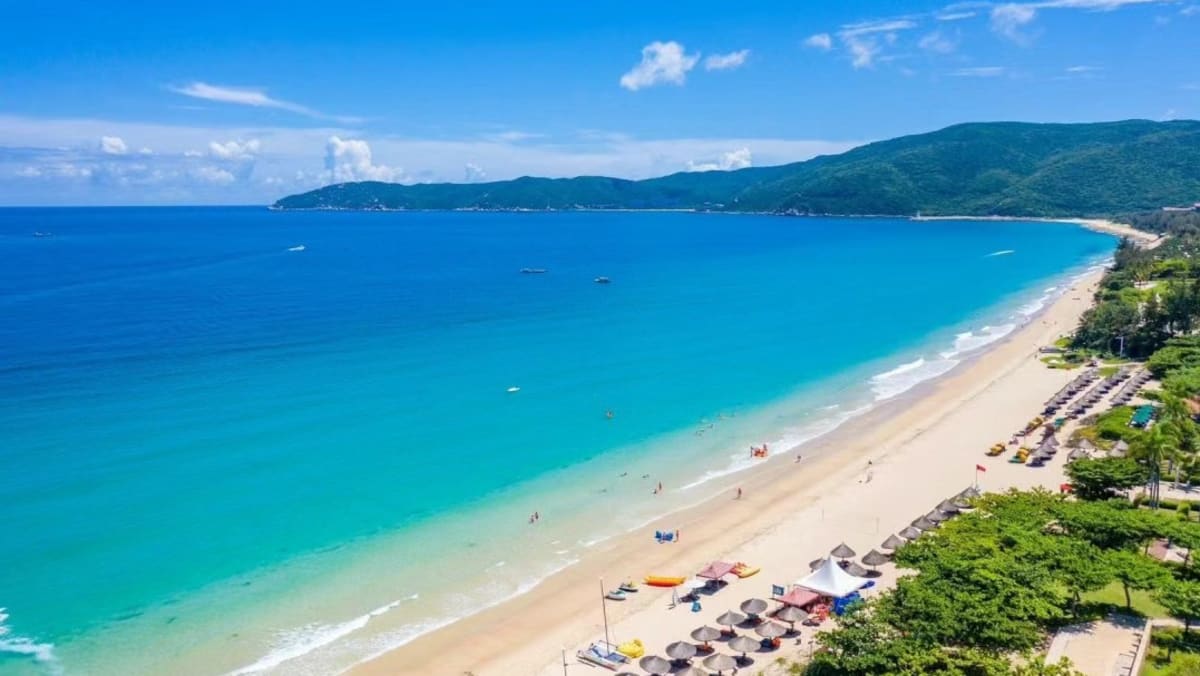
SHENZHEN: China’s only tropical island province, Hainan, is best known for its palm trees, beaches and as a winter refuge for retirees from the country’s north.
On Thursday (Dec 18), even as daily life went on uneventfully, change was in the air as the island of 10 million people formally became a distinct customs zone from the rest of China.
With broader zero-tariff access, lower taxes and a more business-friendly environment, analysts say Beijing is casting Hainan as a high-profile demonstration of its resolve to keep opening up amid global trade headwinds.
At the same time, China is using the island as a testing ground for deeper institutional opening, allowing policies to be trialled and fine-tuned before wider national roll-out, observers say.
“Hainan Free Trade Port is not designed to cushion all types of external shocks,” Wu Haili, an associate professor of practice in economics at Xi’an Jiaotong-Liverpool University, told CNA.
“Rather, it is meant to serve as a low-risk testing ground for China’s transition to higher-level openness.”
Even so, experts urge caution against over-reading the impact, saying the effectiveness of the model will hinge on factors such as regulatory coordination and Hainan’s ability to translate policy advantages into real economic activity.
A STRESS TEST FOR OPENNESS
China first announced plans to turn Hainan into a pilot free-trade zone in 2018. In 2020, that vision was elevated into a blueprint for a full-scale Hainan Free Trade Port, covering the entire province.
The move to carve the island out as a distinct customs regime was announced in July 2025, setting the stage for its Dec 18 launch.
Under the new rules, the share of goods eligible to enter Hainan tariff-free will go up to 74 per cent from 21 per cent, authorities have said, while the number of duty-free items will expand more than threefold to over 6,600.
Foreign companies can benefit from lower tax and production costs, and a business environment more closely aligned with international standards, while using Hainan as a launchpad to tap into the Chinese market, state news agency Xinhua reported.
Wu said the new customs regime may offer businesses a way to navigate tariff barriers.
Under the 2020 master plan, Hainan operates a “first-line open, second-line controlled” model. This means goods entering the island from overseas are treated as outside the mainland customs system, with standard customs controls applying only when they move into the mainland.
“The policy mix of the Hainan Free Trade Port may provide a feasible path to circumvent tariff barriers between China and the United States,” Wu said, adding that outcomes depend on business models, product categories and policy details.
The world’s two largest economies remain locked in prolonged trade tensions, marked by tariffs, export controls and growing uncertainty over supply chains.
https://www.channelnewsasia.com/east-asia/china-hainan-free-trade-port-customs-operations-openness-5633041


