


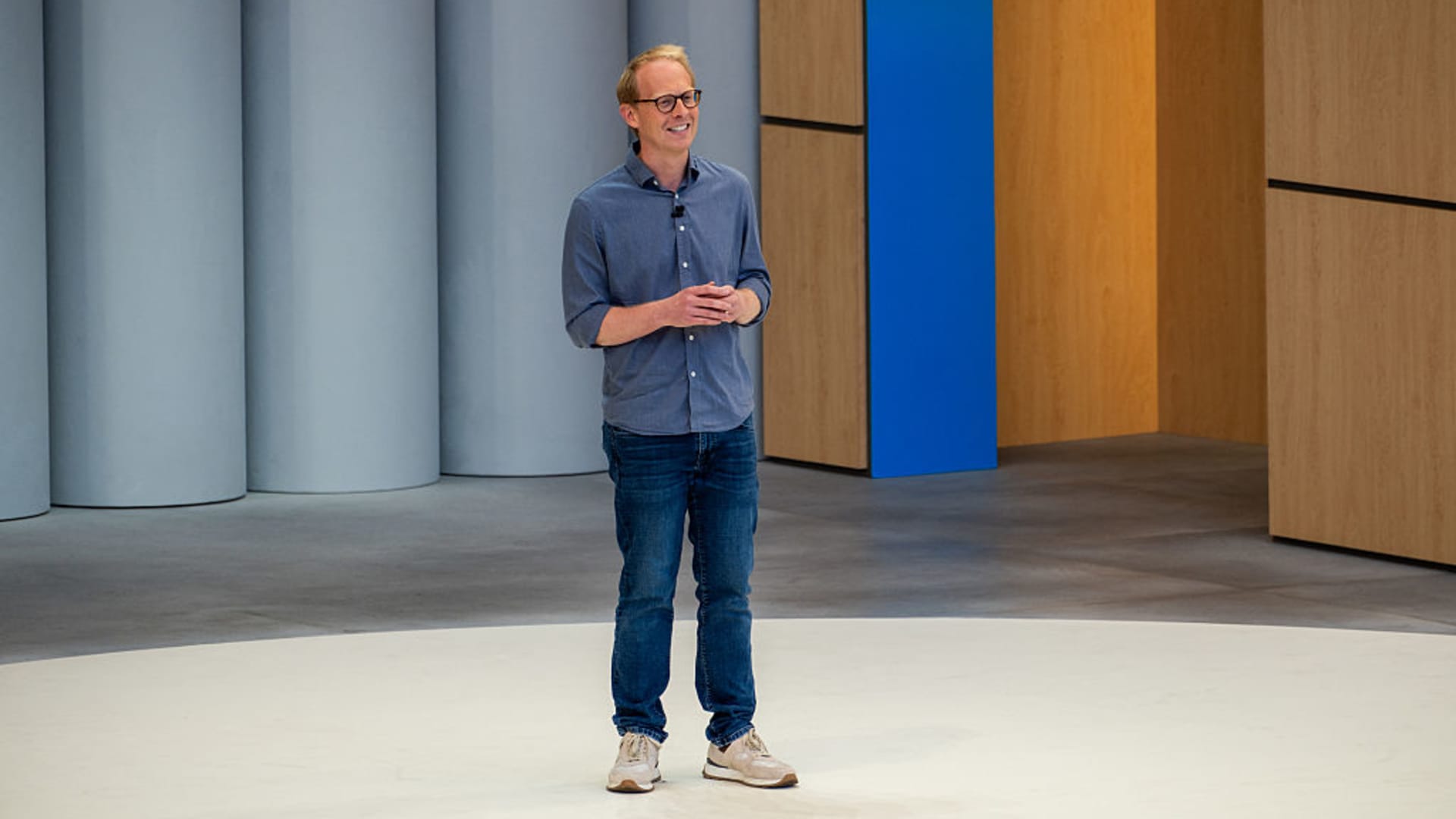
Josh Woodward, VP of Google Labs, addresses the crowd during Google’s annual I/O developers conference in Mountain View, California on May 20, 2025.
Camille Cohen | AFP | Getty Images
Josh Woodward may not be a household name in Silicon Valley. But inside Google, everybody knows about him.
The 42-year-old Oklahoma native, who started at Google by way of a product management internship in 2009, has spent the past eight months running the Gemini app, the centerpiece of the search giant’s artificial intelligence strategy.
Heading into 2026, Woodward’s work is more critical than ever as Google rushes to keep pace with its high-powered AI rivals, namely OpenAI, which kickstarted the generative AI boom with the launch of ChatGPT just over three years ago.
As industry experts forecast a shift in consumer behavior from traditional search to AI-powered apps, Google is fighting to make sure users stay within its ecosystem, whether it’s for chatbot services, images, videos or online shopping. Woodward is helping to spearhead that effort while also keeping his job as head of Google Labs, home to the company’s experimental AI projects.
Clay Bavor, former co-lead of Google Labs, said Woodward’s ability to move fast, break down barriers and execute “has landed him right at the center of the most important work at Google.”
CNBC spoke with more than a dozen people who have worked with Woodward about his evolving profile at Google, how he got there and the pressure he faces to help Google stay ahead of the competition without losing the trust of users. Several current and former colleagues, including some who asked not to be named because they weren’t authorized to speak to the press, emphasized how seriously Woodward takes the societal concerns that come with the power of AI, and about Google’s role in shaping the future.


In April, when Woodward was promoted to run the Gemini app, Google’s position in AI was tenuous. Alphabet shares plunged 18% in the first quarter, their worst performance for any period since 2022, and concerns were building that the company was losing its long-held position as the internet’s front door.
Demis Hassabis, co-founder of Google DeepMind and the person considered the top AI executive at Google, said in the memo announcing the move that Woodward would be focused on the “next evolution” of the app, according to a Semafor report.
A major turning point for Woodward’s group came in late August, with the launch of image generator Nano Banana, a Gemini feature that lets users blend multiple photos together to create personal digitized figurines.
Within days, Nano Banana had become so popular it was overloading the company’s infrastructure, forcing Google to place temporary limits on usage to ease the burden on its custom-designed chips called tensor processing units.
“Our TPUs almost melted,” said Amin Vahdat, Google’s head of AI infrastructure, at a November all-hands meeting, according to audio reviewed by CNBC.
By the end of September, the Gemini app surpassed 5 billion images and dethroned OpenAI’s ChatGPT at the top of Apple’s App Store. Nano Banana is now being rolled into other products like Google Lens and Circle to Search.
Like its top rivals, Alphabet is pouring money into AI infrastructure ahead of an expected surge of new business. The company said in its earnings report in October that capital expenditures for the full year would reach between $91 billion and $93 billion, up from a prior forecast of $85 billion.


Alphabet vs. Meta in 2025
Wall Street’s mood on the company has reversed dramatically.
Despite a brutal first quarter, Alphabet’s stock is up 62% this year, outperforming all of its megacap peers including Meta, which is up 13%.
Google said in October that the Gemini app’s monthly active users swelled to 650 million from 350 million in March. AI Overviews, which uses generative AI to summarize answers to queries, has 2 billion monthly users. OpenAI said in October that ChatGPT hit 800 million users per week.
Last month, Google introduced Gemini 3, its latest model, prompting excitement across much of the tech sector.
“I’ve never had more fun than right now,” Woodward told CNBC’s Deirdre Bosa in an interview soon after the release. “It’s partly the pace. It’s partly the abilities these models give to people who can imagine use cases and products.”
Bavor, who’s now co-founder of AI agent startup Sierra, said Woodward “was among the very earliest people in the company to see the potential in large language models for building products,” and lauded his ability to “get his mind fully around a new technology, to see around corners, to see how it might evolve and how it might be used.”
‘Change for good or bad’
Woodward now faces the challenge of not only leading two units within Google but also finding a balance between moving fast to compete with AI rivals OpenAI and Anthropic and not moving so fast that the search company’s AI products enable potential harm.
It’s a pressing issue as AI rapidly bleeds into daily life, more slop populates social media, and an onslaught of AI-generated content makes it difficult for average consumers to distinguish fact from fiction.
Woodward discussed the theme in a podcast with partners from venture firm Sequoia in March, shortly before taking over the Gemini app. AI-generated videos were rapidly getting more advanced, following the launch of OpenAI’s Sora in late 2024.
“When I’m thinking of video, for example, I’m on the side of wanting to amplify human creativity, but there are these moments that happen in our valley here where things change,” Woodward said. “And they change often for generations. And they can change for good or bad.”
The Nano Banana Pro, released in November, is so advanced that its creations blur the lines between images that are clearly AI generated and those that are real. The product has faced criticism for depicting white women surrounded by Black children in responding to a prompt about humanitarian aid in Africa.
The intensity of the job is hardly reflected in Woodward’s persona. Colleagues harp on his disarming, goofy laugh that often comes out mid-conversation and a friendliness stemming from his Midwestern upbringing.
Caesar Sengupta, who worked with Woodward on one of his earliest projects at Google, said, “I’ve never seen him get angry with anyone.” Sengupta, who’s now founder of AI finance platform Arta, added that he used to tease Woodward, suggesting he would be Google’s next CEO.
Clay Bavor, VP of Virtual Reality for Google, introduces the Daydream View VR headset during the presentation of new Google hardware in San Francisco, California, U.S. October 4, 2016.
Beck Diefenbach | Reuters
Woodward joined Google Labs in 2022. Bavor said Woodward was his first choice to help lead the effort.
One of the team’s first breakout products was known as Project Tailwind, an AI notebook that senior product manager Raiza Martin thought up in her 20% time, Google’s longstanding practice of letting employees dedicate one day a week to a project of personal interest.
Woodward helped shepherd the project through several iterations to what morphed into NotebookLM, a popular product that analyze articles, PDFs or videos a user uploads, and provides summaries or offers insights. Martin stayed on as a senior product manager until December 2024, when she left to co-found AI startup Huxe.
To help build NotebookLM, Woodward turned to an unsuspecting hire.
Steven Johnson had never had a full-time boss and had no connection to Google. Living in New York, he’d spent his career up to that point as an author, writing books about the history of science and technology.
Woodward was an admirer of his work.
“We hatched plans for him to join us as a visiting scholar,” Bavor said.
Johnson joined on a part-time basis in 2022. When he went full time in May 2023, Woodward put him to work immediately.
With Google’s annual I/O developer conference a week away, Woodward had the idea to demo an audio feature for what would become NotebookLM, viewing it as a way to test the evolving capabilities of Google’s AI models. The group worked overtime to get it done in time for Woodward’s presentation.
Leading up to the event, Martin wanted to collect user feedback on communication app Discord even though Google preferred that staffers use homegrown products for such efforts. Woodward intervened to make sure Martin could keep using Discord, employees told CNBC.
“In true Google fashion, everyone was like ‘What is Discord?'” Martin said in October 2024, on Lenny’s Podcast, hosted by tech investor and researcher Lenny Rachitsky. She recalled being asked by Google administration, “Why not use Google Meet, why not Google Groups, why not this and that, and I was like, ‘The server is the way to go.'”
Johnson, who spoke with CNBC on a video call, said Woodward’s approach was, “Let them cook.” The discord server now has more than 200,000 members, a company spokesperson told CNBC.
The screen displays the inscription ”NotebookLM” during a meeting between Alphabet and Google CEO Sundar Pichai and Polish Prime Minister Donald Tusk at Google for Startups in Warsaw, Poland, on Feb. 13, 2025.
Klaudia Radecka | Nurphoto | Getty Images
At I/O, Woodward took the stage after Google Cloud CEO Thomas Kurian’s keynote. He opened by talking about Project Tailwind, a concept that “five engineers at Google put together over the last few weeks.”
“We’ve been developing this idea with authors like Steven Johnson and testing it at universities like University of Oklahoma, where I went to school,” said Woodward, as he walked across the stage to a laptop. “You want to see how it works?”
He began his demo, uploading documents into the app. In a side panel, Tailwind instantly began showing key concepts and questions based on the materials in each document. He hovered his mouse over a button that said citations, saying “My favorite part is it shows its work.”
NotebookLM was initially released in July 2023, followed by a broader rollout in the ensuing months. It was an instant hit, and has since been updated to include podcasting, audio and video features.
Recommended reading
Woodward graduated from Oklahoma with an economics degree in 2006, and then headed to graduate school at University of Oxford in the U.K., where he studied the effects of the U.S. military and economic foreign aid on democracy.
He kicked off his career at Google in 2009 with a product management internship, and went on to hold a number of product management roles.
When Sengupta was tapped by CEO Sundar Pichai to start the Next Billion Users (NBU) project, an initiative to understand users in emerging markets like India, Woodward was “one of the first people I asked to join,” he told CNBC.
At NBU, Woodward wrote a weekly newsletter that was concise and thought-provoking, and became so popular that people would email the author asking to be added to the newsletter, Sengupta said.
Woodward still writes a newsletter — now it’s quarterly — about matters of interest to him and what he’s been reading. Woodward reads so much that he’s often the first person Google executives go to for book recommendations, colleagues said.
He also assigns reading. Martin said on the podcast last year that Woodward had given her an article to read that dissected whether users should trust AI chatbots.

One of Woodward’s best-known attributes, employees said, is his ability to circumvent Google’s massive bureaucracy. He helped set up a system called “block,” where workers can file a note if they see a perceived roadblock, and a team within Labs will handle it, they said. When NotebookLM launched, the product needed more TPUs, and Woodward was able to get them.
“It’s been very cool that we have someone who can take care of the annoying stuff, and we’re able to just get to the users,” said Usama Bin Shafqat, a Google Labs software engineer.
Woodward also came up with a process called “Papercuts” to address minor issues that create friction in a particular product. In October, Woodward posted on X, “Papercut fixed: You can now change models mid-conversations on GeminiApp without having to start over.” The post got more than 100 replies, including many from users thanking him.
Woodward is known for responding directly to users on X and Reddit, and brings feedback to employees so they can address complaints, said Jason Spielman, a former designer at NotebookLM.
“It’s that level of commitment to the end user I hadn’t seen in other leaders,” said Spielman, who left Google in January to join Martin at Huxe.
At a Google all-hands meeting last December, Woodward took the microphone as the Zombie Nation song “Kernkraft 400” blared in the background.
“I’m going to try to do six demos in eight minutes,” Woodward told the audience, according to audio obtained by CNBC.
He started with Jules, a coding assistant. He showed off NotebookLM, which had received several updates. He then moved to Project Mariner, an AI-powered multitasking Chrome extension, and demoed AI video generator Veo and experimental AI tool Whisk. He also showed project Maya, an image generation tool built in collaboration with the Google Shopping team.
Attendees erupted in applause after seeing all of the demos work in real time.
Ahead of last year’s I/O event, Woodward suggested Google host a second show tailored to staffers, according to two employees.
Pichai quickly greenlit the proposal and dispatched Woodward’s Labs teams to make it a reality. The result was Demo Slam, where employees showed off rapid demos to an audience of their peers, who could also try the products. It was such a hit that Google hosted a second Demo Slam in May, the same week as I/O.
Expectations are high for Woodward, and Google broadly, to continue delivering new AI features in 2026. But with 2025 wrapping up, Pichai sees the company riding high.
“The momentum has been incredible to see,” Pichai said at a recent all-hands meeting. “We’ve been shipping at a pretty fast pace across the company”
WATCH: Battle of the chatbots

https://www.cnbc.com/2025/12/20/josh-woodward-google-gemini-ai-safety.html