







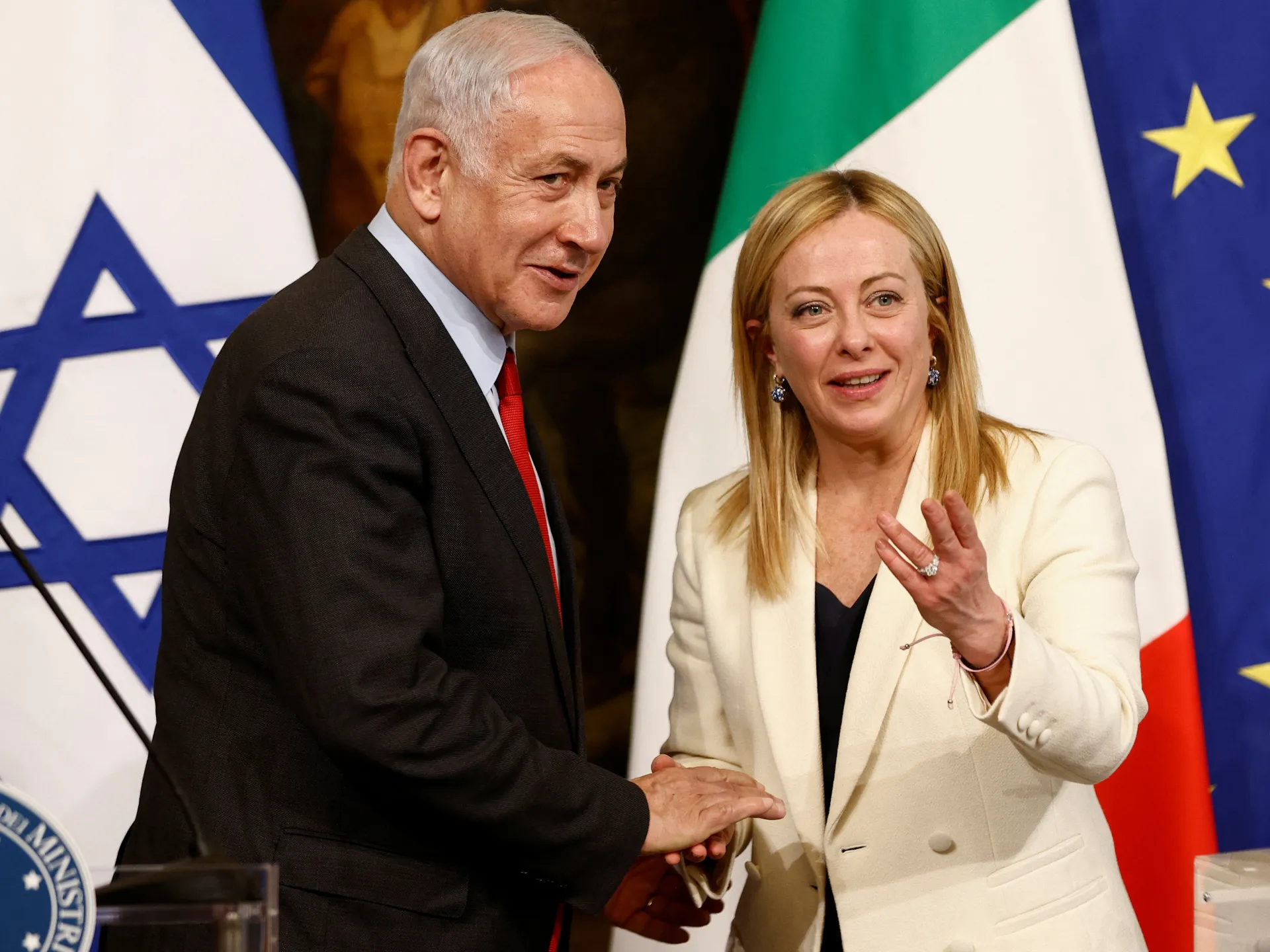
In 2014, during the Israeli assault on Gaza that killed more than 2,200 Palestinians, Giorgia Meloni, then just a member of the Italian parliament, wrote on social media: “Another massacre of children in Gaza. No cause is fair when it sheds the blood of the innocent.”
More than a decade on, that moral clarity is nowhere to be found.
As prime minister, Meloni’s remarks on Gaza have become increasingly cautious and equivocal, marked by the kind of “on the one hand, on the other” tone that frustrates many Italians. Her address on the war against Iran last March captured that ambiguity perfectly. She declared that she “neither condemns nor condones” the conflict, a sentence that managed to confuse many while clarifying nothing.
So when Italy announced earlier this month that it was suspending the automatic renewal of its defence pact with Israel, many observers hailed it as a turning point: Evidence, perhaps, that Meloni’s government was finally bending under the moral weight of Gaza’s destruction. Some hoped this gesture, however cautious, was a rare nod to the conscience of Italians who have marched for months, demanding an end to the war.
Yet it’s impossible to ignore the sequence that prompted the suspension. It did not follow the killing of some 75,000 Palestinians, nor the destruction of Gaza’s hospitals, schools and mosques. Meloni only acted after Israeli forces fired warning shots at a convoy of Italian United Nations peacekeepers in Lebanon, a follow-up to a 2024 incident in which two UNIFIL bases staffed by Italian personnel were struck by the Israeli army.
This pattern is telling. It took yet another direct affront to Italian personnel, not a humanitarian catastrophe, to move the Italian government.
The same reflex was visible when United States President Donald Trump insulted Pope Leo XIV. Only then did Meloni issue rare criticism of Trump, calling his words “unacceptable”. Up to that point, she had found his conduct in Gaza, Cuba, Venezuela and Lebanon quite tolerable. Once again, calculation intervened: She could not afford to alienate conservative Catholic voters who form the backbone of her political base.
Meloni’s foreign policy follows this script of moral performativity. Italy remains the only Western European and G7 nation to participate, even as an “observer”, in Trump’s so-called Board of Peace, a body that many Italian commentators have derided as cynical theatre, turning Italy into what one lawmaker called “a vassal of the United States”.
A European civil petition calling on the European Union to suspend its association agreement with Israel for “crimes in Gaza” gathered more than one million signatures; Italy ranked second in participation after France. This surge in public protest came after last October’s general strike in solidarity with the Global Sumud Flotilla, when more than two million Italians filled the streets, demanding an end to what many regard as genocide.
But the government’s symbolic gestures routinely dissolve once the spotlight shifts. Within days of suspending the defence pact, Italy quietly joined Germany in blocking the EU’s attempt, once again, to suspend the trade deal with Israel.
Meloni’s Italy, it turns out, performs dissent but practises obedience.
Just like when Foreign Minister Antonio Tajani loudly declared a halt to arms exports to Israel in January 2024, only for Defence Minister Guido Crosetto to clarify that the freeze applied solely to new licences, not existing contracts.
And this week, Meloni “condemned” Israel for seizing in international waters vessels from the Global Sumud Flotilla and detaining activists — including several Italians — yet took no concrete diplomatic action. Instead, she doubled down on her claim that the flotilla “doesn’t provide meaningful help to those in need.”But polls now show a widening gap between government rhetoric and public sentiment. Even many conservative voters who once sympathised with Israel have grown uneasy with the scale of civilian suffering, and a recent survey found that only 11 percent of Italians consider Israel “an ally”. For Meloni, who defines her leadership through nationalist pride and sovereignty, this unease is politically dangerous.
Symbolic posturing thus becomes vital.
Suspending an “automatic renewal” clause in a defence pact costs little. Israel’s own foreign minister admitted that the agreement had “no substantial content”. Trade and technology cooperation, by contrast, involves billions of euros and deep strategic coordination. While Rome’s announcement made front-page news, Italian diplomats in Brussels ensured that nothing of economic significance was jeopardised.
The reality is that Europe’s dependency on Israeli defence technology, cyber-intelligence and AI systems runs deep, and Italy is no exception. Italian industry giants Leonardo S.p.A. and Fincantieri maintain strong partnerships with Israeli firms such as Elbit Systems, with Leonardo producing components for the F-35 fighter jets heavily used in Gaza. Despite workers’ protests and petitions demanding a full severance of ties, those contracts continue unabated.
The contradictions extend into diplomacy. Italy has repeatedly abstained or voted against UN General Assembly resolutions calling for a ceasefire, refused to support Palestine’s bid for UN membership in May 2024, and sided with Israel against the International Criminal Court, with Tajani dismissing ICC prosecutor Karim Khan’s request for arrest warrants for Netanyahu and his defence minister as “unacceptable”.
Yet after the International Court of Justice recognised in January 2024 that there exists a plausible risk of genocide in Gaza, Italy, as a signatory to the Genocide Convention, became legally bound to act to prevent it. Continuing to supply weapons, munitions, explosives, and components facilitating Israel’s war effort constitutes not only complicity but a breach of international law. Each missed vote, each quiet licence renewal, reinforces that breach.
What, then, is Meloni’s endgame?
Sociologist Alessandro Orsini offers a fitting metaphor. In his book Gaza Meloni: The Foreign Policy of a Satellite State, he describes Meloni’s behaviour as a “viper strategy”: “When the sun is strong, the viper enjoys the light on the exposed rock. When the cameras shine on her, she says she ‘feels sorry’ for the Palestinians. But when the sun disappears, she retreats under the rock, just as she and Antonio Tajani do when political decisions in favour of Israel must be made.”
It’s a brutal but accurate portrait. Meloni’s humane instincts surface only when they carry no policy cost.
Part of this stems from Europe’s own collective guilt. The continent’s colonial and anti-Semitic histories have produced a moral timidity when confronting Israel. Another part is pure pragmatism: Energy dependence, defence cooperation, and intelligence sharing make Israel an indispensable partner for the EU project. European capitals, even when horrified by the images from Gaza or Lebanon, are reluctant to endanger that alliance.
Double standards, however, are corrosive, and this pattern of moral language masking self-interest seems to mirror Europe itself. France condemns Netanyahu one week and ships munitions the next. Germany cites historical responsibility to justify near-unconditional support. And Italy has allowed itself to become little more than a conduit of Trump and Netanyahu’s agendas.
Yet, as a country, we once played a unique role as a bridge between Europe and the Arab world, a role that combined pragmatism with empathy. That identity could still be rescued. But doing so requires more than ceremonial suspensions of defence pacts or carefully worded expressions of concern. It demands consistency, the courage to align foreign policy with declared values.
For Giorgia Meloni, that courage appears in short supply.
If Italy truly wishes to lead as a sovereign nation, it must rediscover the moral clarity Meloni once expressed as a young parliamentarian. The conviction that no cause is fair when it sheds the blood of the innocent. Until then, Italy will remain a bridge that no longer connects but collapses under the weight of its own hypocrisy.
The views expressed in this article are the author’s own and do not necessarily reflect Al Jazeera’s editorial stance.
https://www.aljazeera.com/opinions/2026/5/1/giorgia-melonis-moral-retreat-on-gaza?traffic_source=rss


