








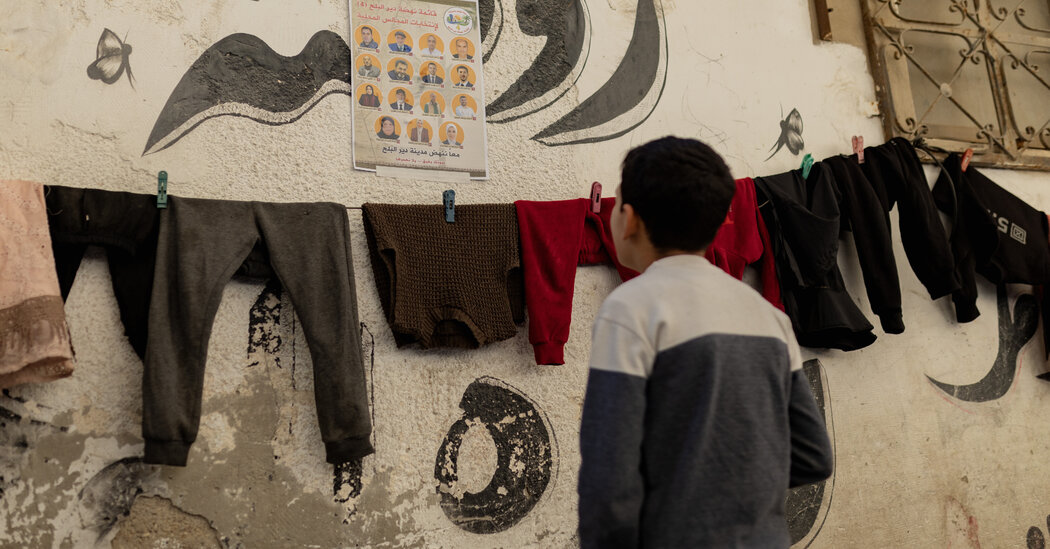
For 20 years, Palestinians in Gaza have endured Israeli bombardments, repeated displacement and a brutal dictatorship. Under such conditions, the holding of elections seemed a distant prospect.
Now, Palestinian officials are making preparations for municipal elections this weekend in a single Gaza city, Deir al-Balah, one of the few places where the Israeli military did not conduct a large-scale ground invasion during two years of war, though it still bears many signs of bombardment.
“My whole generation has been waiting for this opportunity,” said Abd al-Rahman al-Masri, a 27-year-old doctor who has never voted before. He said he wanted the next municipal council to find solutions to Deir al-Balah’s problems, from water and sewage to a lack of space in the cemeteries.
Roughly 70,000 people are eligible to vote in Saturday’s election, organizers said. For many, it is a long-awaited chance to have a say in how their city is run.
The election is being organized by the Palestinian Authority, which governs the Israeli-occupied West Bank, and its involvement is notable given that it was forcibly removed from power in Gaza by Hamas in 2007. Since then, Hamas has controlled the appointment of mayors and municipal council members across the territory.
Months after a cease-fire was agreed to with Israel in October, Hamas still controls much of Gaza. It has said it is prepared to relinquish the administration of the territory but has resisted calls to give up its weapons.
A spokesman for Hamas, Hazem Qassem, said the group supported the municipal elections taking place in Deir al-Balah and vowed not to interfere in them. “Hamas has already decided to hand over all responsibilities and powers to the winning list right after the results are released,” Mr. Qassem said by telephone.
Some candidates have faced accusations of having links to the group, but Mr. Qassem said that Hamas was not participating in the elections “at any level.” It was not immediately clear whether any of the candidates were Hamas members.
The election also appears to represent an effort by the Palestinian Authority to assert itself in Gaza, which it has long said would be an indivisible part of any future Palestinian state. Since the Hamas-led Oct. 7, 2023, attack on Israel, the Israeli government has sought to block the Palestinian Authority from playing any role in Gaza.
With most of the territory lying in ruins since the war, and little indication that reconstruction will begin soon, many residents in Deir al-Balah said they hoped their votes would lead to an improvement in local services.
Dozens of candidates have come together on four separate electoral lists. They have launched campaigns in Deir al-Balah, putting up posters around the town and meeting with voters to set out their policy platforms, largely focused on improving access to services like water and power.
Palestinian analysts have questioned whether the elections can bring meaningful change given that Israel tightly restricts goods into Gaza that are needed for repairing infrastructure.
“For Palestinians, these elections are an affirmation of life despite all the death they witnessed during the war,” said Akram Atallah, a Palestinian columnist originally from Gaza who lives in London. “But the next municipal council won’t be able to deliver substantial results as long as it doesn’t have the necessary resources.”
Israeli officials have said restrictions on the entry of certain goods are necessary to prevent Hamas from obtaining materials for weapons production.
As of Thursday afternoon, the Palestinian Authority was still awaiting permission from Israel to send ballot boxes and other materials for the election into Gaza, according to Fareed Taamallah, a spokesman for the authority’s Central Elections Commission. He said there were concerns that the materials would not be delivered on time but suggested that the commission had alternatives, without elaborating.
The Israeli agency responsible for liaising with Palestinians, known as COGAT, declined to comment. The office of Israel’s prime minister, Benjamin Netanyahu, did not respond to requests for comment.
Mr. Taamallah said that the elections in Deir al-Balah were a “pilot” program and, if they went ahead successfully, more elections could happen in other municipalities in the territory. Polling stations in Deir al-Balah, he added, would be operated by 700 workers and secured by a security and logistics company. It was unclear to what extent Hamas would be present on the streets during the election.
The four candidate lists are officially politically independent, but many of those running with one list called Deir al-Balah Renaissance have been associated with Fatah, the ruling party of the Palestinian Authority.
At an event on Tuesday, Sharif al-Buheisi, the campaign manager for Renaissance, spoke to members of a prominent local family about plans to help young people develop skills and increase their employment prospects.
“We’re here to represent you and stand up for your services,” Mr. al-Buheisi told the gathering of about 25 people, who were sitting on rows of plastic chairs. “The municipality has resources that can make a real difference.”
Raed Abu Asad, 49, a farmer and a candidate on another list, called Deir al-Balah Future, said the top priorities were “sanitation and controlling prices in the markets.”
“The good thing with these topics is that we don’t need many tools or heavy machinery,” he added.
The New York Times spoke to 26 residents in Deir al-Balah about the forthcoming elections, and 16 of them said they intended to vote.
Osama al-Louh, 49, a civil engineer, said he wanted his vote to contribute to greater transparency and equality in how water is distributed across the city.
“Some areas get water every day, while others get it once a week,” he said. “That’s not professionalism, that’s favoritism.”
Other residents said they would boycott the vote entirely, despairing at the scale of problems that Deir al-Balah faces.
“This city needs about $1 billion to function properly,” said Nader Obaid, 50, an architectural engineer. “There are no magic solutions.”
https://www.nytimes.com/2026/04/24/world/middleeast/gaza-elections-deir-al-balah.html


