








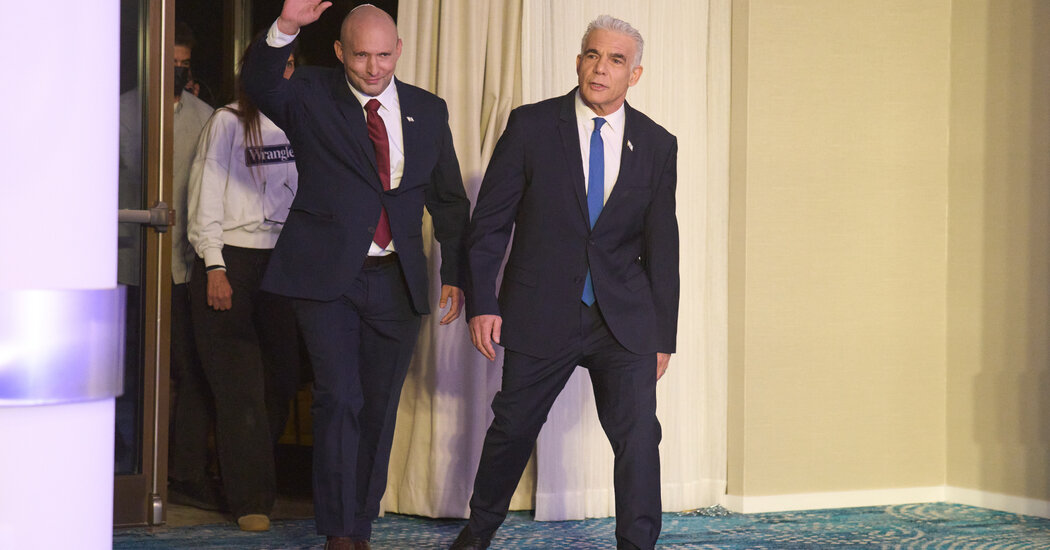
The centrist leader of Israel’s opposition, Yair Lapid, and a right-wing former prime minister, Naftali Bennett, announced on Sunday that they would combine forces in elections later this year. The merger is an apparent bid to reconstitute a partnership that temporarily unseated Prime Minister Benjamin Netanyahu five years ago.
Mr. Bennett and Mr. Lapid said their two parties, Bennett 2026 and Yesh Atid, would unite into a party to be called Yachad, Hebrew for “together,” under Mr. Bennett’s leadership.
They described the move as “the first step in the process of uniting and repairing the state of Israel.”
In a joint news conference broadcast live on Sunday evening, the pair presented their political and ideological differences as an advantage and an example for a deeply fractured nation.
“The unity we share is a message to all the people of Israel,” Mr. Bennett said, adding, “The era of polarization is over.”
Mr. Lapid described Mr. Bennett as “a man of the right, but a man of the liberal, decent, law-abiding right.”
Invoking this month’s election in Hungary, Mr. Lapid said that Prime Minister Viktor Orban had lost in a landslide there after 16 years in power “because people believed change was possible,” adding, “They united behind one candidate.”
Mr. Netanyahu, Israel’s longest serving prime minister, has been in office for most of the past 17 years as the head of the conservative Likud party. After the last election, in 2022, he formed the most right-wing and religiously conservative governing coalition in Israel’s history, made up of far-right and strictly Orthodox coalition partners.
Likud has been leading the polls as Israel’s largest party, with the potential to win 25 or more seats in the 120-seat Knesset, or Parliament, followed by Mr. Bennett’s Bennett 2026.
But Mr. Netanyahu’s coalition, as a whole, has lost support since the deadly Hamas-led attack on Israel in October 2023, and it is not expected to win again in its current form. The assault ignited a devastating two-year war in Gaza and a series of inconclusive conflicts in Iran and Lebanon, all of which have fallen short of Mr. Netanyahu’s promises of total victory.
Many Israelis are angry and frustrated over the intelligence and policy failures that preceded the surprise October 2023 attack, as well as Mr. Netanyahu’s refusal to accept any personal responsibility or to set up an independent commission of inquiry.
Mr. Bennett said a government under his leadership would establish an independent commission of inquiry “on Day 1.”
Before the wars, the right-wing government’s divisive efforts to curb the powers of the judiciary set off mass national protests amid fears for the nature of the country’s democracy. Mr. Netanyahu is also battling corruption charges in a long-running trial that has split Israelis.
Yet the parliamentary opposition has proved weak and ineffective. It is made up of a diverse array of centrist, left-wing, right-wing and Arab parties, with several actors vying to lead the camp and replace Mr. Netanyahu.
Support for Mr. Lapid, who is broadly viewed as weak on national security, has been flagging. Mr. Bennett, who sat out the last election and is not currently a member of Parliament, has been broadcasting a message of national unity and pragmatism. Together, they hope to appeal to the broadest possible range of the Israeli electorate, from the liberal center-left to moderate right-wingers.
In a nod to the right, Mr. Bennett said on Sunday that a government he led would “not hand over a centimeter” of territory “to the enemy.” In their opening statements, both men avoided other contentious issues, such as the surge of settler violence in the occupied West Bank and the future of Gaza.
By joining forces, the pair increase their prospects of overtaking Likud in the election, which is slated to take place in October at the latest.
Traditionally, the party that emerges from an Israeli election with the largest number of seats, and has a realistic chance of forging a coalition, is given first crack at forming the next government.
Mr. Bennett and Mr. Lapid are far from political strangers.
The pair formed their first alliance in 2013, joining a Netanyahu-led coalition that kept the ultra-Orthodox parties out of power for two years.
After an election in 2021, the two men patched together a coalition made up of eight ideologically disparate parties spanning Israel’s fractious political spectrum, relying for the first time on the support of a small Arab, Islamist party. It was dubbed the “change government” by supporters.
Mr. Bennett’s party won only 7 seats that time, to Mr. Lapid’s 17. But Mr. Lapid conceded the premiership to Mr. Bennett, who emerged as the consensus candidate, paving the way for other right-wing politicians to join the anti-Netanyahu alliance.
Under their arrangement at the time, Mr. Bennett was to be replaced as prime minister by Mr. Lapid for the second half of their government’s four-year term. But it lasted only a year, collapsing after members defected to the Netanyahu camp, and accomplished little along the way.
Mr. Lapid got to serve as a caretaker prime minister for six months until the 2022 election, the country’s fifth in less than four years, and the formation of the current Netanyahu-led government.
Johnatan Reiss and Aaron Boxerman contributed reporting.
https://www.nytimes.com/2026/04/26/world/middleeast/israel-netanyahu-lapid-bennett.html


