








‘Turtles’
Stream it on Tubi.
David Lambert’s melancholic, Brussels-set drama centers on the kind of couple we rarely see in cinema: two older gay men who have been married for 35 years and are confronting the slow fade of their romance. It begins when Thom (Dave Johns) wakes up his husband, Henri (Olivier Gourmet), to celebrate Henri’s retirement. Thom, who moved to Brussels for love and gave up his drag ambitions to support Henri’s career in law enforcement, is delighted at the prospect of having more quality time to spend together. Henri, however, responds with not a smidgen of joy — in fact, he’s annoyed and depressed. His job gave him purpose and routine, and without it, he feels empty.
“Turtles” is a bittersweet comedy, though I didn’t expect it to be as bitter as it turns out to be. Henri regrets a life lived by the rules, and starts setting up dates on hookup apps behind Thom’s back. Thom finds out, and their conflict escalates step by step, with each trying to make the other jealous. While there are plenty of funny moments — including an argument over the custody of two pet turtles that neither of them can tell apart — there are also stinging fights, and the kind of cruelty that only someone who’s loved you for a long time can inflict on you. Lambert and his actors do a remarkable job of balancing these tones, nestling inside a breezy, colorful movie some hard truths about life.
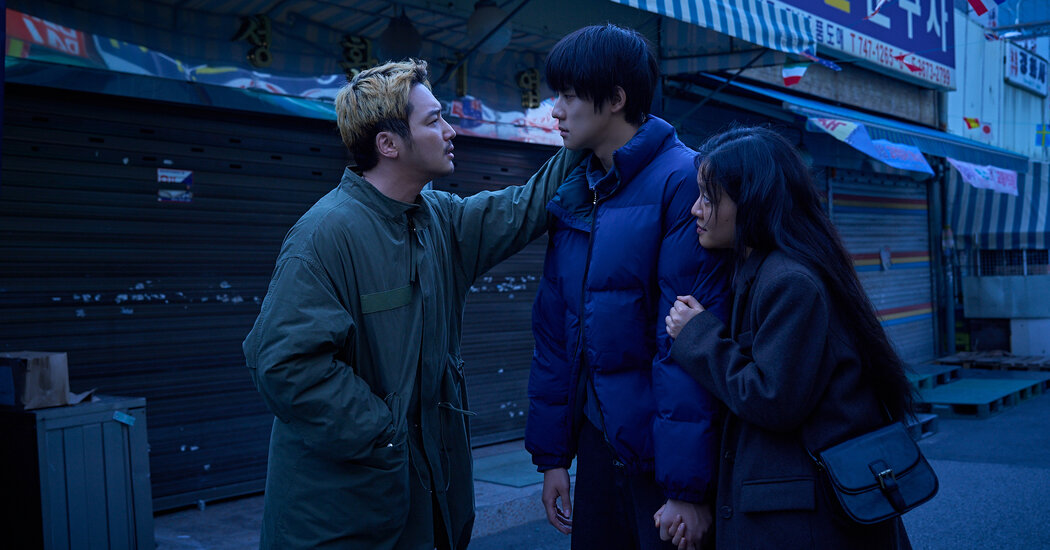
Directed by Lee Jong-pil, this graceful tale of romance and tragedy feels nostalgic in how unabashedly it leans into the melodrama of love: the fated meetings, the grand gestures, the magical coincidences and missed chances.
A two-part prelude sets the tone: In the first scene, a man and a woman declare their devotion to each other and decide to get married; in the second, we see the man, now a famous actor, abandoning his wife and child. Then the film hops forward to the life of Gyeong-rok (Moon Sang-min), a young man who dreams of seeing the aurora borealis in Iceland and applies for a job at a local mall to save up for the trip. There, he meets the bleach-blond, David Bowie–loving Yo-han (Byun Yo-han) and the shy and mysterious Mi-jeong (Ko A-sung), who works in the basement and is bullied by all the other mall workers. The film follows the twisting and turning relationships of these three characters, with the tragic betrayal of the prelude hanging over the narrative: Who was the child in that opening, and will he end up like his mom (or dad), or prove their example wrong?
Lee and his cinematographer, Kim Sung-an, compose each scene as an exquisite interplay of light, shadow and rhythm, so that the film unfolds like the titular pavane — a royal, processional waltz from 16th-century Europe.
Metal piercing through metal, flesh pressing against flesh, bone cracking under pressure. In the Italian director Giulio Bertelli’s debut feature, Olympic sports are abstracted as a series of tactile brutalities on the human body. “Agon” follows three top Italian athletes as they train for a fictional, futuristic version of the Olympics called Ludoj. The real-life judoka champion Alice Bellandi plays a version of herself, while a fencer, Gio (Yile Vianello), and a shooter, Alex (Sofija Zobina), are played by professional actors. Bertelli (who is a son of Miuccia Prada, the head designer of the eponymous fashion house) crafts a sleek, stylish film that zeros in on surfaces, textures and sounds more so than words.
In breathless close-ups, we see Alice experiencing and recovering from a severe knee injury, Gio being egged on by her aggressive coach and causing a terrible accident, and Alex getting embroiled in a scandal around poaching. The editing evokes a kind of militaristic rhythm: It underlines the roots of the Olympic Games in ancient Greek contests of life and death (known as “agon”), and the irony of subjecting people to such primitively inhumane exploits in the modern day.
Directed by the Argentine filmmaker Celina Murga, this ensemble drama of midlife crises and marital conflicts is a master class in acting. The film revolves around two couples: Pablo and Carla, played by Joaquín Furriel and Romina Peluffo, and Natalia and Hernán, played by Marina de Tavira and Alfonso Tort. Pablo and Natalia both teach agronomics courses at a university in Buenos Aires, and each of their spouses is unemployed and stuck in a rut. The two professors both begin affairs with their students, sparking a confrontation with the status of their marriages, and their own senses of self.
Murga employs a parallel structure, cutting between the lives of the two couples, which mirror one another. Both pairs argue in bed and bicker about child care; both Pablo and Natalia begin lying to their spouses; and in both cases, the affair with a student brings up the melancholy of lost youth. When the two arcs diverge, they illuminate the social dynamics of gender, like the different consequences that unemployment and adultery have for men and women. But there are no big showdowns, no dramatic reveals in “The Freshly Cut Grass.” This is a film of lived-in, natural performances that invite us to see something of ourselves in the characters rather than make judgments.
In a tiny, rural Czech village, Standa (Michal Istenik) lives in the shadow of his late firefighter father. His father’s friend and colleague, the gruff and domineering fire chief Brona (Miroslav Krobot), has taken him under his wing and gotten him to join the fire department, too. Standa is eager to prove himself; his wife is pregnant, and he’s about to become a dad.
But the ideals of traditional masculinity, Standa soon realizes, are tied up with a host of other toxic ideas. Adam Koloman Rybansky’s film uses a dark comedy setup to explore the nexus of patriarchy, jingoism and xenophobia: A van crashes into a fountain during Easter celebrations, injuring a villager. The driver flees before anyone can see him, and Brona and the other villages decide that it is a terrorist attack by Arab immigrants (of which there seem to be none in the village).
As things spiral, Standa’s morality comes into conflict with the paranoid and racist demands of Brona and his brigade, whose performance of strength and aggression belies a deep insecurity. Koloman Rybansky’s mordant tale of village life and strife becomes a microcosm of our fractured world today.
https://www.nytimes.com/2026/05/01/movies/international-movies-streaming.html


