









Crypto Journalist
Anas Hassan
Share



The Federal Reserve is poised to deliver another 25-basis-point cut at its December meeting, which would reduce the federal funds rate to approximately 3.50-3.75%, while forward markets price at least three additional cuts through 2026 that could push rates into the low-3% range by year-end.
Delphi Digital noted that with quantitative tightening ending December 1, a Treasury General Account drawdown ahead, and the Reverse Repo Program fully depleted, “this is the first net-positive liquidity backdrop since early 2022—turning policy in 2026 from a headwind to a mild tailwind.“


The research firm emphasized that 2026 represents “the year policy stops being a headwind and becomes a mild tailwind,” favoring duration, large caps, gold, and digital assets with structural demand, like Bitcoin.
Fed Forced to Cut Despite Inflation Pressures
Markets widely anticipated the December cut, with CME FedWatch pricing 88% probability ahead of the Federal Open Market Committee meeting.
The decision came despite limited economic data; October’s inflation and employment figures weren’t released due to the government shutdown, forcing policymakers to rely on alternative indicators showing mixed signals.
The Kobeissi Letter starkly framed the Fed’s dilemma, noting that “even as inflation hits 3%, the Fed MUST cut rates to ‘save’ US consumers.”
The analysis highlighted a K-shaped economy in which “consumers are struggling while large cap tech stocks are soaring,” forcing the Fed to cut rates “into one of the hottest stock markets in history.”
With retail sales rising only 0.3% in September and the S&P 500 up 17.8% year-to-date through December, the wealth gap widens as “Americans need the support as a labor market deteriorates.“
Goldman Sachs chief economist Jan Hatzius projects the Fed will pause in January before delivering cuts in March and June, pushing rates to a terminal level of 3-3.25%.
In fact, according to Reuters, Bank of America shifted its December forecast from hold to cut, stating that “by cutting rates next week, we think the Fed would increase the risk of pushing policy into accommodative territory, just as fiscal stimulus kicks in.”
The backdrop extends beyond rate cuts. Quantitative tightening’s end removes roughly $60 billion in monthly balance sheet reductions that drained liquidity throughout 2023 and 2024.
Divided Committee Shows Market Volatility
Growing divisions within the Federal Open Market Committee complicate the outlook.
October’s meeting produced unusual dissent, with members voting both for no cut and for a more aggressive 50-basis-point reduction, a rare occurrence in Fed history with only 28 prior instances of opposing dissents.
According to Forbes, Minutes revealed sharp disagreements, stating: “Many participants were in favor of lowering the target range for the federal funds rate at this meeting, some supported such a decision but could have also supported maintaining the level of the target range, and several were against lowering the target range.“
Political factors add pressure. Reports emerged that the Trump administration canceled interviews for Fed chair finalists, fueling expectations that Kevin Hassett might replace Jerome Powell next May.
Bank of America cited leadership change as the primary driver of its forecast for two additional 2026 cuts in June and July, noting that its “forecast of additional cuts next year is due to the change in leadership, not our read on the economy.“
Keith Buchanan, senior portfolio manager at Globalt Investments, observed that markets are betting “the Federal Reserve will have ammo to lay off the hawkish tone that we saw a couple of weeks ago and perhaps lean more dovish into what looks to be disappointing and weakening labor data.“
Asian Currencies Positioned for Easing Benefits
Asian currencies stand to benefit from December’s cut and potential 2026 easing, according to Reuters.
India’s rupee, which breached 90 per dollar for the first time, faces relief from reduced pressure, while Indonesia’s rupiah, South Korea’s won, and the Philippine peso, all down over 4% this quarter, could stabilize as Fed policy turns accommodative.
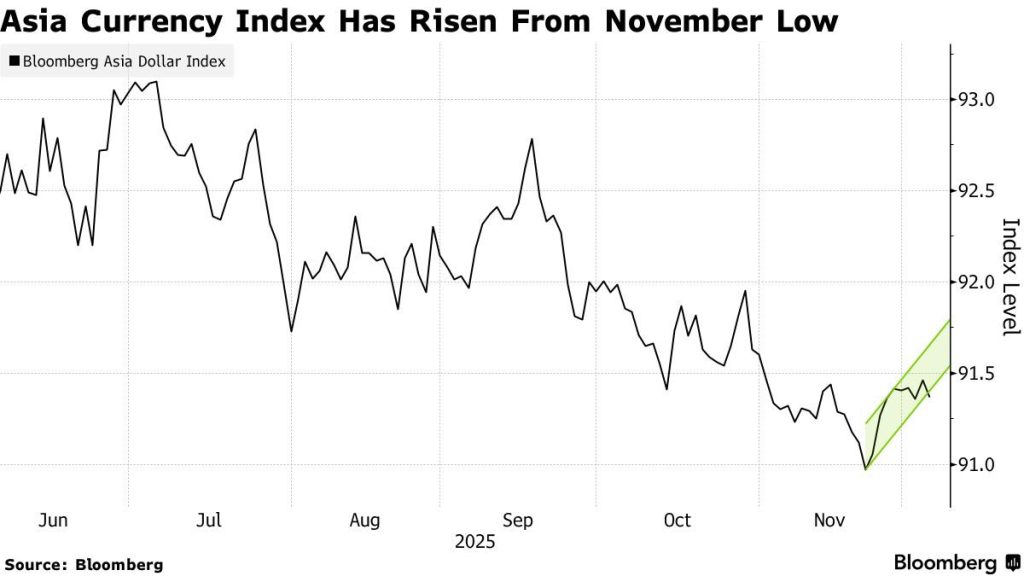
Source: Bloomberg.
As per Bloomberg, traders now price over 90% probability for the quarter-point December cut based on swaps data.
Wee Khoon Chong, senior Asia Pacific market strategist at BNY, expects that “further Fed easing is likely to be supportive for Asia FX in general.“
https://cryptonews.com/news/fed-rate-cuts-could-turn-2026-into-cryptos-first-tailwind-year-delphi-digital/


