






Autonomous AI agents have registered roughly 90,000 on-chain identities since January 2025, and the ETH they burn through every micro-transaction is not coming back.
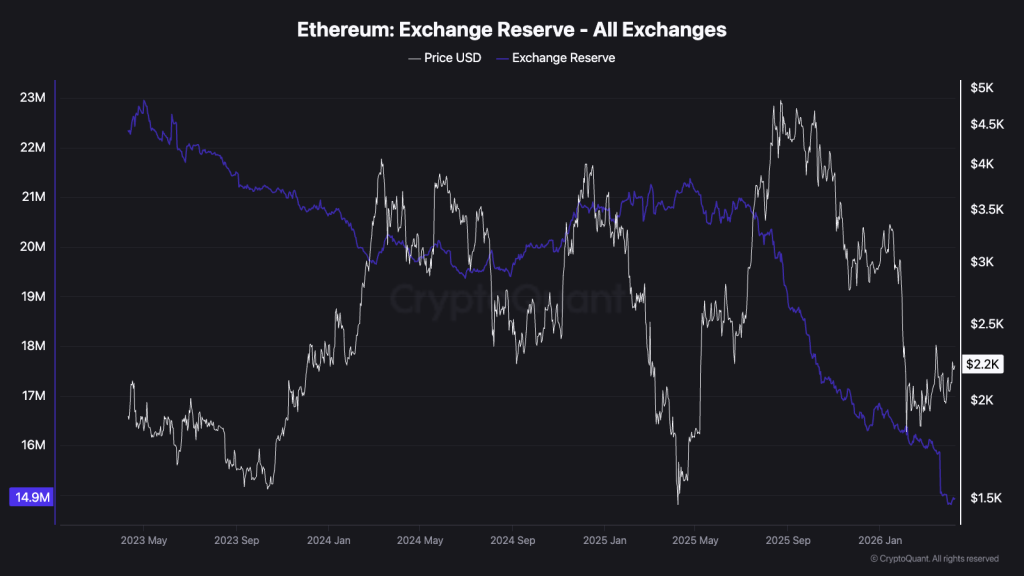
Exchange reserves have collapsed to 16.2 million ETH – the lowest level since 2016 – while over 37 million ETH sits locked in staking contracts.
The EIP-1559 burn mechanism was designed for humans transacting at human speed. AI agents don’t sleep, don’t hesitate, and don’t wait for gas to drop on a Sunday morning.

The question is no longer whether AI activity is compressing ETH supply. The question is whether the compression is structural enough to constitute a genuine ETH supply shock – one that reprices the asset rather than just tightens a few metrics.
Discover: AI price predictions for Ethereum, Bitcoin, and XRP through end of 2026
How AI Agents Are Burning ETH Faster Than the Market Expects
Under EIP-1559, base fees are destroyed rather than paid to validators. That mechanic was calibrated around human-driven transaction demand – periodic spikes during NFT mints, DeFi yield chases, and token launches.
AI agents introduce a fundamentally different demand profile: continuous, high-frequency, and immune to price fatigue.
Projects built on frameworks like Etherealize, alongside autonomous trading systems powered by ASI ($FET) and RENDER, now dominate DEX activity during low-liquidity windows – particularly weekends – where their algorithmic execution faces minimal human competition.
Each interaction triggers a base fee burn. At scale, the aggregate effect on net ETH issuance is material.
Glassnode on-chain data confirms ETH’s annualized net issuance is currently running at approximately -0.5%, meaning burns are outpacing new validator rewards.

That deflationary state has now persisted across a 12-month high in burn rates, according to CryptoQuant metrics tracking exchange-level reserve depletion alongside network-wide fee destruction. The Etherealize-driven agent economy is not a speculative catalyst – it is already showing up in the supply figures.
What makes AI agent burn different from prior DeFi demand spikes is durability. A yield farming craze burns ETH for weeks; a machine economy running autonomous wallets on deflationary crypto rails burns ETH indefinitely.
The frequency is predictable, the volume scales with agent registrations, and there is no behavioral off-switch triggered by a price correction. That changes the supply calculus in ways that cycle-based models don’t fully capture.
Bitcoin Hyper Targets Early Mover Upside as Ethereum Tests Key Supply Levels
ETH at a $271 billion market cap limits the upside math even if the supply-shock thesis fully validates. A move from $2,400 to $3,000 represents roughly 25% – meaningful, but not the asymmetry that earlier-cycle positioning delivers. For traders who accept the AI-driven deflationary crypto thesis but want higher-beta exposure to the same infrastructure trend, the presale layer is worth examining.
Bitcoin Hyper is currently in presale at $0.0521787, with over $1.1 million raised and a staking APY currently sitting above 90%. The project is built around Bitcoin-native speed infrastructure – a direct architectural play on the machine-economy demand that is driving AI agent adoption across L1 networks. Its positioning assumes that the high-frequency, low-latency transaction environment that makes AI agents viable on Ethereum will expand to Bitcoin-adjacent rails as agent registrations scale.
The entry window at current presale pricing closes as each stage fills. For traders watching Ethereum consolidate below resistance while the supply metrics tighten, the asymmetry argument is straightforward. Research Bitcoin Hyper here before the presale window closes.
The post Etherealize Say AI Will Fuel Ethereum Supply Shock: Here’s Why and Next Coin to Pump appeared first on Cryptonews.
https://cryptonews.com/news/ethereum-ai-agents-deflationary-supply-shock/


