








Our first question to Oprah Winfrey: “You always wear really beautiful clothes. Always have. And I wonder if it’s a joy to get dressed now?”
“I can tell you what a joy it is to actually pack clothes that you know are gonna fit and you’re gonna feel good in them,” Winfrey replied. “I mean, it is a joy to get dressed. That is such a powerful first question, Jane Pauley, really!”
Powerful is one of the superlatives befitting Oprah Winfrey, one of the best-known and most-admired people on the planet, and one of the richest. But for all her success, she seemed powerless against a weight problem, a deeply personal struggle she has waged publicly and openly.
In 1985, when her talk show, “AM Chicago,” was getting national attention, Oprah appeared on “The Tonight Show” with guest host Joan Rivers.
“And I’m sitting there, and we’re toward the end of the interview, and Joan turns to me and, ‘So, tell me, you know, how’d you gain the weight?'” Oprah recalled. Her response? “I ate a lot.”
“I was stunned in that moment, when I look back and I see that moment. But I left feeling humiliated and embarrassed, but not the least bit anger, not the least bit of anger or being upset about it,” she said.
Why? “Because I thought, ‘She’s right.'”
CBS News 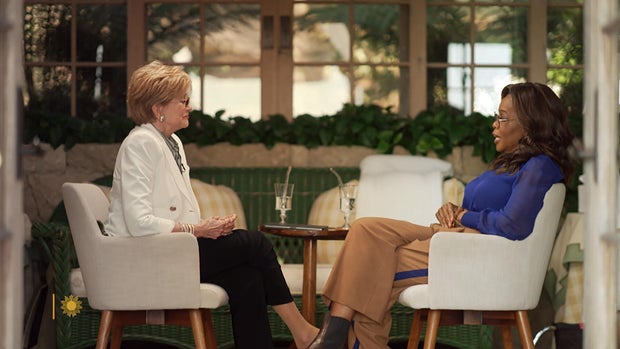

Over the next 40 years, Oprah would gain and lose hundreds of pounds. In the fall of 1988, after a strict four-month liquid diet, a new svelte Oprah appeared wearing size 10 Calvins, weighing 145, and pulling a wagon with 67 pounds of animal fat
It was all back, plus 25 more, when she went to the Daytime Emmy Awards four years later. “And I go to the Emmys praying not to win, literally praying not to win, because I don’t want to have to get up out of my seat and have everybody watch me do that walk to the stage,” she said.
She started over again the next day, working out with an on-call personal trainer this time. In 1994 she even ran a marathon.
Oprah knew how to lose weight … she did it over and over. She says her body was seeking a range of 211 to 218. “So usually, by the time I would hit 211 when I first went on the diet for the wagon of fat and pulled out the wagon of fat, when I did my first marathon, once I get to 211, I go, ‘Oh, I gotta do something.’ But now I understand that the biology of me, which is different than the biology of you and everybody else – every body, all of us, has our own – but no matter what I did, no matter how hard I worked, no matter what, it was always trying to get my body back to 211.”
Not because 211 is her ideal weight, but rather a “set point”: a genetically-influenced weight range. Oprah calls it the “enough point.”
“Enough” is also the title of a new book she co-wrote with Dr. Ania Jastreboff from the Yale School of Medicine, who says, for most people, an enough point is “the weight that they kind of always gravitate to.”
Avid Reader Press 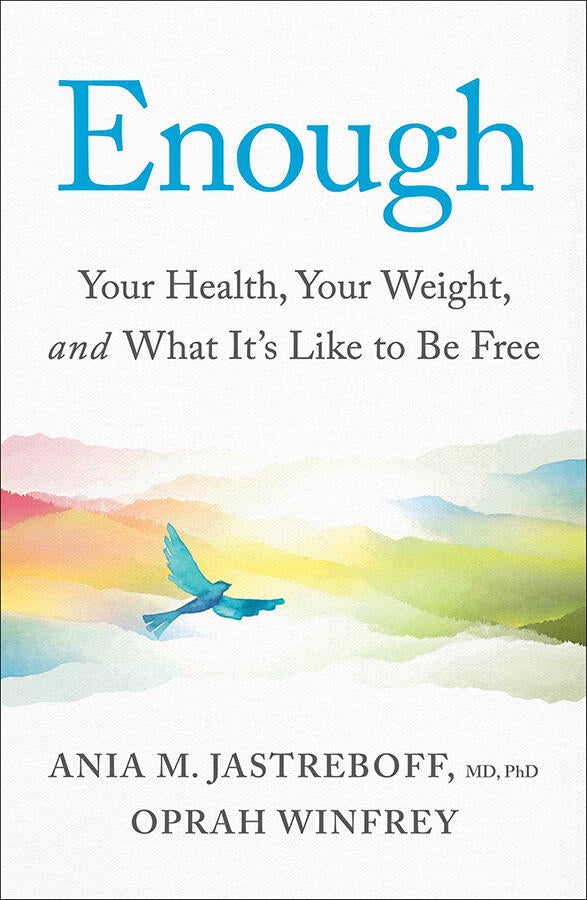

So, to lose weight, you cut back on calories, and start craving high-fat food , or you eat less – but nothing changes. “Our body’s like, ‘Well, if you’re gonna eat less, then I’m gonna make you more efficient. I’m gonna make you burn less,'” said Jastreboff. “So what happens is, together, collectively, we end up eating more, and burning less.”
“It’s the enemy within, which is in our brains,” I said. “So, now that we know what the problem is, the hormones that drive people, why don’t people just stop obeying it?”
“That would be like trying to control something that is not in your control,” Jastreboff said. “That would be like holding your breath for the rest of your life. Every time somebody says, ‘Just eat less, move more,’ we’re asking our patients to control their biology and hold their breath. And it’s just not possible. And why would we do that? We don’t do that for any other disease.”
And that’s what the American Medical Association says obesity is — a disease. A treatable disease. But the good news is that, if it’s a disease, it’s not your fault.
“It’s not my fault, Jane! It’s not my fault,” Oprah said. “And I could weep right now, could weep right now. I’m not going to! But I could weep right now for all of the many days and nights I journaled about this being my fault, and why can’t I conquer this thing?”
In the last decade, nearly a dozen weight management drugs have been approved for chronic weight management. And for millions, drugs like GLP–1s are the answer to their prayers. Finally, a scientifically-supported, medically-approved weight-loss strategy that worked. And yet, Oprah resisted. “I was so motivated by shame that I felt I could not take the drug,” she said, “because if I took the drug – I, who had been the poster child for I can do it, I can do it, I can do it, willpower, willpower, let’s just get more willpower – if I couldn’t do it, then I would be shamed, and ashamed of myself for not being able to do it myself.”
The medications don’t work for everyone, and some can’t tolerate side effects ranging from nausea to gallstones. But it’s been two years since Oprah finally started medication, and it’s working for her. She says she is now down to her marathon weight of 155. “And so, that’s it for me. I’m gonna just try to maintain,” she said.
“Well done. Because I thought 160 was your goal weight?” I asked.
“Yeah, yeah, it was,” Oprah said, “but as I continue to work out here the combination of the medication and hiking every day and resistance training has given me the body that I had when I was running a marathon. So, I was 40 and feeling really good, but to be able to be 71 and feel that I am in the best shape of my life feels better than it did when I was 40.”
“I would submit that you would have been a phenomenal success, but I don’t think you would have become ‘Oprah’ if you hadn’t had the weight issue and been open about it and shared it,” I said.
“Yeah. I would agree with that,” she said. “And that’s why I don’t have any regrets about it. There’s a wonderful spiritual, African American spiritual, called, ‘I Wouldn’t Take Nothing For My Journey Now.’
I wouldn’t take nothing for my journey now
for my journey now
for my journey now
I wouldn’t take nothing for my journey now.
“I wouldn’t change the journey,” she said. “because I think the struggle with the weight actually helped me be more relatable and relate more to other people who were in their own struggles. But I’m glad now to be in a position where I feel the healthiest and strongest I have ever been.”
READ AN EXCERPT: “Enough” by Dr. Ania Jastreboff and Oprah Winfrey
CBS News 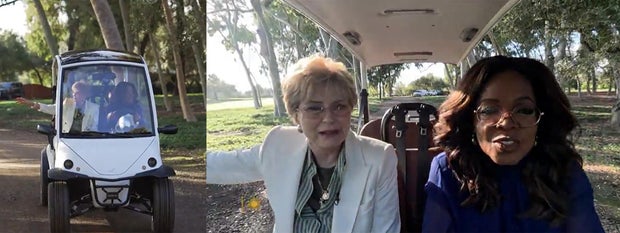

“I feel free”
Oprah Winfrey grew up riding on dirt roads. Now, on her sprawling Montecito estate near Santa Barbara, California, she owns the road. She took me for a ride: “This used to belong to my neighbor,” Oprah said. “So, this is 23 acres. Her house used to be right there. We took this fence down, so this became my whole backyard, this.”
Around here, all of the views are spectacular, especially the one looking back.
Born in Mississippi in 1954, Oprah Winfrey was a teen beauty queen who became a local TV reporter in Nashville, and then an anchor in Baltimore. “The beautiful thing about my life was that I started out in local television, as you did,” Oprah said. “And when you start out locally, you get this, like, little teeny-tiny thing. But I failed. I failed in Baltimore.
“They brought me in as a 22-year-old with an anchor guy, white-haired Jerry Turner, who was the most popular local anchor in the country, not just Baltimore. And he totally hated me. He resented me. He would do everything he could to condescend to me any way. I remember one time we were on the set and he said to me, ‘So, you’re from Mississippi? Can you name all the tributaries of the Mississippi River?’
“And I was, like, ‘All the tributaries of the Mississippi River? No, I can’t.’ He goes, ‘Well, what school did you go to?’ ‘Well, I went to Tennessee State.’ ‘Was that an accredited school? So, you got a degree?’ I mean, that kind of thing. This is in-between the commercial breaks.”
“Boy, that happened to me in Chicago,” I said. “Started in September, basically was taken off the late news in the spring.”
Maybe we share a few things. I was a shy kid from Indiana who started as a local reporter in Indianapolis, and wound up on national TV – and Oprah was watching. “You were such an inspiration. I remember calling Gayle that morning, ‘Oh my God.’ It just, it was unbelievable.”
“Well, that I inspired you!”
But Oprah famously went on to build her worldwide media empire, and a following that some world leaders can only dream of.
I asked, “You have such power. Now that you are this woman undeterred by weight – ‘weight noise’ – what are you gonna do?”
“That’s a beautiful question, but I don’t feel compelled to do anything,” Oprah replied. “I don’t know what it means actually, other than I feel free.”
And what about her name being credibly bandied about for the presidency? “No, it’s not gonna happen,” she said. “What I really want to do is to continue to use who I am and what that represents as a force in the world, as a force for good, and to allow people to not let the noises of the world steal their joy.”
“You are such a person of positivity!”
“I am indeed,” she agreed.
For all of her astonishing success, it seems that Oprah is still always aware of how far she’s come – how she became something so much bigger than television. “I have to say, there’s a wonderful poem by Countee Cullen called ‘Yet Do I Marvel.’ And I would have to say, yet do I marvel at that, myself,” she said.
“Sometimes in the early spring, the frogs are in the pond, and I can open the door and I can hear the frogs out at night. And it sounds just like Mississippi, being on the porch in Mississippi. But the distance from Mississippi to Montecito cannot be measured. It just cannot be measured. And I marvel at, how did this happen? How did it happen that I was able to navigate the waters of racism and sexism and misogynism and all the things that we had to endure? Yet do I marvel!”
And marvelous, it is.
I said, “We have little bits of things in common, I’m happy to say. Little bits of things.”
“Yes. A lot,” Oprah said, “because we were women of this business at a time when it was really tough to be in this business. And now it’s become something else. It’s become something completely new.”
“But both. It was a time that was tough to be a woman in the beginning. But boy, was the timing good!”
“Boy, was the timing good! We made the best of it. Yes, we did.”
CBS News 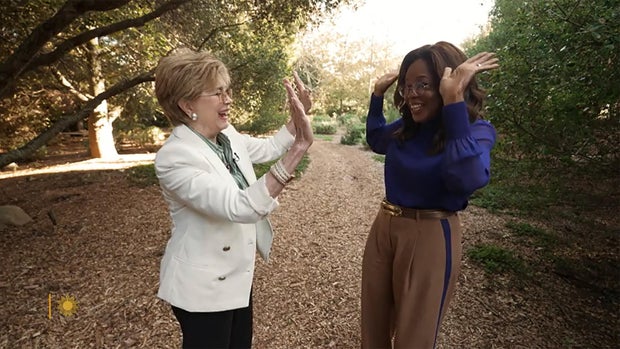
For more info:
- “Enough: Your Health, Your Weight, and What It’s Like To Be Free” by Ania M. Jastreboff, M.D., Ph.D., and Oprah Winfrey (Avid Reader Press), in Hardcover, eBook and Audio formats, available January 13 via Amazon, Barnes & Noble and Bookshop.org
- oprah.com
- Ania Jastreboff, M.D., Ph.D., Yale School of Medicine
Story produced by John D’Amelio. Editor: Remington Korper.
https://www.cbsnews.com/news/enough-oprah-winfrey-on-her-weight-loss-lessons/


