






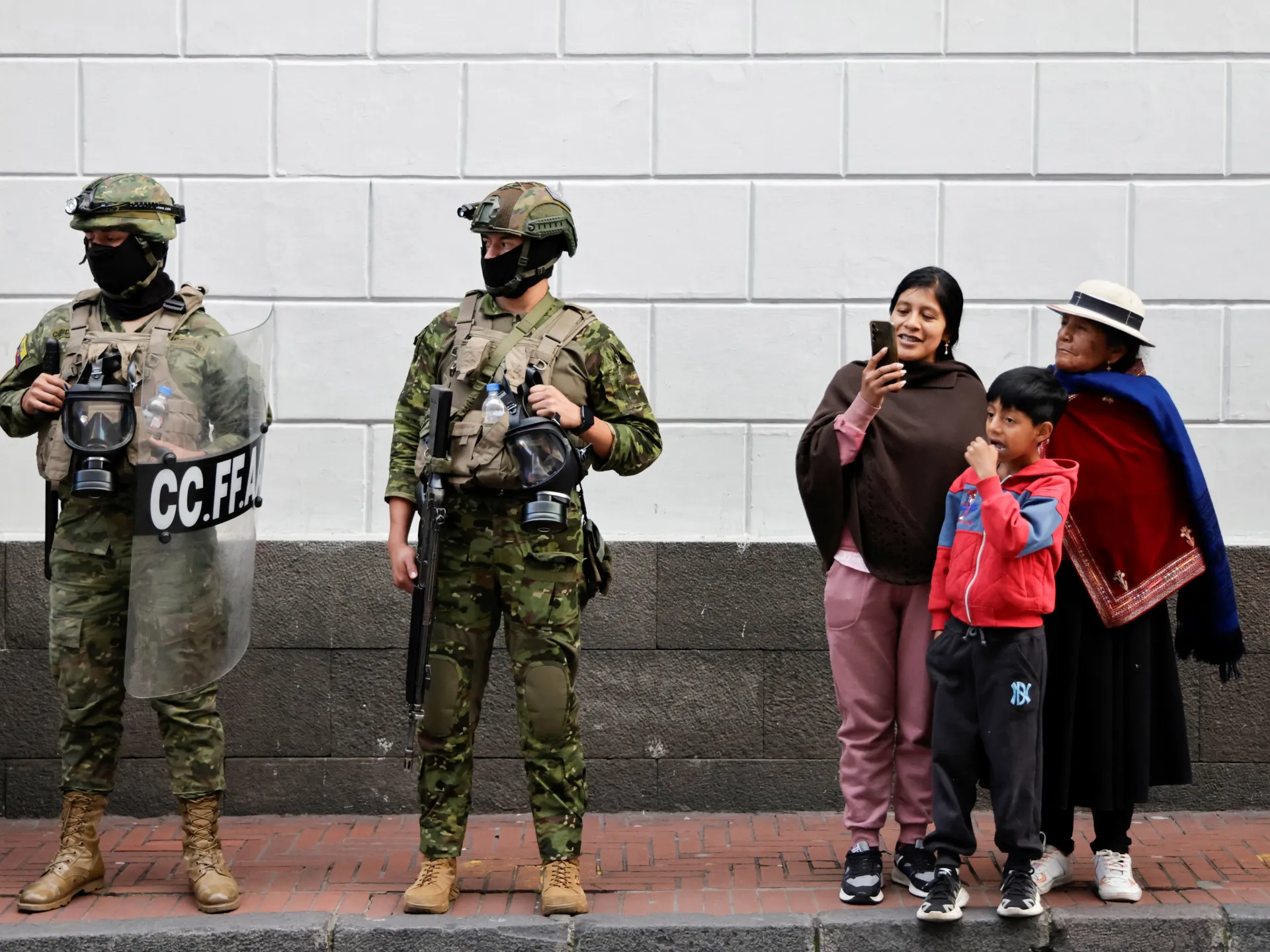
Ecuador has touted “concrete results” in its fight against organised crime, as the country joins forces with the United States to conduct an anti-cartel military offensive.
On Wednesday, the government of President Daniel Noboa announced that intentional homicides in March had decreased by 28 percent, compared to the same month last year.
Recommended Stories
list of 3 itemsend of list
Interior Minister John Reimberg added that 4,300 people had been arrested nationwide as part of the recent crime crackdown, and 2,200 search warrants had been executed.
In a social media post, Reimberg credited Noboa’s leadership and the work of the Security Bloc — a blended task force composed of national police and military members — for the arrests.
“President Daniel Noboa’s firm decisions to confront organized crime — combined with the sustained deployment of the Security Bloc, featuring effective territorial control and a genuine presence in the country’s most critical zones — are yielding clear and measurable results,” he wrote, pledging to continue the effort.
Defence Minister Gian Carlo Loffredo echoed Reimberg’s remarks, applauding the work so far.
“They are cornered — let that be clear — and this is just the beginning,” he wrote in his own post on Wednesday.
But the crackdown has already spurred questions about potential human rights abuses, as Ecuador, the US and other countries embark on a more aggressive campaign against cartels throughout Latin America.
Close ties with US
President Noboa had run for re-election last year on the pledge that he would combat violent crime in the country, which surged after the start of the COVID-19 pandemic.
Since then, Ecuador has seen an influx of criminal networks seeking to capitalise on its weakened economy and strategic position on the Pacific Ocean, between major cocaine producers like Colombia and Peru.
The country’s reputation as an “island of peace” in South America has largely been overshadowed by the spiralling homicide rate, which is now among the highest in the region.
But Noboa has struggled to bring that rate down. Last year, as he embarked on his first full term as president, the country saw a more than 30-percent leap in homicides, with 9,216 cases recorded in 2025, compared to 7,063 in 2024.
Previously, Noboa had served an abbreviated 18-month term after he was elected to replace outgoing President Guillermo Lasso, who dissolved his own government in 2023. Only 35 years old at the time, Noboa was the youngest elected president in Ecuadorian history.
A rising star on the political right, he has largely embraced the “mano dura” or “iron fist” security policies of other regional leaders, including El Salvador’s Nayib Bukele and the US’s Donald Trump, who is a close ally.
Noboa recently joined Bukele and other right-wing Latin American leaders at a security summit Trump hosted in early March at his Mar-a-Lago resort in Florida in the US.
And like Trump, he has compared Ecuador’s struggles with criminal violence to a war in order to justify a military-style response.
Declaring ‘war’ on cartels
In an interview on Wednesday with the newspaper El Mercurio in the city of Cuenca, Noboa reprised that theme as he discussed a recent bombing campaign along Ecuador’s borders.
“It’s a war, a total conflict in which we’re fighting against mafias that move tens of billions of dollars through illegal mining,” he told reporters.
On March 3, Noboa and Trump launched a joint military operation in Ecuador to confront what the US described as “designated terrorist organisations”. The US has largely provided intelligence and logistics to support the campaign, which has been carried out on the ground by Ecuadorian forces.
Then, starting on March 15, Noboa imposed a two-week-long curfew on four Ecuadorian provinces — El Oro, Guayas, Santo Domingo de los Tsachilas and Los Rios — as his government led an offensive against the “criminal economy”.
In Wednesday’s statements, Ecuadorian officials warned that they would continue to use “all necessary measures”, including curfews, to stamp out crime.
But reports have emerged that the hardline campaign may have threatened civilian safety.
On March 17, for example, Colombia’s President Gustavo Petro alleged on social media that bombs had landed near civilian farms along the Ecuador-Colombia border. He also noted that unidentified bodies had been recovered.
“There are 27 charred bodies, and the explanation provided is not credible,” Petro wrote. “Bombs lie on the ground in close proximity to families — many of whom have peacefully chosen to replace their coca leaf crops with legal crops.”
Then, on March 24, The New York Times issued a report alleging that Ecuadorian soldiers had set fire to and then bombed a dairy farm near the border, according to local workers.
Those allegations have prompted domestic scrutiny of Noboa’s campaign. Jahiren Noriega Donoso, a lawmaker in Ecuador’s National Assembly, questioned last week whether the attacks were really accomplishing Noboa’s objectives.
“Unequivocally, the war that Daniel Noboa has launched is not a war against crime,” she wrote on social media. “It is a war against the poorest among us.”
https://www.aljazeera.com/news/2026/4/1/ecuador-claims-28-drop-in-homicides-amid-concerns-over-anti-crime-campaign?traffic_source=rss


