








QUALITY OVER QUANTITY
Officials have defined “good housing” as one that is safe, comfortable, green and smart, with higher baseline standards covering features such as ceiling height, ventilation, natural light, sound insulation and indoor air quality.
While the term first emerged in August 2022, it only gained policy prominence last year when it was written into the government work report at the Two Sessions political gatherings in March.
It was subsequently referenced at a key party conclave in late October, when Communist Party leaders outlined priorities of the 15th Five-Year Plan (2026 to 2030), and again during the agenda-setting Central Economic Work Conference last December.
In official language, the emphasis signals a move away from volume-driven construction towards standards centred on build quality, liveability and durability.
The policy push comes as evidence points to widespread quality problems across new homes.
A nationwide review by Zhijian Cloud, a construction quality data platform, based on third-party inspections of more than 100,000 newly completed homes found that nearly two-thirds of units delivered in 2025 were rated “poor quality”, roughly six times the share in 2022.
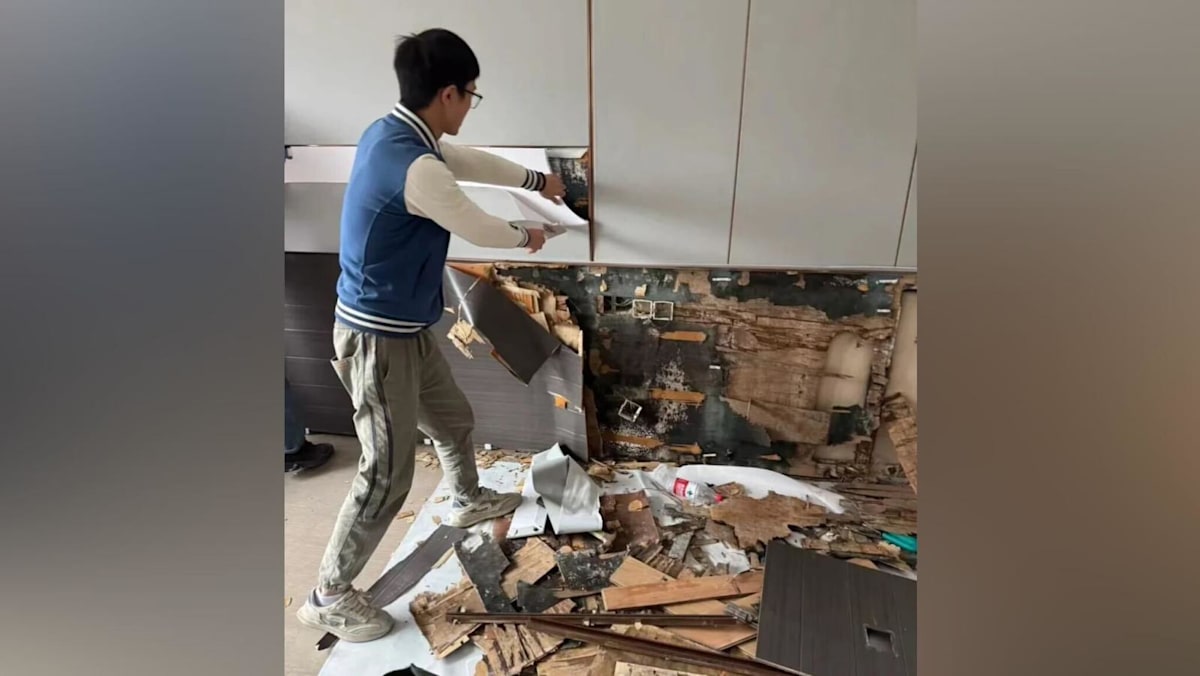
Assessments of the subpar units typically cited problems such as wall cracking and hollowing, water leakage, poorly installed doors and windows, flooring defects and failures in concealed systems such as wiring and drainage.
Such issues were evident in Liu’s case. More than three months after the contractually agreed delivery date, his apartment has yet to be formally handed over.
According to him, the developer, a subsidiary of a large state-owned property group, has changed the access password, leaving Liu locked out even as construction workers continue repairs. Meanwhile, he is servicing a monthly mortgage of nearly 20,000 yuan on a home he cannot live in.
Chen Bin, chief executive of home inspection firm Originality of Home Inspection, which operates in cities including Beijing, Shenzhen and Hangzhou, said defects in waterproofing and concealed systems are widespread in many newer projects, often linked to cost pressures, layered subcontracting and rushed finishing.
During an inspection observed by CNA in early January, a home inspector at Chen’s firm said hollowing in walls and floors was among the most common defects, alongside loose door frames, unstable cabinets and poorly secured fittings.
“Almost every home has some problems like these,” he said, adding that such defects are difficult to avoid in large-scale developments.
Earlier that day, he inspected an apartment measuring more than 100 sq m and flagged over 100 separate issues, ranging from hollow tiles to missing fittings.
“We’ve found apartments where sockets were cut open but never installed, with exposed wiring, and even lights coming loose.”
https://www.channelnewsasia.com/east-asia/china-good-housing-property-sector-policy-push-5836421


