






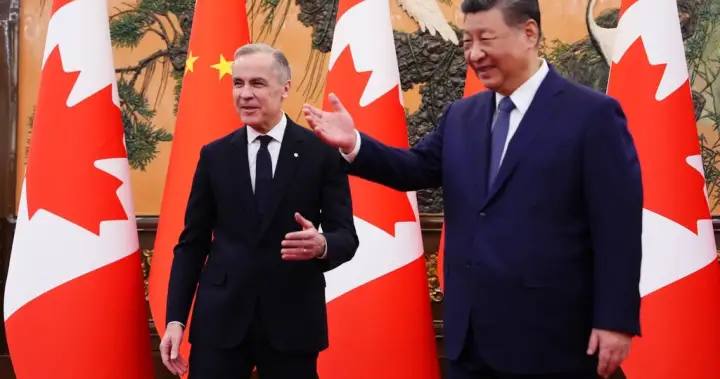
When the new members of Prime Minister Mark Carney’s council on Canada-U.S. trade convenes next week, Canada-China economic relations — and the agreement Canada made to give Chinese electric vehicle makers a toehold in the Canadian market — will likely be hard to avoid, auto sector voices say.


“I have always said that the China deal would be an issue during the trade negotiations with the U.S. and I do believe it will need to be discussed,” said Lana Payne, national president of Unifor, the union that represents thousands of Canadian auto workers, and who was among those named Tuesday to the government’s Advisory Council on Canada-U.S. Economic Relations. “[There’s] no way around it. We have to be prepared for this at the negotiating side.”
Canada’s automakers feel the same way.
“If [the Canada-China EV deal] is not on the agenda the US will put it there.”
That Canada-China EV agreement, which Carney signed on to during a January visit to Beijing, has ruffled feathers in Washington and, according to several witnesses who testified Monday at a House of Commons committee, threatens to drive a wedge between Canada and the United States.


Get daily National news
Get daily Canada news delivered to your inbox so you’ll never miss the day’s top stories.
Kingston was one of those committee witnesses and testified that Canada’s China deal came up time and time again as he met with American industry representatives during a visit to DC last week.
“Every conversation starts and ends with China and a question to me as to why Canada has taken the actions that it did,” Kingston told the House of Commons Standing Committee on Science and Research Monday. “So it is a significant risk and it’s an unforced error at a very sensitive time.”
Kingston is not on Carney’s newly appointed advisory committee but Flavio Volper, CEO of the Canadian Automotive Parts Manufacturers Association, is, like Payne, among those appointed.
“While Canada’s relationship with China is one of several important lenses in trade discussions with the US, the one that matters most is the integrated relationship Canadians have with their American counterparts,” Volpe said Tuesday.
“We all share concerns about China, and both countries are similarly engaged with them.”
Even with the current Canada-U.S. trade war over automobiles, 90 per cent of Canadian vehicle production is still sent to the U.S. market.
Kingston, whose organization represents what used to be known as the “Detroit Three” — Ford, GM and Stellantis — told the committee Monday that Canada’s decision to allow Chinese automakers to sell up to 49,000 electric vehicles domestically is a “vehicle-sized irritant,” just as the two sides are trying to find a way to renew the Canada-United States-Mexico Agreement (CUSMA).
“There is simply too much at stake for the auto industry and the broader Canadian economy if we are perceived by Washington as being out of step and misaligned on how to deal with China,” Kingston said.
David Adams, president of Global Automakers of Canada, which represents the likes of Toyota, Honda and others, was of the same view.
“We shouldn’t be throwing the baby out with the bath water,” Adams testified at Monday’s committee hearing. “Our focus and attention must remain on the U.S.”
The government’s new Advisory Committee on Canada-U.S. Economic Relations will be chaired by Carney’s minister for Canada-U.S. trade, Dominic LeBlanc.
It replaces and enlarges a similar advisory council that former prime minister Justin Trudeau had convened and that last met, with Carney in the chair’s seat, in September, before Canada and China had come to terms on Chinese electric vehicles.
Charles Burton, a former Canadian diplomat in China and a senior fellow with Czech-based think tank Sinopsis, told the committee that Chinese EVs represent an unacceptable security risk, calling them “spy machines on wheels” that could harvest data on drivers, on Canadian infrastructure, even on the licence plates of nearby drivers — and transmit all that to Chinese state security agencies.
“I just despair about this,” Burton said.
“China is an integrated regime where business is expected to respond to the Chinese Communist Party. This is a mistake from the security point of view and could have very serious consequences for Canada’s security in years ahead.“
The Carney government struck the Canada-China EV deal in part so that China would drop tariffs on Canadian canola but also in part as a response to the Trump administration’s decision to stop supporting development of electric vehicles, vehicles which governments in most parts of the world, including Canada, see as the future of the car industry.
Indeed, Guy Saint-Jacques, a former Canadian ambassador to China, testified at the same committee last Thursday, that China is too significant a player in the electric vehicle market to ignore.
He said that the deal Carney struck in Beijing in January opens up the possibility of Chinese manufacturers setting up shop in Canada, partly compensating for any job losses as U.S. manufacturers — like those Kingston’s association represents — move production out of Canada to the United States.
Saint-Jacques said Canada could require Chinese firms to ensure vehicles it might make in Canada reach 100 per cent Canadian content.
“We should welcome Chinese car manufacturers, but set the rules,” Saint-Jacques said.
© 2026 Global News, a division of Corus Entertainment Inc.
Carney’s new advisers may turn to issue of Chinese ‘spy machines on wheels’


