






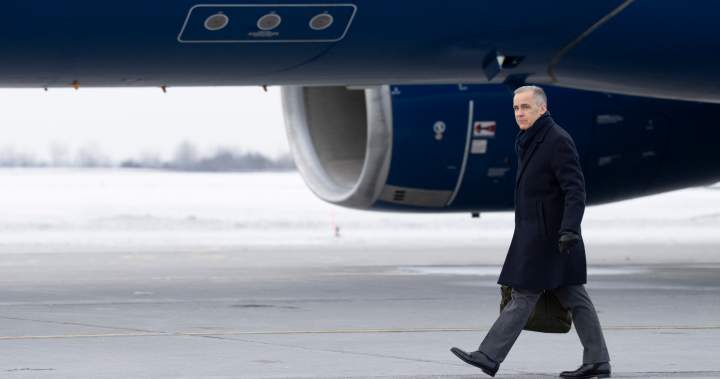
Prime Minister Mark Carney will be in Paris Monday for a meeting with Ukraine’s allies in a bid to end Russia’s war on the country.


The meeting of the “coalition of the willing,” made up of nations like Canada, France and other European countries, seeks to accelerate a negotiated peace plan for Ukraine nearly four years after Russia’s invasion.
In a media statement issued Friday, Carney said his focus remains on fortifying Ukraine and deterring future Russian aggression as Ukraine seeks security guarantees from the United States and other nations.
Carney’s office says Canada is working with coalition allies to boost Ukraine’s defence capabilities and support the nation’s long-term recovery, and seeks the return of Ukrainian children “unlawfully deported” during the war with Russia.
Canada, which has been among the largest contributors per capita to Ukraine’s recovery, announced $2.5 billion in financing and loan guarantees when Carney met Ukrainian President Volodymyr Zelenskyy in Halifax at the end of last month.


Get breaking National news
For news impacting Canada and around the world, sign up for breaking news alerts delivered directly to you when they happen.
U.S. President Donald Trump, who hosted Zelenskyy a day later at his Mar-a-Lago resort, insisted that Ukraine and Russia were “closer than ever before” to a peace settlement, though he acknowledged that outstanding obstacles could prevent a deal.
Benjamin Zyla, a professor with the University of Ottawa’s international development and global studies department, said the peace plan currently on the table leaves key issues for Ukraine to ponder, including territorial integrity.
“That is for the Ukrainians to decide and the Canadian government has made this clear that it’s only for Ukrainians to decide,” Zyla said.
“The second major issue is the question of protecting the Ukrainian territory should Ukraine and Russia reach a peace agreement in the near future.”
He said an international peace force is vital to any agreement to protect Ukraine against further actions from Russia, but it wouldn’t be like peacekeeping missions of the past. Instead, Zyla said the force would need to operate more like an “enforcement mission” that upholds any signed agreement between the two countries.
The meeting comes days after the U.S. extracted Venezuelan President Nicolás Maduro and his wife from the country in a military operation that saw multiple explosions ring out as low-flying aircraft swept through the nation’s capital.
Zyla said talk of what happened in Venezuela will likely be a topic leaders discuss, including if that invasion will have any impact on reaching an agreement between Russia and Ukraine.
“It’s too early to tell what such an impact might be, even though most experts consider it a blatant breach of international law,” Zyla said.
Carney reacted on Saturday afternoon to Maduro’s ouster by noting that one of the first actions taken by his new government in March was to impose additional sanctions on his “brutally oppressive and criminal regime.”
In a statement posted to social media, Carney noted that Canada has not recognized “the illegitimate regime of Maduro since it stole the 2018 election.”
“The Canadian government therefore welcomes the opportunity for freedom, democracy, peace, and prosperity for the Venezuelan people,” Carney wrote.
But he also wrote that Canada has “long supported a peaceful, negotiated, and Venezuelan-led transition process that respects the democratic will of the Venezuelan people,” adding that Canada calls on all parties to respect international law.
“We stand by the Venezuelan people’s sovereign right to decide and build their own future in a peaceful and democratic society,” Carney’s statement said.
© 2026 The Canadian Press


