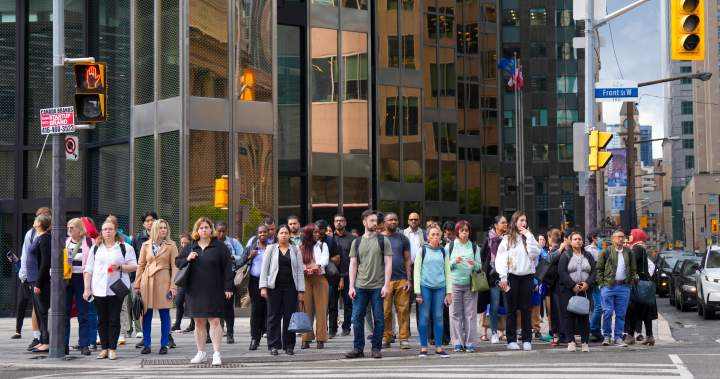
The year 2026 marks another census year in Canada, which means all Canadian households will be required to fill out the questionnaire that helps inform policy decisions across the country — and more than 30,000 jobs will be available to help make that happen.


The Census of Population will take place in May, and helps to ensure an accurate snapshot of Canada’s population.
An updated census will help government bodies and businesses alike better understand who Canadians are and how they build their lives, and what kinds of government services could be needed to meet the demographics of each region of the country.
What is the Census of Population?
The census takes place in Canada every five years, and is conducted for the federal government by Statistics Canada.
Once the census is complete, the agency says the result is a “comprehensive statistical portrait of Canada that is vital to our country.”


Get breaking National news
For news impacting Canada and around the world, sign up for breaking news alerts delivered directly to you when they happen.
Information gathered from the census is important to gain insight into not only the Canadian population as it is now, but also how it’s changed and where it could be heading.
For example, Statistics Canada says census data can help Canadians start a business by better understanding its customer base, assist governments in creating new programs for communities, and allow municipalities and provinces alike to create better transportation that serves the population’s needs and provide the best options for school locations.
It can also help better inform governments about specific social and demographic data for population groups. This can be beneficial for lone-parent families, Indigenous Peoples, immigrants and seniors.
Census data is also used to set electoral riding boundaries.
Seventy-five per cent of Canadians will receive the basic, or short-form, census, with questions that include their date of birth and age, sex at birth and gender, relationships of household members, knowledge of official languages in addition to other languages spoken, and Canadian military experience.
The remaining 25 per cent, chosen at random, will be required to fill out the long-form census.
This will have the same questions as the short-form, but with more categories, including questions on education, employment and labour market, specific housing details, income, ethnicity and cultural background, and mobility and daily activities.
Working with Statistics Canada
In a press release, Statistics Canada says it needs to staff approximately 32,000 positions across Canada specific to the 2026 census in both supervisory and non-supervisory roles from March to July.
Some of the roles and responsibilities may include those of enumerators going door to door to collect census information, although most Canadians will be able to participate online.
Crew leaders will be tasked with supervising and assisting a team of enumerators and are responsible for the collection of census questionnaires in assigned areas.
Wages will be $25.87 per hour for enumerators and $31.32 for crew leaders, plus authorized expenses, the agency says.
To qualify, applicants are required to be the age of majority, or a legal adult, in their current province or territory of residence. They must also reside in Canada with a Canadian home address, and must be a Canadian citizen or permanent resident or possess a valid work permit.
Those who qualify can submit an application at the official census jobs website.
Canada’s unemployment rate fell for the second straight month in November 2025, according to the latest numbers released by the federal government at the start of December.
Cost of living has remained a persistent challenge for many Canadians, however, with Deloitte announcing on Wednesday that it has downgraded predictions for growth in the Canadian economy in 2026 amid the trade war and tariffs.
© 2026 Global News, a division of Corus Entertainment Inc.
Canada’s 2026 census starts this spring — and 32K jobs are up for grabs