






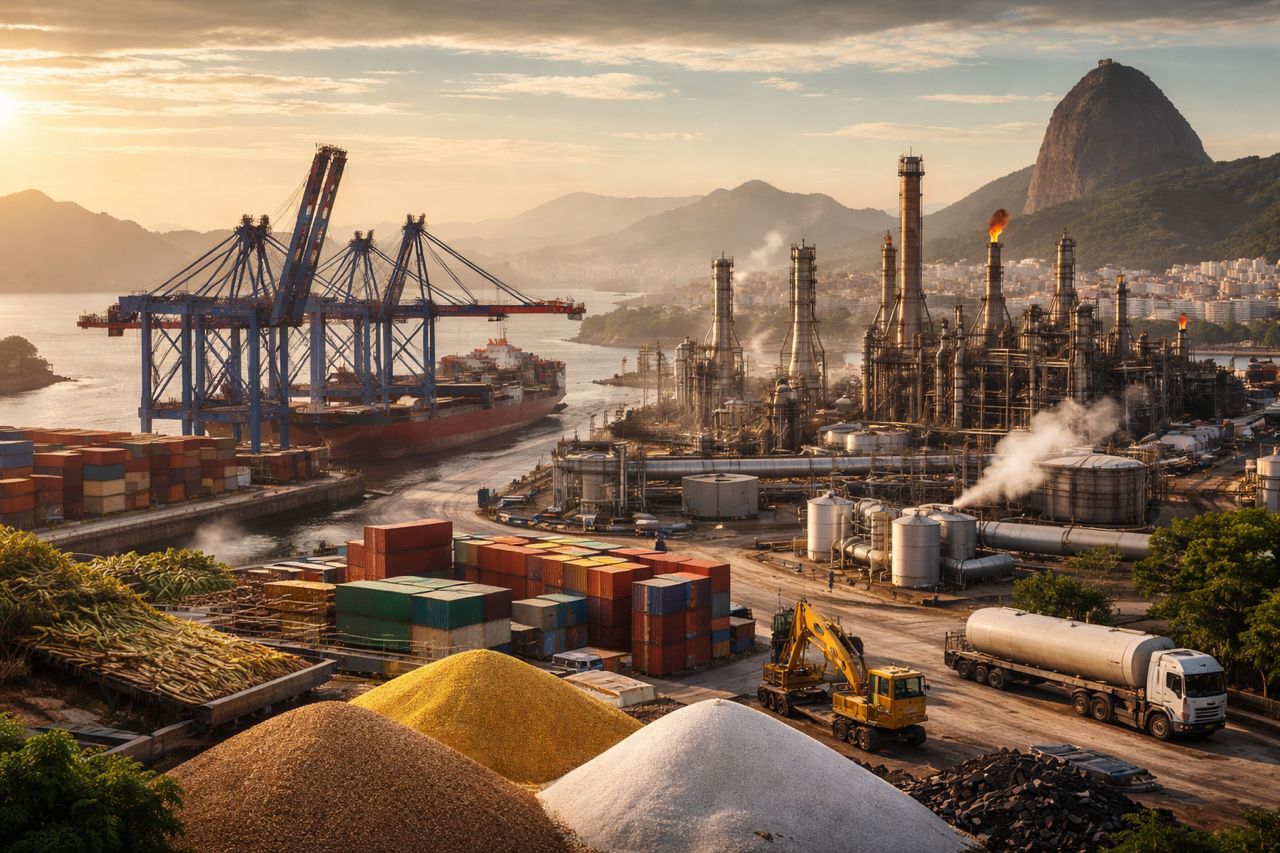
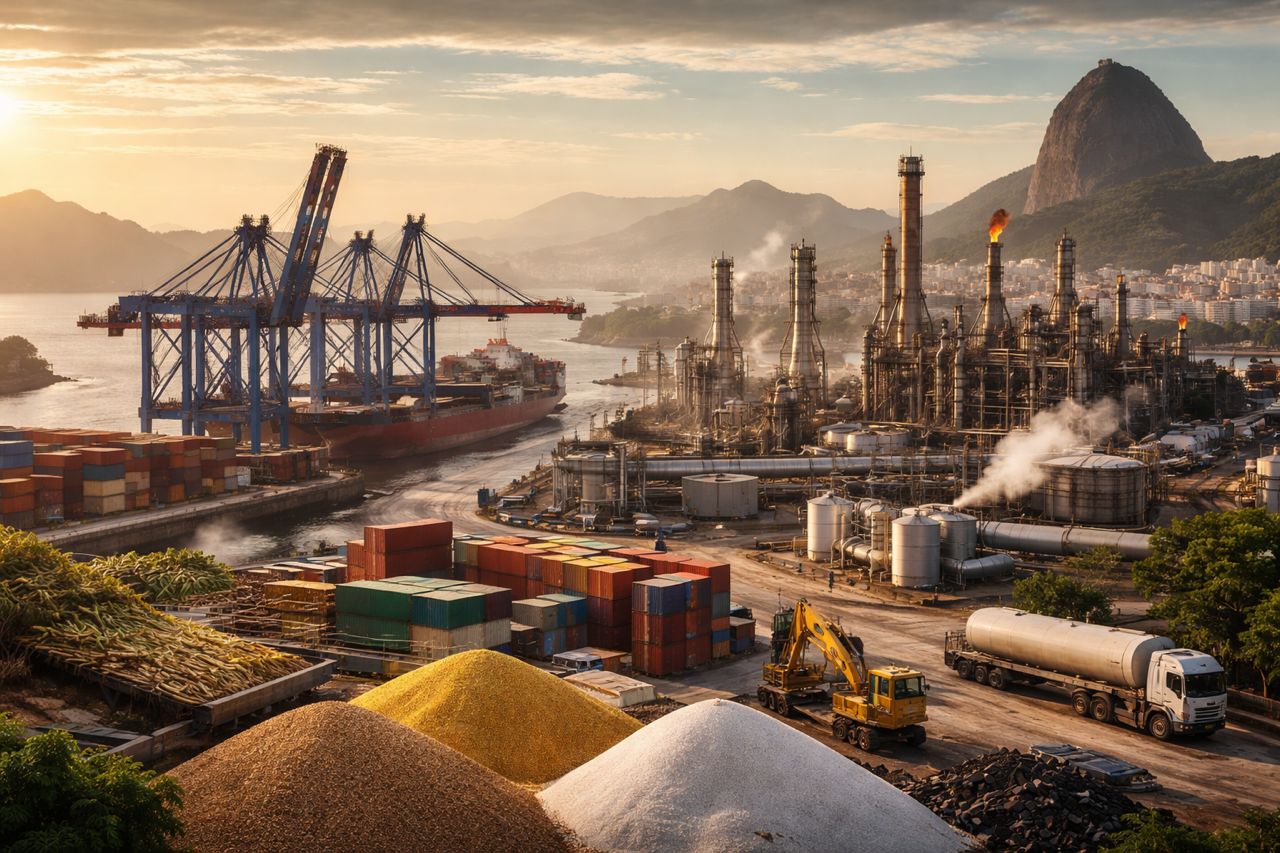

Brazil’s industrial producer prices declined in February 2026, reflecting ongoing weakness across key sectors and extending a broader deflationary trend at the factory gate.
The Producer Price Index (PPI) for manufacturing and extractive industries fell 0.25% month over month in February, according to data from Brazil’s Institute of Geography and Statistics.
Thirteen out of twenty-four industrial activities reported lower prices than in January, pointing to a broad-based decline.
On a 12-month basis, the index dropped 4.47%, slightly deeper than January’s 4.35% decline, indicating that producer prices remain in contraction.
However, aside from a marginal 0.07% uptick, prices have been relatively stable so far this year.
The PPI measures prices at the factory gate, excluding taxes and freight, making it a key indicator of cost pressures within the production chain before goods reach consumers.
Why industrial prices are falling
Key sectors, including food, petroleum refining, and chemicals, were the main contributors to February’s decline, exerting significant downward pressure on the index.
The food industry was the largest drag, subtracting 0.21 percentage points from the overall 0.25% decline.
Prices in the sector fell 0.87% in February, marking the tenth consecutive monthly drop.
Similarly, prices for petroleum refining and biofuels fell 0.50% in February, contributing to a 10.22% annual decline.
Other chemical products also saw prices fall 0.26% during the month and are down 8.29% year over year.
These declines reflect a combination of easing input costs, global price trends, and sector-specific adjustments.
In particular, chemical prices have moderated following the cooling of earlier cost shocks, especially in fertiliser inputs.
Sectors showing resilience
Despite the broader weakness, some sectors posted notable price gains, partially offsetting the decline.
Machinery and electrical equipment recorded a 1.73% increase in February, while perfumes, soaps, and cleaning products rose 1.44%.
Metallurgy advanced 1.41%, and clothing prices increased by 1.32%.
Metallurgy made a meaningful contribution to the monthly index, adding 0.10 percentage points.
Non-ferrous metals, particularly gold, saw price increases driven by stronger global demand. Meanwhile, higher input costs, including copper, supported continued gains in machinery and electrical equipment, which recorded its sixth consecutive monthly increase.
Breakdown across economic categories
A breakdown of the PPI by major economic categories shows that declines were concentrated in capital and intermediate goods.
Capital goods prices fell 1.29% in February, while intermediate goods declined 0.25% and consumer goods edged down 0.03%.
Intermediate goods, which carry the largest weight in the index at 53.77%, had the greatest impact, contributing 0.13 percentage points to the overall decline.
On a 12-month basis, intermediate goods also drove most of the deflation, falling 6.73%, compared with declines of 1.08% for capital goods and 1.83% for consumer goods.
Within consumer goods, performance diverged.
Durable goods prices rose 1.57%, while semi-durable and non-durable goods declined 2.48%, highlighting uneven demand conditions across segments.
Trends across key industries
Several industries illustrate the broader dynamics shaping Brazil’s industrial price trends.
Extractive industries declined 0.61% in February but remain slightly positive on a year-to-date basis, up 0.78%. Over 12 months, however, prices are down 9.35%, reflecting alignment with global commodity markets. Crude oil provided some support, helping to limit deeper declines.
Food production continues to experience sustained price declines, although some items, such as milk and beef, recorded increases due to higher costs and demand. In contrast, sugar prices fell in line with global market trends and discounting strategies.
Petroleum refining and biofuels remain under significant pressure, with annual declines exceeding 10%, making them among the most deflationary sectors.
The motor vehicles sector, a major industrial segment, saw prices fall 0.68% in February, reversing earlier gains and pointing to moderating momentum.
What the annual trend shows
The broader trend highlights persistent deflation across Brazil’s industrial sector.
The 4.47% annual decline in producer prices has been largely driven by a handful of sectors.
Food accounted for a 2.53 percentage point drag on the index, followed by petroleum refining and biofuels at 1.05 percentage points, other chemical products at 0.68 percentage points, and extractive industries at 0.43 percentage points.
Together, these sectors explain the bulk of the downward pressure.
At the same time, some industries have recorded strong annual gains. Printing, for example, rose 19.34%, underscoring the divergence across sectors.
Why it matters
Producer prices are a leading indicator of inflation, reflecting cost pressures before goods reach consumers.
The continued decline in Brazil’s PPI suggests that upstream inflationary pressures remain subdued, which could help moderate broader price trends in the economy.
However, the uneven performance across sectors—particularly the resilience in machinery and metals—points to ongoing volatility driven by input costs and global commodity dynamics.
Overall, Brazil’s industrial sector remains under deflationary pressure, led by food and energy-related industries, even as pockets of strength tied to global demand continue to emerge.
https://invezz.com/news/2026/03/31/brazil-factory-gate-prices-fall-in-february-as-food-fuels-drive-deflation/


