






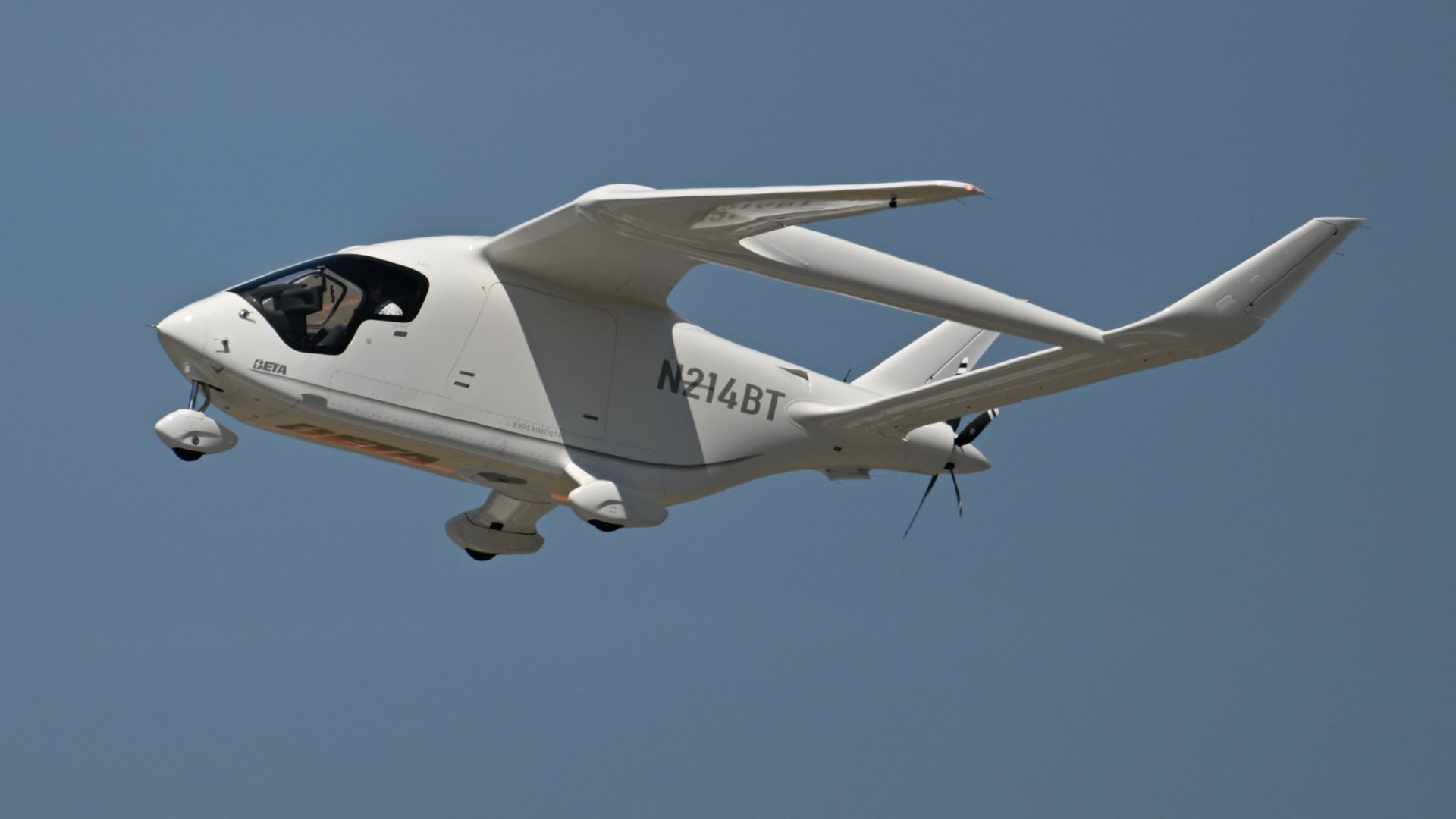
Fully electric battery powered ALIA CTOL, CX300 single engine airplane, manufactured by Beta Technologies, performs during the 55th edition of the International Paris Air Show (Salon international de l’aeronautique et de l’espace – SIAE) at the ParisLe Bourget Airport, in Le Bourget, north of Paris, France on June 18, 2025.
Mustafa Yalcin | Anadolu | Getty Images
Beta Technologies posted its first quarterly results on Thursday since the stock debuted on the New York Stock Exchange.
The electric aircraft maker, which went public last month, reported revenue of $8.9 million, more than double the $3.1 million from a year ago.
“As a newly public company, we remain firmly grounded in what makes BETA unique—our simple, stepwise approach, our vertical integration and our focus on designing and manufacturing the complete electric aviation ecosystem to meet the needs of customers around the world,” CEO Kyle Clark said in a statement.
Net loss widened to $452 million, a loss of $9.83 per share, from a loss of $82.1 million, a loss of $1.81 per share, in the year-ago period.
The company said the net loss took a hit from the issuance of convertible preferred stock.
Beta forecasted full-year revenue to reach between $29 million and $33 million and adjusted EBITDA to range between a loss of $295 million and a loss of $325 million.
The Amazon-backed company is establishing itself as another player alongside rivals Joby Aviation and Archer Aviation in the small but competitive electric vertical take-off and landing, or eVTOL, space.
Air taxi manufacturers are vying to gain approval from the Federal Aviation Administration, which launched the eVTOL Integration Pilot Program, or eIPP, in September.
Clark told CNBC that the program is a “massive testament” to the Trump administration’s efforts in accelerating the nascent industry.
Beta is applying to the program with state partners, including North Carolina, Michigan and Ohio, to host its commercial aircraft operations as soon as next June.
“We have flown more than twice as many miles than anybody else in this industry,” Clark said. “That real-world flying gives us the ability to go into these eIPP opportunities with a mature type of certification product with a ton of reliability.”
The company is currently working on military and cargo operations before focusing on passenger applications. During the quarter, aircraft engine supplier GE Aerospace agreed to invest $300 million in Beta and co-develop a hybrid electric turbogenerator for both defense and civil use.
“The eIPP program is meant to augment America’s drone dominance and that is a military interest as well as a civil interest,” Clark said. “Partnership with dual-use aircraft like ours, with the military and civil applications, is a big part of this.”
The company also worked with Hartzell Propeller to land certification during the quarter, becoming the first FAA-certified propeller specifically designed for advanced air mobility aircraft.
The achievement marks another step closer to obtaining Type Certification, or approval of aircraft design, for Beta’s H500A electric engine.
“To take something as big and new as a primary propulsion electric motor that other people are buying, that we’re using in our own aircraft — we’re flying all over the world in — and be in the final steps to Type Certification is a huge validation point,” Clark said.
Beta announced earlier this week an up to supply deal with air taxi company Eve Air Mobility.
Eve agreed to purchase Beta’s electric pusher motors, which could potentially equate to as much as $1 billion over 10 years. Clark said during an earnings call that the deal contributed to a component backlog of over $1 billion.
https://www.cnbc.com/2025/12/04/beta-technologies-q3-ipo-revenue.html


