Welcome to FT Asset Management, our weekly newsletter on the movers and shakers behind a multitrillion-dollar global industry. This article is an on-site version of the newsletter. Subscribers can sign up here to get it delivered every Monday. Explore all of our newsletters here.
Does the format, content and tone work for you? Let me know: [email protected]
In today’s newsletter
-
Greg Abel’s debut Berkshire letter commits group to dealmaking
-
Victory Capital sparks bidding war for Janus Henderson
-
Investors seek shelter from AI rout in asset-heavy stocks
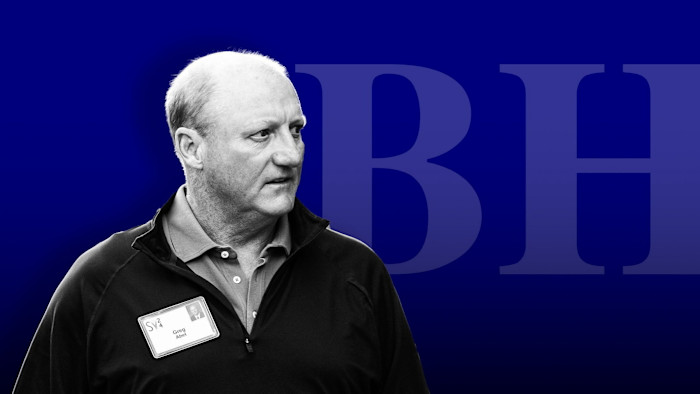
Greg Abel’s debut Berkshire letter commits group to dealmaking
Greg Abel on Saturday used his first Berkshire Hathaway investor letter since taking over in January as chief executive to underscore his investment bona fides, committing to the principles that his predecessor Warren Buffett had long extolled.
Defending the conglomerate’s robust balance sheet, which held $373bn of cash at year-end, Abel cast himself as the protector of Buffett’s long legacy of always seeking value in dealmaking.
“Our balance sheet is a strategic asset to be deployed at the right time,” he wrote. “It allows us to act decisively, invest when others are tentative or fearful, and stand firm when financial storms roll through.”
He told shareholders that Berkshire has been active in evaluating new investments and that it would remain a key port of call when companies wanted to sell. The Nebraska-based conglomerate would be “an asset, not a risk, to America and the global financial system”, he also wrote.
He pointed to Berkshire’s $9.7bn purchase of the chemicals business of Occidental Petroleum, which it completed earlier this year, as well as its agreement to buy pest control business Bell Laboratories.
Investors and analysts traditionally scour Berkshire’s annual letter, which in the past were filled with Buffett’s personal anecdotes, for insights into how the so-called Oracle of Omaha saw the world.
Abel has already begun to reshape Berkshire’s corporate headquarters. The company last year hired its first internal legal counsel and announced a top executive from Berkshire’s energy business, the unit Abel rose up through, would become its next chief financial officer later this year.
One of Buffett’s investment deputies, Todd Combs, departed for JPMorgan Chase as part of the reshuffle.
The letter accompanied fourth-quarter results that showed Berkshire’s operating earnings had weakened, falling 30 per cent from the year prior to $10.2bn, as profits slumped within its insurance division.
Victory Capital sparks bidding war for Janus Henderson
Victory Capital has gatecrashed an earlier deal agreed with Nelson Peltz’s Trian Fund Management and General Catalyst to buy asset manager Janus Henderson.
On Thursday, Victory announced that it had bid $57.04 a share for Janus in a transaction that would value the British-American group at $8.6bn. The competing offer comes just weeks after a Trian and a group of investors, led by venture capital group General Catalyst, had agreed to buy the business for $49 a share, valuing it at $7.4bn.
Activist investor Peltz was previously Janus’s biggest shareholder with a 20 per cent stake.
Victory’s surprise move adds impetus to the wave of consolidation in the global asset management sector. Earlier this month, US fund group Nuveen struck a deal to acquire London-based Schroders for £9.9bn.
The proposed deal would give Janus’s shareholders $30 in cash per share, with the remainder paid in Victory Capital stock. The Texas-based asset manager said its plan represents a 16 per cent premium to Trian’s bid. The combined entity would have a total enterprise value of about $16bn and Janus shareholders would own about 38 per cent of the new group.
Victory Capital has dramatically bulked up over the past decade through a series of acquisitions. In 2024, it combined with French asset manager Amundi’s US offshoot, increasing its assets under management by roughly $100bn.
Victory now has $320bn in assets under management. Janus manages about $484bn, meaning a combination would more than double Victory’s size.
Victory Capital has been pursuing a deal with Janus in advance of the investment firm reaching a deal with the Trian-led investor group. It made a $52-a-share cash and stock offer in December. Janus rebuffed the approach because of the strength of the existing deal and certainty of closure, according to people familiar with the matter.
Under the terms of the merger agreement with the Trian-led group, Janus can terminate the deal before June this year if it reaches a superior agreement with another party.
Investors shelter from AI rout in asset-heavy stocks
With bearish sentiment weighing heavily on AI-related stocks in the US, investors have found shelter in “old economy”, asset-heavy companies.
Sectors such as utilities, energy and materials have emerged as winners from the AI anxiety gripping Wall Street, as investors flee sectors seen as vulnerable to disruption. Instead they seek businesses with tangible assets.
The S&P 500 software sub-index last week tumbled to its lowest level since the immediate aftermath of President Donald Trump’s “liberation day” tariff announcement last April, losing $1.2tn in combined market capitalisation in less than a month.
This group has borne the brunt of worries that new AI tools could upend entire industries, including wealth managers and insurers.
Meanwhile the S&P 500 utilities sub-index is up more than 10 per cent this year, while energy stocks have gained 22 per cent, as sectors with substantial physical assets find themselves suddenly back in vogue after years of underperformance relative to asset-light tech business.
“All these capital-light businesses that could scale historically are also the ones that could be easily disrupted,” said Guillaume Jaisson, European strategist at Goldman Sachs.
On the other hand, “capital-heavy businesses are difficult to replicate, it takes time”, Jaisson said.
Capital-light business models were particularly sought-after in the low interest rate environment that followed the global financial crisis, as investors focused on easily scalable business models at a time of easy borrowing conditions.
But a rise in interest rates since the pandemic has put pressure on these valuations at a time when investment has increased in capital-intensive sectors such as defence and infrastructure.
“The thing that has been working best for the last 15 years is now the most vulnerable,” said Gerry Fowler, head of derivatives strategy at UBS. “The avoidance of things at the moment centres around: is your business based on intangibles and intellectual property?”
The woes for the private credit industry continued last week. A large credit fund managed by KKR tumbled on Thursday after reporting a jump in troubled loans and lower investment income, highlighting the mounting strains in private markets.
Elliott Management has been locked in a months-long battle with Japan’s Toyota Motor. The US fund founded by Paul Singer is pressing the automotive group to increase its offer price to take its largest subsidiary private.
Vanguard has reached a separate settlement with Texas and other Republican-led states that accused the asset manager and its biggest competitors, BlackRock and State Street, of conspiring to suppress coal production in a key case about environmental, social and governance investing.
US investors are increasingly asking Asian fund managers to carve out special vehicles to enable the former to invest in the region without falling foul of American investment restrictions on Chinese technology.
Rathbones chief executive Jonathan Sorrell has set out a new strategy to stem outflows and become “the best wealth manager in the UK by far” by embracing AI and paying more for performance.
And finally


A wine and chocolate tasting? Le Cordon Bleu London invites you to think out of the box by attending a class pairing fine wines with chocolate. The two-hour course provides a selection of chocolates with red, white and sparkling wines under the guidance of their master sommelier and pâtisserie chef who will demystify this topic for you. You have nothing to lose, except your figure.
March 12 at 7pm
Thanks for reading. If you have friends or colleagues who might enjoy this newsletter, please forward it to them. Sign up here
We would love to hear your feedback and comments about this newsletter. Email me at [email protected]
Recommended newsletters for you
The Week Ahead — Start every week with a preview of what’s on the agenda. Sign up here
Working It — Everything you need to get ahead at work, in your inbox every Wednesday. Sign up here
https://www.ft.com/content/9c3cb6d1-ffed-45b2-81b6-66b8d493c310