








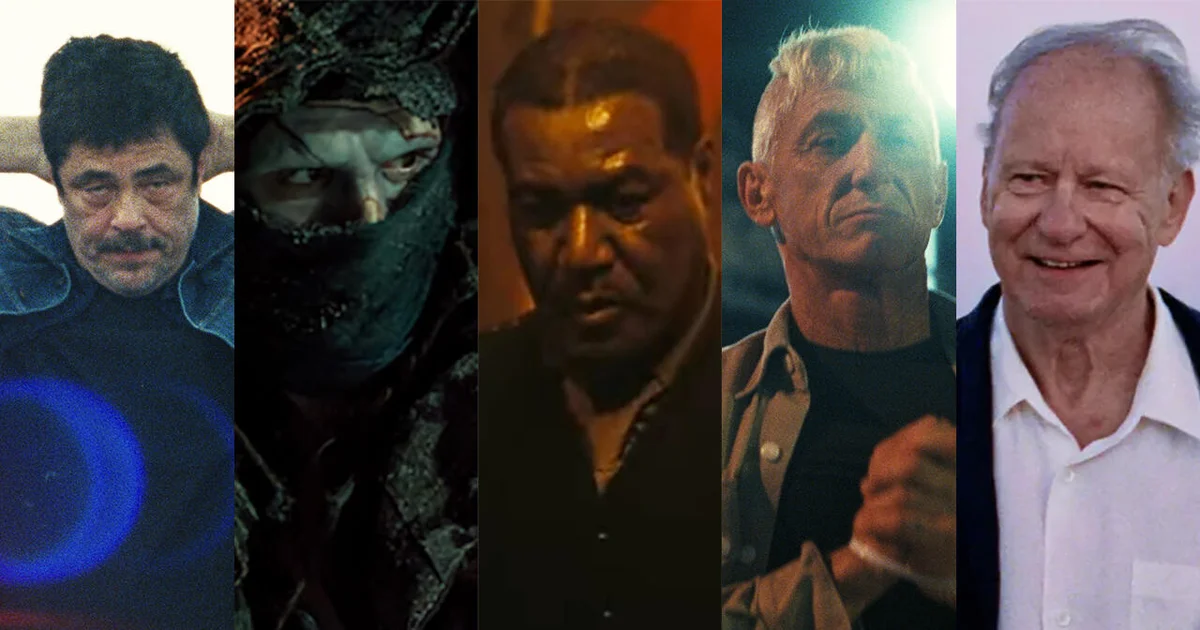
Watch scenes from the performances nominated for the Oscar for best supporting actor, as well as interviews with the nominees below. The 98th Academy Awards will be presented Sunday, March 15.
Warner Brothers; Netflix; Neon 

Benicio Del Toro, “One Battle After Another”
Benicio Del Toro, who an Academy Award for best supporting actor for “Traffic” (2000), and was nominated for “21 Grams” (2003), earned his third Oscar nomination for “One Battle After Another.”
In Paul Thomas Anderson’s darkly comic thriller, Del Toro plays Sergio St. Carlos, a martial arts sensei and overseer of an underground railroad for undocumented immigrants. His association with revolutionaries requires him to bring his strategic and focused attention to whatever situation washes up at his door, including Bob (best actor nominee Leonardo DiCaprio), a lapsed revolutionary figure who is on the run after military forces have attacked his cabin. Sergio tries to give the kind of help the desperate Bob doesn’t know he needs.

In a conversation recorded for the SAG-AFTRA Foundation, Del Toro said that when Anderson approached him about the role, he first sent a picture of a poster depicting a tiger dressed in a judo kimono. “I said, ‘Okay, send me the script when you can.’ And he sent me this picture. And I was like, Huh? And then I read the script and I kind of, like, understood. There’s like a strength in there. I thought it was cool. There’s a strength, and the kimono gives him some kind of, like, sense of honor.”
There were many changes to the script done on the fly, to suit the characters, or to take advantage of found locations. Del Toro, who had a short window in joining “One Battle” following filming of “The Phoenician Scheme,” said it was originally intended that Bob and Sergio would kill police officers, but it soon devolved into a discussion of where. Thinking ahead, Del Toro said doing so would mean having to clean up the mess.
“The drafts did change,” Del Toro said. “In the draft that we were about to shoot, there was, I believe, Bob killed one of the officers and then I killed the other one. It was pretty intense. I just said, ‘Well, if we’re gonna kill him in my dojo, we’re gonna have to clean it up. And then after that, Leo is on his own.’ All these conversations happened between Leo, Paul and myself, and little by little we started getting to what you see now. I can’t take the credit of that. Leo had great ideas in there, too, and so did Paul. But I think I was the one who instigated the thing about, Wow, we’re going to kill him in my place. And then, you know, there was talk about we’ll burn the place down. And then I go, ‘We got to get some good insurance here. I ain’t going to burn all those trophies, you know?’ But that’s how the dialogue came, and Paul was just very light on his feet to change.
“Every movie has ‘movie moments.’ And I think you can have a movie and have three movie moments, but if you have a movie that deals with killing and you have too many movie moments, we’re going to check out. It’s just logic, and working with people that are seeing the same story, the same idea of logic. We showed up, we were ready to kill people. You know, I was just practicing the choke and all that stuff on the floor and rolling around, and [Paul] showed up and said, ‘We’re not killing anyone.’ ‘Okay. Well, what do we do then?’ There’s a seriousness and a motivation and an understanding of the story. I was very clear of what the purpose of my character was: I’m to take Leo from point A to point B. That’s it. And so, I knew that. And then how do we do? How do we do it in the most convincing and realistic way? And it went in the direction that it did.”
- “One Battle After Another” is nominated for 13 Academy Awards, including best picture.
Jacob Elordi, “Frankenstein”
Guillermo del Toro’s lifelong fascination with Mary Shelley’s “Frankenstein” has afforded moviegoers with a gift they didn’t know they needed: a new interpretation of the often-filmed gothic novel about a crazed scientist who creates life from the remains of the dead. Not only is del Toro’s “Frankenstein” one of the most opulent renditions ever made; it is also one of the most emotional, in its telling of the respective stories of scientist Victor Frankenstein (Oscar Isaac), and the Creature he births (Oscar-nominee Jacob Elordi).
As the Creature befriends a blind man (David Bradley), who has shared his love of books, Elordi’s character explores his sense of self, and his sense of purpose, and seeks answers – in literature, and in his own fragmented memories.

Some of the most indelible performances of Frankenstein’s Creature, such as Boris Karloff’s, were pantomimic – a man struggling to communicate, whose physicality could be brutal but also childlike. Del Toro’s creature is capable of speech, empathy, and a desire to connect, but much of the time he struggles as he takes in the world around him.
Asked why he chose Elordi for the role, del Toro told “Sunday Morning,” “Eyes. I cast the eyes.”
In an extended conversation with “Sunday Morning,” Elordi (who had previously played Elvis Presley in Sofia Coppola’s “Priscilla,” and starred in “Saltburn” and the HBO series “Euphoria”) talked about the process of becoming the Creature, and his communication with the director:
“I remember, there became a point in filming where I would just stare at him, ’cause I was pretty non-verbal the whole time we were filming, and Guillermo and I, we would stay on set the whole time. So, if there was a lunch break or something, the pair of us would be on set, and I would just stare at him. And he looked back at me one time and he’s like, ‘I’ll let you know when you can break.’ And it actually, it was like a pat on the back. I knew that I was submitting myself to him and I could trust him, and he did. And it was when the film was over, you know, but it was a great thing to hear.”
Was he in the Creature’s mindset that whole time? “Well, for me, when I’m shooting a movie, this whole sort of idea of Method and the conversation around it, I think, is so skewed and butchered, because if you’re making a film, for me, the way that I create, your 24 hours of your day is about the film. Everything you do is about the film. You eat for the film, you sleep for the film, you talk about the film, you dream about the film, you take in media that has to do with the film or music or art. For me, filmmaking and acting is an all-consuming process. You know, you can’t, like, moonlight in the movie. You don’t turn it off, and nor would I want to, because you have six months to play with one of the greatest artists of the last century. Six months to play Frankenstein’s Creature. Six months to be around castles and fire and monsters and beauty and pain and all these things. I mean, that’s the world that I want to live in.”
His performance was enhanced by the Oscar-nominated makeup and prosthetics he wore. Asked how long it took to apply, Elordi said, “It would depend; when he was freshly minted and newborn, you know, head-to-toe sort of sculpture, it was 10 or 11 hours depending on how much we were moving or whatnot. And then when he’s in his coat and you can sort of just see this section of his body, it’s about 5 to 6 hours. Which was a treat. That was like, ‘Okay, thank God it’s a short day!'”
- “Frankenstein,” a Netflix release, is nominated for nine Academy Awards, including best picture.
Delroy Lindo, “Sinners”
With more than 75 film and TV credits to his name, including “Malcolm X,” “Crooklyn,” “Get Shorty,” “Heist,” “The Last Castle,” and “Da 5 Bloods,” and a Tony Award nomination for “Joe Turner’s Come and Gone,” Delroy Lindo has been a steady presence for more than five decades. He brings that gravitas to Ryan Coogler’s conflagration of genres, “Sinners,” in which a music-filled story of Black entrepreneurs in the Jim Crow South becomes swarmed with vampires.
Lindo plays Delta Slim, a blues musician recruited by twin brothers Smoke and Stack (best actor nominee Michael B. Jordan) to play in their new juke joint. Stack finds the musician to be a hard fish to reel in.

“Sinners” represents Lindo’s first Oscar nomination.
He told “CBS Mornings” that development of the character of Delta Slim started with Coogler sending him two books: “Deep Blues” by Robert Palmer, and “Blues People” by LeRoi Jones (a.k.a. Amiri Baraka). “I read those two books, I then exposed myself to a lot of music specific to the Delta – Delta Blues musicians Howland Wolf, Sunhouse, Muddy Waters, Ike Turner,” he said. “I looked at a lot of documentary film that centered on people living in the region. So, I was just soaking up as much data, information as I could, and then filtering it through my own process to come up with Delta Slim.” He also got lessons to play the piano and harmonica.
The backstories of blues artists fueled Lindo’s delivery when Slim tells of the experience he and a fellow player had when they showed up in the wrong Southern town one day. In an early cut of “Sinners,” Coogler had deleted the chain-gang scene containing Slim’s three-page monologue; Lindo fought to reinsert it, and the director relented. “Not in its entirety, but enough was there that it kind of restored the overall spirit of what he had written originally,” Lindo said.

Lindo said that receiving his first Oscar nomination was a big deal. “Part of the reason that it’s a big deal is because of how people are responding in my behalf. It’s a big deal to a lot of people, therefore it enhances how I’m thinking about the whole experience,” he said.
- “Sinners,” is nominated for 16 Academy Awards, including best picture.
Sean Penn, “One Battle After Another”
A two-time best actor Oscar winner (for “Mystic River” and “Milk”), Sean Penn gave one of his most intense performances in “One Battle After Another,” playing a maniacal military officer, with a piercing gaze and a ridiculous haircut.
As the white supremacist Col. Steven J. Lockjaw, Penn is in pursuit of a Black revolutionary, Perfidia (best supporting actress Oscar nominee Teyana Taylor), but his pursuit of her becomes carnal, and ultimately vengeful when – years later – he searches for the young woman he believes may be his daughter.
Lockjaw detains Willa (Chase Infiniti) and administers a DNA test. It is to find out whether she is the product of Lockjaw’s assignation with her mother 16 years earlier – and her life rides on the result.

Penn had first met Paul Thomas Anderson when Anderson was directing his debut feature, “Hard Eight.” (Sean’s brother, Michael, composed music for that film.] In a Variety conversation with Julia Roberts, Penn remembered a piece of advice he’s given the young director – “A go-to quote I had at the time, which was, ‘Always consider the possibility that everyone else is wrong.’ And he’s stuck to it.”
Penn later crossed paths with Anderson during post-production of their respective films (“Into the Wild” and “There Will Be Blood”) at Skywalker Ranch. Penn finally acted in an Anderson film, in “Licorice Pizza.” And then came “One Battle After Another.”
“There are great, great directors, of course, who aren’t writers,” said Penn. “But when a great director is also a great writer, then the first thing he did is when he gave you the script, and you’re having that experience. With him it’s always gonna be so fresh. I had no idea what he was taking on.”
W Magazine asked Penn about any special preparation he may have done for the role of Col. Lockjaw. “Because of other aspects of my life, I’ve spent a lot of time around that culture,” he replied. “As for any preparation, this one felt like, ‘Shut up, Sean. Stay out of their way.'”
- “One Battle After Another” is nominated for 13 Academy Awards, including best picture.
Stellan Skarsgård, “Sentimental Value”
Beginning as a teenager on Swedish television, Stellan Skarsgård has accrued more than 150 film and TV credits, from European dramas (“The Unbearable Lightness of Being,” “Breaking the Waves”), to Hollywood hits (“The Hunt for Red October,” “Good Will Hunting,” “Mamma Mia!,” the “Pirates of the Caribbean” and “Dune” franchises), and even a galaxy far, far away (“Andor”). In “Sentimental Value,” for which he received his first Academy Award nomination, he plays Gustav, a once-successful filmmaker who tries to enlist his estranged daughter, Nora (best actress nominee Renate Reinsve), to take on the lead role in his latest film.
But she refuses to even read the script, and it becomes evident that there is a lot of unspoken, buried tension between her and the father who abandoned his family when she was a child. It turns out that the script Gustav has written – based on the life of his own mother (Nora’s grandmother), who was tortured by the Nazis during World War II – reveals as much as it obscures when it comes to the fractured family history. Gustav is confronted by Nora about the example he set as a parent. What is unearthed is not just the tension between father and daughter, but also between Nora and her sister, Agnes (best supporting actress nominee Inga Ibsdotter Lilleaas).
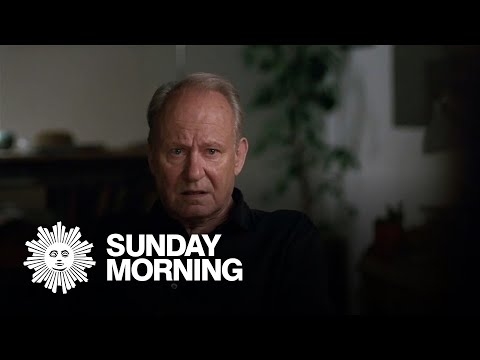
Though dialogue in “Sentimental Value” is in both Norwegian and English, there are also many moments in the film when Skarsgård holds the screen without talking, saying a lot with his expressions. “I love that stuff,” he told “Sunday Morning.” “Movies, real movies are not literature. Cinema to me is what happens in the image. Not what is said; what is not said.”
Skarsgård suffered a stroke in 2022, and since then he has worn an earpiece while filming to help with lines. “It’s actually more complicated than learning the lines, because the prompter has to say their line while the other actor is talking,” he said.
In discussing “Sentimental Value,” a film about the pull between career and family, Skarsgård reflected on having eight children, many of whom are actors (including Alexander Skarsgård), which he credits with inspiring him. “I stole things from them. Like, expressions and the sort of naive attitude towards everything,” he said. “Just watching them is fantastic.”
Skarsgård won the Golden Globe for his performance.
See more:
https://www.cbsnews.com/news/best-supporting-actor-oscar-nominees-2026-academy-awards/


