








Just before midnight on March 23, an empty car was set alight in the Jewish district of Antwerp, Belgium, breaking the quiet of the night.
The police quickly arrested two teenagers. Several hours later, blurry footage appeared online of the incident, showing one person pouring liquid on a car and a second person lighting it on fire.
In the video, a group that was unknown just a few months ago claims responsibility. The group, which calls itself Harakat Ashab al-Yamin al-Islamiyya, has also taken responsibility for a series of other attacks across Europe, including one on Wednesday when two people were stabbed in a Jewish area of London.
Now, counterterrorism officials say they are investigating whether the group has ties to Iran — and whether these criminal acts are the latest iteration of asymmetrical warfare by Iran or another malign actor, all using low-cost, unsophisticated methods to sow fear in Jewish communities across Europe.
Those accused of carrying out the attacks did not appear to have allegiance to an extremist cause and were likely recruited to act with the promise of money, law enforcement authorities and lawyers say.
Chantal Van den Bosch, the lawyer for one of the teenagers charged in the Antwerp incident, said in an interview that her client had “no idea” the arson would be filmed and shared online, and said he had taken part to make “quick cash.”
“They’re basically cannon fodder. They’re being used,” she said.
Prosecutors declined to comment on her assertions. Investigators in the case have not released details beyond an initial news release.
Suspicions among authorities about the involvement of Iran or one of its proxies in Iraq suggest that the war in the Middle East is having an unanticipated ripple effect across Europe. The crimes the group has claimed responsibility for have caused no deaths and, until Wednesday’s stabbings, no injuries (though this latest attack did not fit the pattern of the previous ones, analysts pointed out, and the claim of responsibility could be false). Property damage has been limited.
But the episodes have forced the authorities to mobilize intelligence assets and draw upon British police teams to investigate, stretching limited resources.
More than a dozen attacks over the last two months in Britain, the Netherlands, Belgium, France and Germany, mostly targeting the Jewish community, have been claimed online by Harakat Ashab al-Yamin al-Islamiyya, also known as the Islamic Movement of the Companions of the Right. They include explosions at Jewish schools and outside synagogues in Belgium and the Netherlands, and vehicles set ablaze in several European cities. Still, it remains unknown whether the group is actually behind each of the attacks.
Adrian Shtuni, an associate fellow with the International Center for Counter-Terrorism, which has been tracking the group, said that the tactics, choice of targets and geographic spread, as well as the specific networks disseminating the claims, “all point strongly in the direction of Iran.”
The attacks, mostly at night on Jewish or Israeli-linked targets, are calibrated to “generate fear and psychological pressure without triggering major escalation” — a hallmark of hybrid Iranian-linked efforts, Mr. Shtuni said. And in many cases, those accused of carrying out the crimes are teenagers or young adults likely recruited “through casual online ‘gig-economy’ channels such as Snapchat or Telegram,” he noted.
(Hybrid warfare involves tactics, including cyberattacks, sabotage, assassination and disinformation campaigns, that are used covertly to destabilize countries, erode trust in institutions and undermine adversaries without provoking a major military response.)
“These are not trained terrorists or ideologically committed agents,” Mr. Shtuni said. “They are ordinary locals hired for small cash payments to carry out acts of targeted violence and intimidation.”
The Iranian Embassy in London did not immediately respond to a request for comment.
The attacks have heightened fears among Jews across Europe. The police have stepped up security at synagogues and other Jewish sites. In Belgian cities, soldiers have been deployed alongside the police to secure Jewish institutions since mid-March.
In London, there has been a spate of antisemitic incidents, mostly in an area of the city that is home to just over half of Britain’s approximately 300,000 Jews.
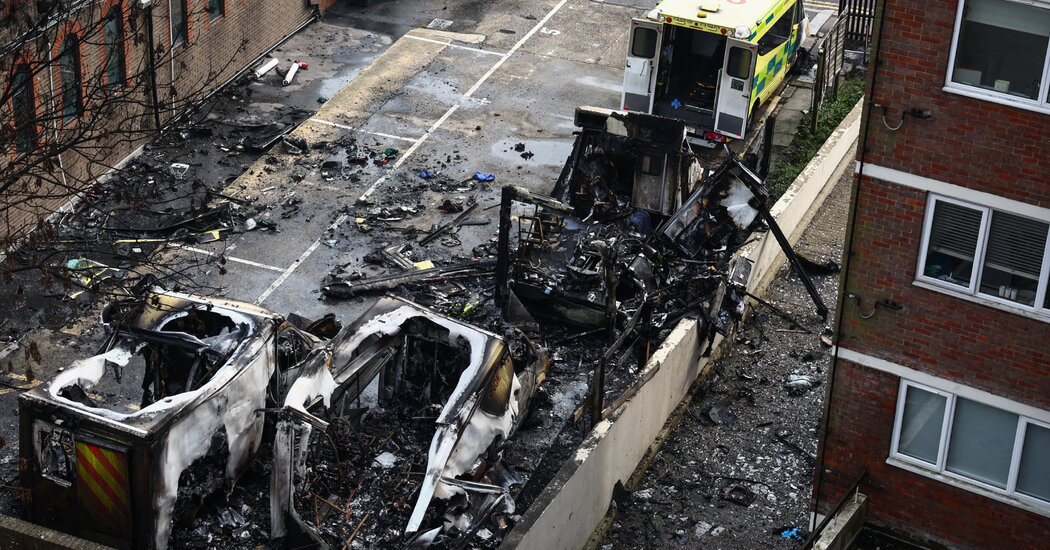
Four ambulances that served a Jewish charity were set alight outside a synagogue in north London on March 23. Then, in the span of four days in mid-April, there was an arson attack at the Finchley Reform Synagogue, a suspected arson attack at a site once used by a Jewish charity, an arson attack at the Kenton United Synagogue, and an attack on a Persian language broadcaster — all claimed by Harakat Ashab al-Yamin al-Islamiyya.
Last week, four men from London — ages 17 to 20 — appeared in a London courtroom for a hearing, charged with arson and accused of setting fire to the four ambulances.
A prosecutor said three were seen in a video setting fire to the vehicles, ultimately causing more than one million pounds in damages, while the fourth drove a getaway car. One of the men said he had never been arrested or charged with any other crimes. All four will face a trial early next year.
Counterterrorism police in Britain have arrested a total of 28 people in relation to the series of attacks, and eight have been charged with arson-related offenses, London’s Metropolitan Police Service said in a statement on Wednesday.
London’s Metropolitan Police Service and counterterrorism officials have said in statements that they are investigating whether the group is linked to Iran, though they stopped short of attributing the attacks to Iran.
In response to the attacks, synagogues in London were raising money to provide enhanced security and were arranging more volunteer patrols. After Wednesday’s stabbings, the British government announced an additional 25 million pounds, around $33.7 million, for more police patrols and security for Jewish communities. Shabana Mahmood, Britain’s home secretary, told Sky News on Thursday, “There are very real risks that the community is living through.”
There had been growing concerns about these types of attacks, even before the United States and Israel struck Iran two months ago, setting off war in the Middle East. Ken McCallum, director general of MI5, Britain’s domestic intelligence service, said in an Oct. 2025 assessment that Iranian transnational aggression was on the rise and his agency had been forced to increase its efforts to counter it.
Vicki Evans, Britain’s senior national coordinator of counterterrorism policing, last week told reporters that the police were looking into the threat of Iranian state aggression in Britain in the recent attacks.
She pointed to the Iranian regime’s “routine uses of criminal proxies,” and said the police “are considering whether this tactic is being used here in London — recruiting violence as a service.”
In what appeared to be messaging aimed at people who might be recruited to commit crimes, she added: “Those tasking you will not be there when you are arrested and face court. You will be used once and thrown away without a second thought.”
Mr. Shtuni and other analysts monitoring the group say the absence of any link to a militant organization with training camps or official propaganda channels does not make it harmless.
By using a loose network of throwaway proxies, Mr. Shtuni said, states or networks can create threats that are hard to track and even harder to stop.
“Its amateurish appearance is a feature, not a flaw,” Mr. Shtuni said. “It reflects a deliberate evolution in hybrid warfare that prioritizes deniability, scalability, psychological impact and persistence over dramatic attacks that kill large numbers of people.”
Dave Rich, the director of policy for the Community Security Trust, a British charity that tracks antisemitism and coordinates security measures at Jewish institutions, said that regardless of the model of the attacks, they amount to antisemitism, he said.
“It’s the model of hostile states rather than a kind of more organic active extremism by people who are themselves extremists,” Mr. Rich said, but he added, “the police have been very, very clear they are treating them as antisemitism and hate crimes.”
Jeanna Smialek contributed reporting from Brussels, Adam Goldman contributed reporting from London and Lara Jakes contributed reporting from Rome.
https://www.nytimes.com/2026/04/30/world/europe/european-antisemitism-hybrid-warfare.html


