






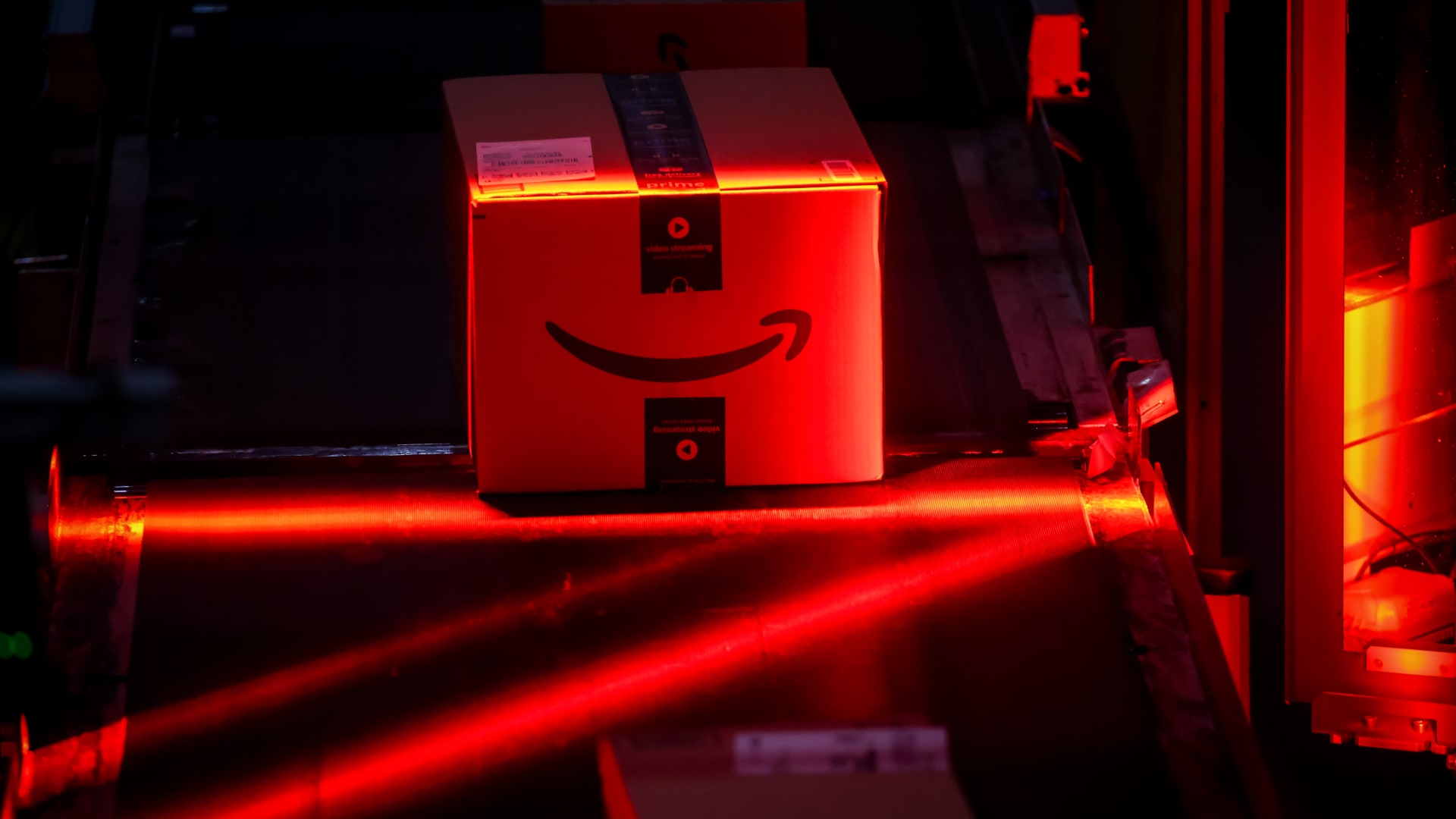
An automated barcode reader scans packages prepared for shipping at an Amazon fulfillment center on Cyber Monday in Robbinsville, New Jersey, Dec. 1, 2025.
Michael Nagle | Bloomberg | Getty Images
For Amazon sellers, who account for over 60% of goods sold on the e-retailer’s sprawling marketplace, times would be tough no matter what right now.
The Trump administration’s high tariffs on imports have created a year of hardship, and the recent war with Iran has led to a spike in energy costs, further pressuring merchants to either raise prices on struggling consumers or eat the losses.
As if that’s not enough, Amazon is implementing a new set of policies that some sellers say make doing business on the platform increasingly untenable.
In recent weeks, Amazon has changed how it pays out seller earnings and collects payments for its advertising services. The company then announced it would start charging merchants a 3.5% fuel surcharge to offset surging oil prices from the Iran war.
To some sellers, the moves represent another example of Amazon putting the squeeze on them.
“We’re running out of f—ing margin,” said Michael Patrón, who runs an eight-figure Amazon business and frequently criticizes the company’s policies on his X account. “I think that’s why it keeps getting more and more frustrating.”
Patrón and hundreds of large Amazon sellers are boycotting its advertising platform on Wednesday to protest the recent policy changes that are strangling their already stretched bottom lines.
The 24-hour advertising boycott is being organized by Million Dollar Sellers, a community of more than 700 members that collectively generate about $14 billion in revenue.
“Sellers have complained for years, but this feels different,” MDS co-founder Eugene Khayman said in a post on X about the boycott. “The reason is simple: this is no longer just about irritation. It is about cash extraction.”
Amazon spokesperson Ashley Vanicek said the recent changes to advertising payment methods and disbursements align “a small subset of sellers” with practices already used by most of its merchants.
The company said it introduced the fuel surcharge to partially recover costs that have been driven higher by rising oil and logistics prices.
Amazon’s third-party marketplace, launched in 2000, has grown to be a key pillar of its retail strategy. It hosts millions of sellers, allowing everyone from small businesses that operate out of a garage to established brands to list their wares on the site.
Seller services revenue, which includes commissions, fulfillment, advertising and customer service support, has surged more than 400% since 2017.
In the fourth quarter, revenue in the unit grew 11% year over year to $52.8 billion and comprised roughly 42% of Amazon’s total sales for the period.
Cash crunch
Several sellers told CNBC they expect to raise prices as a result of the temporary fuel surcharge, which takes effect April 17. The other policy changes threaten to tie up their cash, which could have more damaging consequences.
It could leave merchants unable to make payroll or pay suppliers, and push them to take on more debt, Khayman said.
“The majority of sellers, it’s, you know, husband and wife teams, one employee, one assistant, kind of a thing where they get 3% cash back on their ad spend, which is probably their third-largest expense,” Khayman said in an interview. “So you’re getting a large amount of money back on this, and they’re taking away that ability.”
Many sellers, especially smaller businesses, “live off of their credit card points” earned from purchases on Amazon ads, Khayman said.
Earlier this month, Amazon announced it would begin automatically deducting advertising costs from some sellers’ earnings, rather than letting them pay using a credit card. The notice said that if merchants’ proceeds couldn’t cover their advertising costs, Amazon would charge their existing payment method as a backup. The company also offered sellers a $2,500 credit toward ad costs “to ease this transition.”
Amazon framed the move as being better for sellers’ “cash flow management,” but merchants said it would likely have the opposite effect.
On Tuesday, Amazon announced it would delay the ads payment change to Aug. 1 after it received feedback on the policy.
“Based on feedback we heard, we’re deferring this change until August 1, 2026, to give this group of advertisers more time to prepare,” the company wrote.
Breaking point
In mid-March, Amazon instituted a new policy for some of its U.S. sellers that means it will hold onto sales proceeds longer. Sellers now have to wait to collect their earnings until seven days after products are delivered. Previously, Amazon paid out sale proceeds to merchants seven days after the item shipped to customers.
The policy changes piled up, creating more anxiety for sellers.
“Combined with the payout delays, this creates MAJOR cash flow crunch,” Adam Runquist, founder of Heist Labs, which acquires e-commerce brands, wrote in a LinkedIn post responding to the ads announcement. “There is a breaking point with the increased fees and cash flow pressures — Amazon may soon be finding it.”


One seller, who has run a five-figure Amazon business for over two decades, said the delayed payment policy will put significant strain on his company, which was already struggling to pay its overhead costs.
“Amazon’s already taken all its money out,” said the seller, who asked to have their name withheld out of fear of retribution. “Whatever is left over, that’s our money, and we’re not getting it. We’re getting it delayed.”
Amazon said most of its sellers have been on a seven-day disbursement system since 2016. The company said it gave sellers who weren’t already using the system a six-month notice to allow them to prepare for the transition.
The policy gives customers time to receive their purchase, initiate returns and submit claims, Amazon said.
Fee scrutiny
The boycott is just the latest example of Amazon coming under scrutiny over the growing cost of selling on its platform.
Amazon’s average cut of each sale crossed 50% for the first time in 2022, according to Marketplace Pulse, a third-party market research firm, which cited a sample of sellers’ profit and loss statements.
Seller fees are part of the Federal Trade Commission’s antitrust lawsuit against Amazon, filed in September 2023 and scheduled for trial in 2027, which accuses the company of using anticompetitive tactics to maintain its e-commerce dominance, as well as stifling merchants on its marketplace.
Amazon has previously disputed the FTC’s claims, saying that its practices are good for competition.
The company said the findings from Marketplace Pulse are an inaccurate depiction of the cost to sell on the site because they conflate fees with the expense of optional services that some sellers purchase from the company.
“We are committed to supporting the success of selling partners in our store and continue to help them achieve record sales year after year,” Vanicek said in a statement. “We invest heavily in powerful tools, services, and programs to enable their business growth at a cost that is typically lower than alternatives.”
Charles Chakkalo, an Amazon merchant of 15 years, said the recent policy changes amount to shortening some sellers’ cash flow from 90 days to “effectively zero.”
“I think this is simply Amazon squeezing out the processing fees they’re paying the credit card company,” said Chakkalo, who sells home and kitchen items and runs a newsletter for Amazon merchants. “And if the smaller sellers cannot handle this kind of charge, so be it. There’s a handful of other sellers that are going to try to make it on the platform.”
Amazon has served as a launchpad for many businesses to tap into its massive customer base and has touted seller success stories in yearly progress reports, noting last year that independent merchants in 2024 netted an average of about $290,000 in annual sales.
It often refers to merchants as its partners.
But, Chakkalo said, the latest policy changes feel less like Amazon has a collaborative relationship with merchants and instead, one where they’re just “facilitators” for the company.
“It’s, again, a slap in the face. A reminder that, ‘Hey, wake up, this is not your business,'” he said. “This is your business, subject to my reign.”

https://www.cnbc.com/2026/04/15/amazon-sellers-boycott-ads-payment-changes.html


