






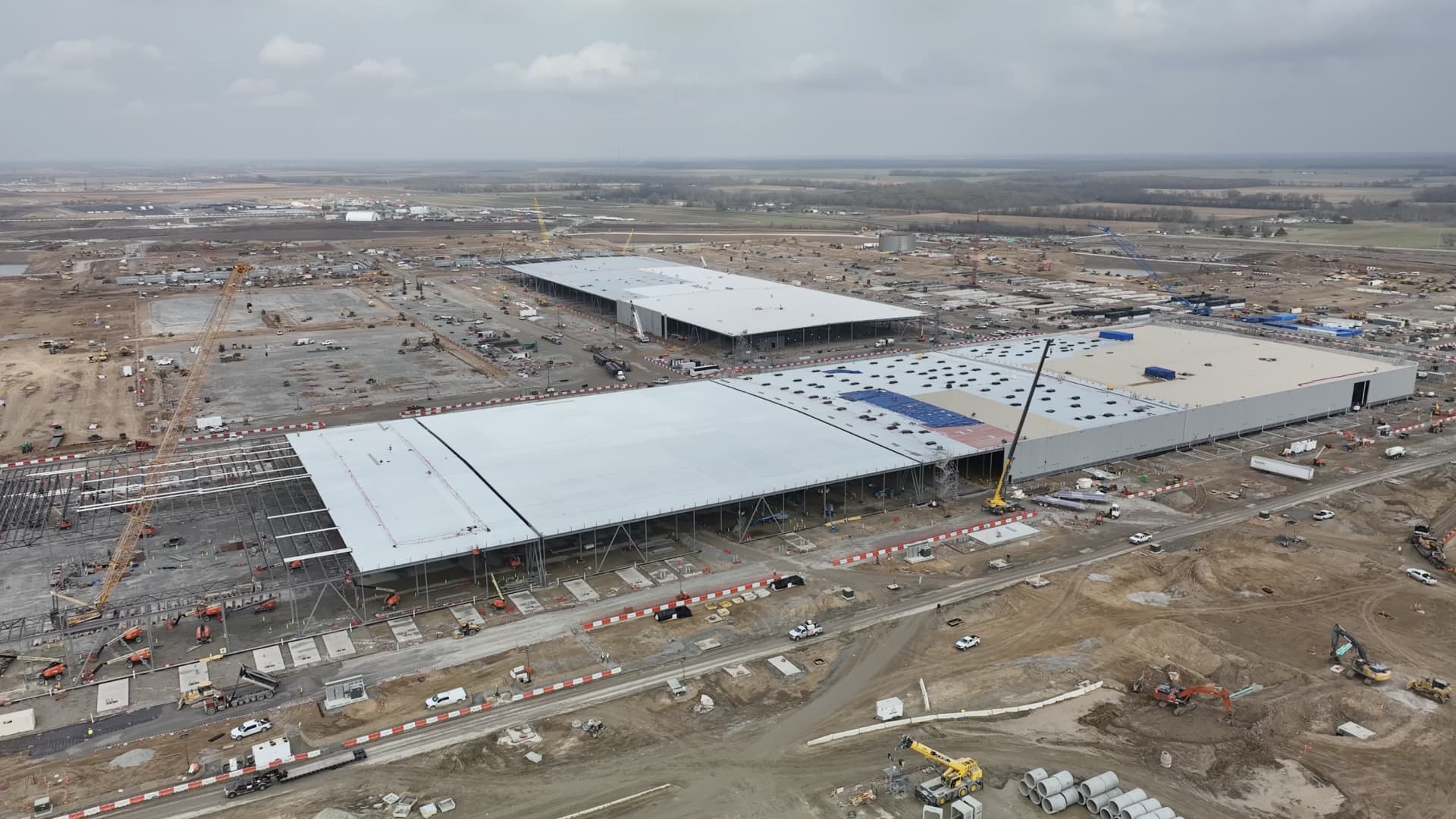
Meta’s 5-gigawatt “Hyperion” data center under construction in Richland Parish, Louisiana, on January 9, 2026.
Meta
The popular narrative that artificial intelligence is the engine keeping the U.S. economy alive appears to be overstated, according to recent analyses.
The AI boom has reshaped market valuations, driven large investments and record bond issuance to finance data centers, and heavily influenced gross domestic product, or GDP, especially in early 2025. This led many economists and market participants to suggest AI investment was the savior of an otherwise-stagnant domestic economy.
However, a January report from MRB Partners U.S. economic strategist Prajakta Bhide reveals that consumption was the most crucial driver of U.S. GDP growth last year, which is usually the case in periods of economic expansion. AI-related capital expenditures were the second-biggest driver, she said.
“AI is an important part of the growth story, but it’s not the only part of the growth story. That’s a narrative that’s out there, that if we didn’t have the AI capex, GDP would have slumped last year. And that’s simply not true,” Bhide said in an interview with CNBC. “Still, it’s the U.S. consumer that continues to drive the expansion.”
Bhide found that without making any adjustment for imports, A.I.-related components seem to have added around 90 basis points, or 0.9%, to real GDP growth on average between the first quarter to the third quarter of 2025, or a little under 40% of average real GDP growth over the period. When adjusted for the real imports of computers, peripherals and parts, semiconductors and related devices, and telecom equipment — or AI-related equipment — then the net average contribution of A.I.-related investments is smaller, between 40 to 50 basis points, or about 20-25% of real GDP growth excluding these imports between the first and third quarters.
GDP is comprised of four components: consumption, investment, government spending and net exports. Imports don’t count since it measures domestic production. Given that a lot of high-tech equipment is imported, AI’s GDP value is smaller than one might suspect, Bhide said.
Also, even though data centers get a lot of headline attention, she found that it was investments in software and computers that were AI’s most important contributions to GDP growth in 2025.
“Although a negative shock to the optimism around A.I. implies a risk to GDP growth, the more realistic (and smaller) estimate of A.I.’s growth impact after adjusting for imports dispels the popular notion that the U.S. economy would falter without it,” Bhide wrote in the Jan. 8 report. “Without an A.I. boom, there would have certainly been less GDP growth last year, but there would also be fewer imports, so that overall real growth would still have been decent, above 1.5%, due to solid personal consumption.”
Bespoke Investment Group in December similarly dispelled notions of AI contributions to GDP in a post on X, publishing a chart titled: “A unique Q1 created vastly over-stated ‘AI share of Economy’ perceptions.”
The firm found that in the second and third quarters of 2025, categories linked to AI spending accounted for just 15% of quarterly GDP growth, with their share of overall GDP coming out less than 5% overall.
There is not yet an official final number for 2025 U.S. GDP growth given that annual revisions come out later, and the quarterly results show a mixed picture in a year dominated by strong AI investment, consumer demand and headwinds such as volatile U.S. tariff policies.
Real GDP increased at a much higher-than-expected annual rate of 4.3% in the third quarter of 2025. GDP rose at a 3.3% annualized pace in the second quarter, also stronger than estimated. Meanwhile, first-quarter GDP shrank at a 0.3% annualized pace, marking the first quarter of negative growth since the first quarter of 2022.
Support for a resilient economy ahead
Bhide’s research underscores the importance of consumer spending as a major leg of economic expansion. Looking ahead, she expects resilient consumption to continue in 2026 despite slower income growth and rising wealth concentration among top U.S. earners.
“You do have the support coming from the fiscal side, and that gives you a little bit of an offset for the aggregate income growth being not as maybe as strong as last year. … The U.S. consumer’s still, in our view, in good shape,” Bhide told CNBC.
“The argument that only the rich are driving consumption and that somehow makes consumption vulnerable … we don’t find a lot of evidence for that. I don’t think the hollowing out of consumption is that much of a cyclical risk,” she added.
Bhide expects economic growth this year also will be supported by further AI investments, Federal Reserve rate cuts and a stabilization in the U.S. unemployment rate that has been aided by a collapse in immigration. She remains watchful of quarterly productivity statistics and the pace of job creation.
https://www.cnbc.com/2026/01/26/ai-wasnt-the-biggest-engine-of-us-gdp-growth-in-2025.html


