







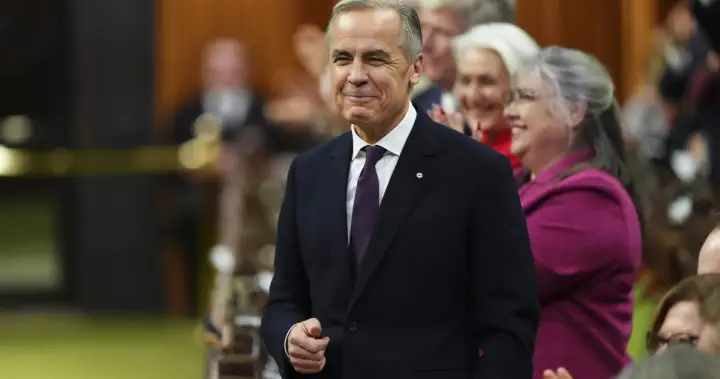
Just over half of Canadians want the federal Liberals to win enough seats in Monday’s byelections to give Prime Minister Mark Carney a majority government, new polling suggests.


The Ipsos poll conducted exclusively for Global News found that 53 per cent of Canadians want the Liberals to form a majority, while 47 per cent are opposed to the idea.
The support is starkly split between Liberal and Conservative voters, but 56 per cent of NDP voters also said they would prefer the Liberals to win enough of the three byelections being held Monday to form a majority.
Two of the three byelections are in Toronto-area ridings that are considered safe Liberal seats, which makes it likely the government will cross the 172-seat majority threshold in the House of Commons.
“I think the Liberals are going to be sleeping quite nicely on Sunday night and getting ready to celebrate on the Monday,” said Darrell Bricker, CEO of Ipsos Public Affairs.
The Liberals got even closer to a majority after Marilyn Gladu became the fourth former Conservative and fifth MP to cross the floor since December 2025 on Wednesday.
MP Lori Idlout switched to the Liberals from the NDP last month.
Although a majority of Canadians have voiced displeasure with MPs switching parties in past Ipsos polling, Bricker said Canadians appear to be accepting what it’s leading to in this case.
“Even if people don’t necessarily like the means, the ends of stability — particularly in a situation in which the country is confronted with a lot of big issues, including its position with the United States — Canadians seem to think that this is all right,” he said.
The prospect of a majority Liberal government puts more pressure on Conservative Leader Pierre Poilievre amid the growing exodus from his caucus, Bricker added, despite a decisive leadership vote result in January.


Get breaking National news
Get breaking Canada news delivered to your inbox as it happens so you won’t miss a trending story.
“He can’t make the argument, which is, ‘You need me to be around because there could be an election any day,’” he said. “There isn’t going to be an election any day. So caucus relations is going to be an outsized part of what Mr. Poilievre is going to have to do over the next period of time.
“When restless members in opposition have nothing to worry about, and there’s no prospect of being in government, and they haven’t been in government since 2015, well, idle hands are the devil’s workshop.”
Liberal support grows as Conservatives fall
The Ipsos poll suggests more bad news for the Conservatives.
If a general election were held tomorrow, 33 per cent of voters would choose the Conservatives, down three points from last month. The Liberals, meanwhile, rose by one point to 45 per cent support.
The Liberals now lead the Conservatives by 12 points — four times the gap between the two parties in December 2025, which was also the margin in last year’s election.
“Those double digits are coming from somewhere,” Bricker said.
“Last [year], they came from just the NDP. Now they’re also coming from the Conservatives, and the groups that voted disproportionately for the Conservatives, are more likely to vote for the Conservatives last time, are now taking a look at the Liberals and feeling comfortable with them.”
That includes younger voters, who flocked to the Conservatives in the 2025 election, believing the party was best equipped to address affordability issues.
Now, according to the new Ipsos poll, 29 per cent of respondents aged 18 to 35 say they would vote for the Liberals, versus 22 per cent who chose the Conservatives.
Men and women are now equally likely to vote Liberal at around 45 per cent each, the poll found, despite Ipsos saying men have historically been more likely to vote Conservative.
“[Poilievre] is losing across the demographic perspective,” Bricker said. “You can’t go from three to a dozen points behind without losing people who were voting for you in the last election. And that’s who he’s losing.”
Conservative support remains highest in Alberta, Saskatchewan and Manitoba, though that support sits at less than half of all voters surveyed in those provinces.
The NDP would gain nine per cent of the vote if an election were held tomorrow, the poll found, up one point from last month but equal to the number in December.
The Bloc Québécois was unchanged at seven per cent nationally (29 per cent in Quebec), while the Green party sits at two per cent, down one point. The People’s Party of Canada rose one point from last month to two per cent.
These are some of the findings of an Ipsos poll conducted between April 2 and 7, 2026, on behalf of Global News. For this survey, a sample of 1,000 Canadians aged 18+ was interviewed online. Quotas and weighting were employed to ensure that the sample’s composition reflects that of the Canadian population according to census parameters. The precision of Ipsos online polls is measured using a credibility interval. In this case, the poll is accurate to within ± 3.8 percentage points, 19 times out of 20, had all Canadians aged 18+ been polled. The credibility interval will be wider among subsets of the population. All sample surveys and polls may be subject to other sources of error, including, but not limited to, coverage error and measurement error.
© 2026 Global News, a division of Corus Entertainment Inc.
53% of Canadians want Carney Liberals to win majority in byelections: poll


