


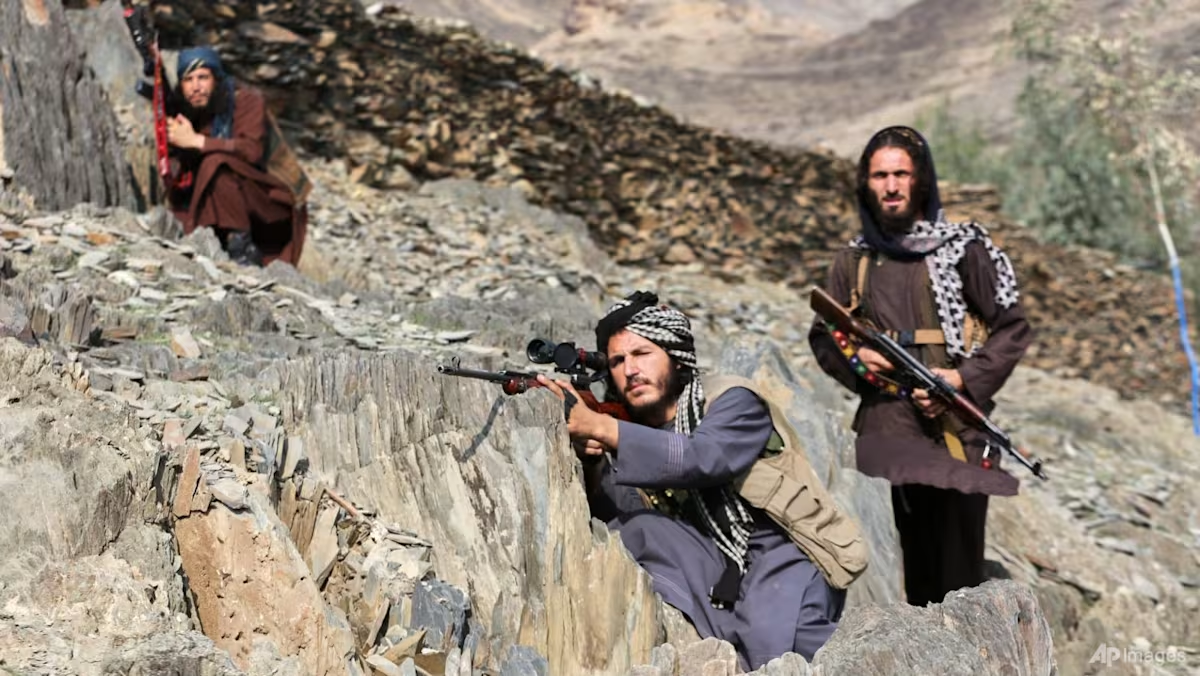
WHO ARE THE PAKISTANI TALIBAN?
The TTP was formed in 2007 by several militant outfits active in northwest Pakistan. It is commonly known as the Pakistani Taliban.
The TTP has attacked markets, mosques, airports, military bases, police stations and also gained territory – mostly along the border with Afghanistan, but also deep inside Pakistan, including the Swat Valley.
The group was behind the 2012 attack on then schoolgirl Malala Yousafzai, who received the Nobel Peace Prize two years later.
They also fought alongside the Afghan Taliban against US-led forces in Afghanistan and hosted Afghan fighters in Pakistan. Pakistan has launched military operations against the TTP on its own soil with limited success, although an offensive that ended in 2016 drastically reduced attacks till a few years ago.
The Afghan Taliban, in turn, is widely believed to provide some assistance to the Pakistani Taliban.
“All evidence tells us that Afghanistan Taliban have supported the Pakistani Taliban, and they have allowed them to take residence inside Afghanistan, but they are also supported at the same time by al-Qaeda, which has swelled its numbers inside Afghanistan, under the patronage of the Afghan Taliban,” Amin Saikal, an adjunct senior fellow at the S Rajaratnam School of International Studies of the Nanyang Technological University, told CNA.
“So I think unless the Afghan Taliban really gives up their support for the Pakistani Taliban, this conflict is likely to continue and could also escalate.”
WHAT HAPPENS NEXT?
Pakistan is likely to intensify its military campaign, analysts say, while Kabul’s retaliation could come in the way of raids on border posts and more cross-border guerrilla attacks to target security forces.
On paper, there is a wide mismatch between the military capabilities of the two sides. At 172,000, the Taliban have less than a third of Pakistan’s personnel.
The Taliban do possess at least six aircraft and 23 helicopters, but their condition is unknown and they have no fighter jets or effective air force.
Pakistan’s armed forces include more than 600,000 active personnel, have more than 6,000 armoured fighting vehicles and more than 400 combat aircraft, according to 2025 data from the International Institute for Strategic Studies. The country is also nuclear-armed.
Türkiye and Qatar may try to mediate again to restore the fragile ceasefire, said Dr Saikal.
“But I doubt … that the ceasefire will work until such time that the Afghan Taliban give up their support for the Pakistani Taliban,” he added.
“And that doesn’t doesn’t seem to be on the cards either, simply because the Afghan Taliban are worried that if they give up support for for the Pakistani Taliban, those Taliban may join the ISK, which is the Islamic State branch of Khorasan operating in Afghanistan since 2016 and and there is a strong rivalry between Afghanistan, or Afghan Taliban, and ISK.”
What could complicate the situation is the Afghan Taliban’s close relationship with India, said Dr Saikal. The Indian government has, in recent years, shifted to engaging with the Taliban, partly to prevent Afghanistan from re-emerging as a hub for militancy and terrorism that threatens India’s security.
“New Delhi has been supporting the Afghan Taliban, and that is a major threat as far as Pakistan is concerned, given the history of the conflict between Pakistan and India, and as a result, I think that Pakistan is very much determined now to bring the Taliban into line or under their influence,” Dr Saikal said.
https://www.channelnewsasia.com/asia/afghanistan-pakistan-strikes-taliban-what-we-know-5949761
