


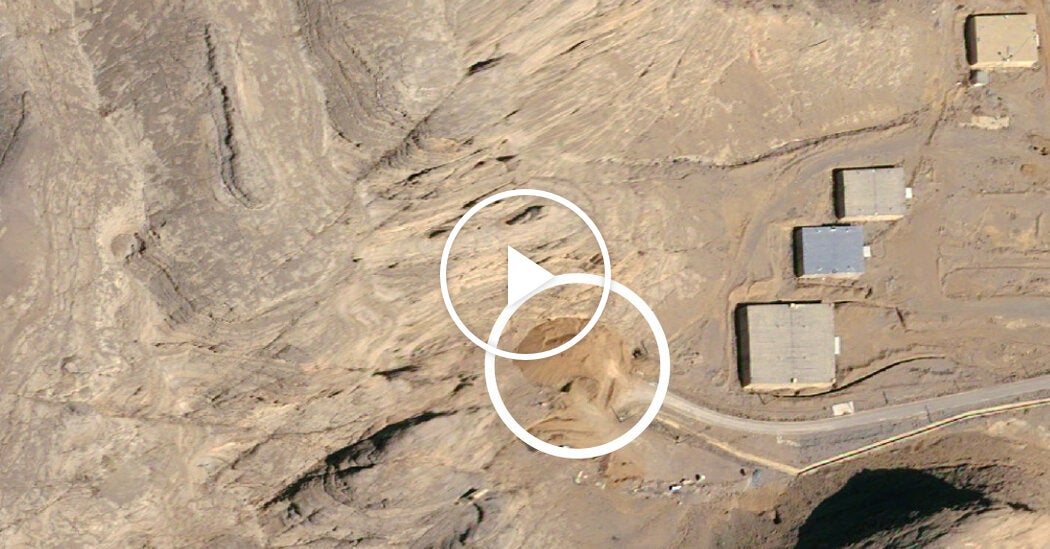
new video loaded: What Tunnel Entrances Reveal About a Key Iranian Nuclear Site
transcript
transcript
What Tunnel Entrances Reveal About a Key Iranian Nuclear Site
Satellite images show how Iran has tried to bolster its defenses at parts of the Isfahan nuclear facility.
-
What you’re seeing here are buried tunnel entrances at a nuclear facility in Iran. It’s one of the most important sites in the country for U.S. and Israeli forces. U.N. inspectors think that roughly half of Iran’s highly enriched uranium is buried here. And these three entrances are the only known ways to access it. If you think about nuclear sites in Iran, three main sites come to mind. They’re pretty well known: Fordo, Natanz and Isfahan. Natanz and Fordo, They were largely taken out in U.S. strikes last year. So I’ve been focusing on Isfahan. The uranium here is still relatively accessible. It’s actually a pretty large complex. This area here was very important for uranium processing, but it was heavily hit by the U.S. and Israel last June. If you go a little bit further north, that is underground and that requires tunnels to enter. In a terrain view, it gets quite interesting. There are three roads that lead to these tunnel entrances, and these tunnel entrances have become very important, both last year, but also right now. They lead to the underground facility where U.N. inspectors say uranium is stored and a new enrichment site could be located. If this falls into the wrong hands, that would be a problem in the long term. Here’s a great example of how very recent satellite imagery gives us new insights. This is from late January of this year, and what you see here is a line of trucks. And they’re filled with soil, and they’re lining up to go to some of these tunnel entrances. If you look a little bit closer here, you see another one of these trucks that’s just unloading some of the soil and some earthmoving equipment. Iran in preparation for any possible attacks at that point. They try to protect this facility a little bit more. So this is Jan. 29. And if you just look a few days later, we go to Feb. 2. This is the completely buried tunnel entrance, completely covered in soil to protect from any attack. And this is how it still looks in mid-March. The U.S. and Israel have basically two options here: The first one is to heavily bombard the entrances to this underground complex that would block any access, at least in the near future. They haven’t done that yet. So that’s very, very interesting — a little bit surprising. And it might point towards a second option: That would be to go in with ground forces and to extract the uranium. But that would require a really large amount of troops to secure the vast area, bringing in earthmoving equipment to clear the tunnels and a lot of time in hostile territory.

By Christoph Koettl and Alexander Cardia
March 20, 2026
https://www.nytimes.com/video/world/middleeast/100000010792563/isfahan-nuclear-site-iran.html
