


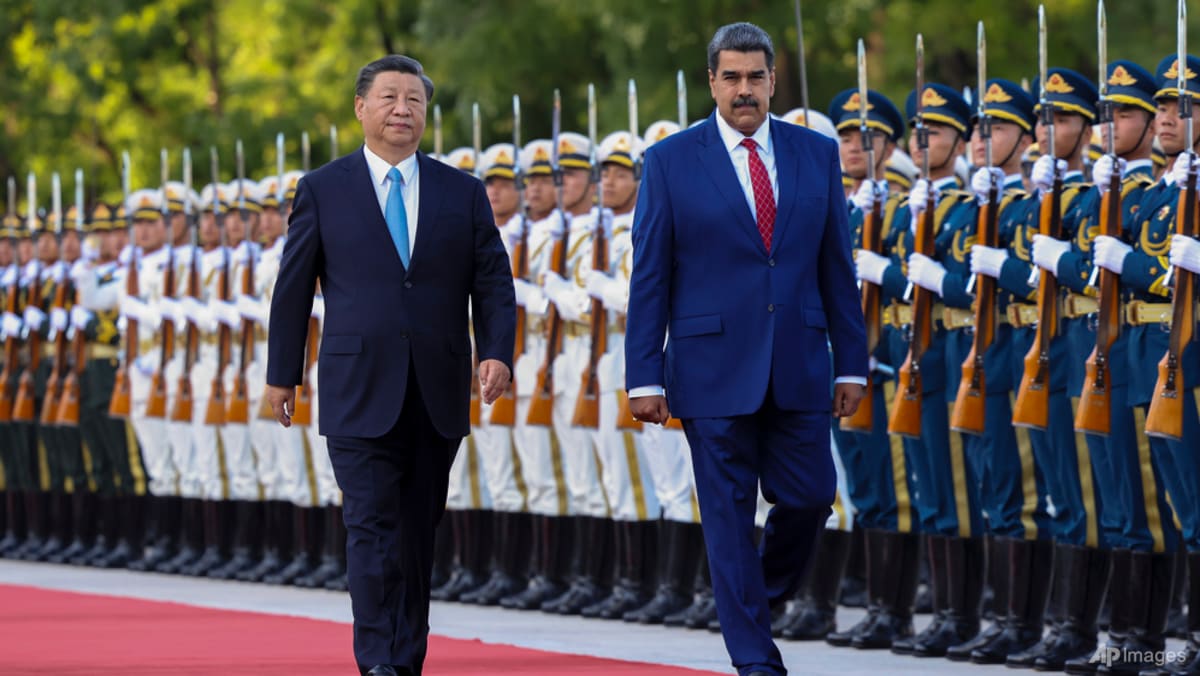
SHANGHAI: The United States’ direct operation in Venezuela, capturing President Nicolas Maduro and his wife, has generated international shockwaves and mostly condemnation, including from China.
It is among the countries that have publicly criticised the US, and condemned the operation as a “clear violation of international law” and demanded the immediate release of Maduro and his wife.
US elite forces had swooped into Caracas during a lightning pre-dawn raid on Jan 3, seizing the Venezuelan leader while airstrikes pounded sites in and around the capital.
Maduro faces US criminal counts including narco-terrorism and conspiracy to import cocaine. On Monday (Jan 5), he appeared in a New York court, where he pleaded not guilty to narcotics-related charges. His wife Cilia Flores also pleaded not guilty.
Washington has justified the strike – the biggest US intervention in Latin America since 1989 – as a targeted law-enforcement operation rather than broader military intervention.
While the forcible removal of a sitting head of government has sparked domestic and global unease, analysts say the stakes for Beijing extend well beyond Venezuela – to its Latin America strategy, its currency ambitions, and possibly even its calculus over Taiwan.
Here’s their take on key questions for Chinese policymakers.
WHAT’S AT STAKE FOR CHINA IN LATIN AMERICA?
The short answer: investments, energy supplies, and influence.
China has poured more money into Venezuela than any other country in Latin America.
According to data from the Center for Strategic and International Studies, a US think tank, Venezuela has received over US$62 billion from China since 2007 – representing 53 per cent of all Chinese lending to Latin America.
The next largest recipients were Brazil, Ecuador and Argentina.
The relationship took shape under former Venezuelan President Hugo Chavez, who was in power from 1999 to his death in 2013. Chavez signed several trade agreements with Beijing and described China as a “Great Wall” against US influence.
Under these agreements, Venezuela committed to supplying up to one million barrels of oil per day to China. In return, Beijing promised political backing. Maduro continued these arrangements after taking office in 2013, though new Chinese lending largely dried up since 2016 as both sides focused on restructuring existing debt.
https://www.channelnewsasia.com/east-asia/us-venezuela-capture-maduro-china-latin-america-taiwan-implications-5817086
