


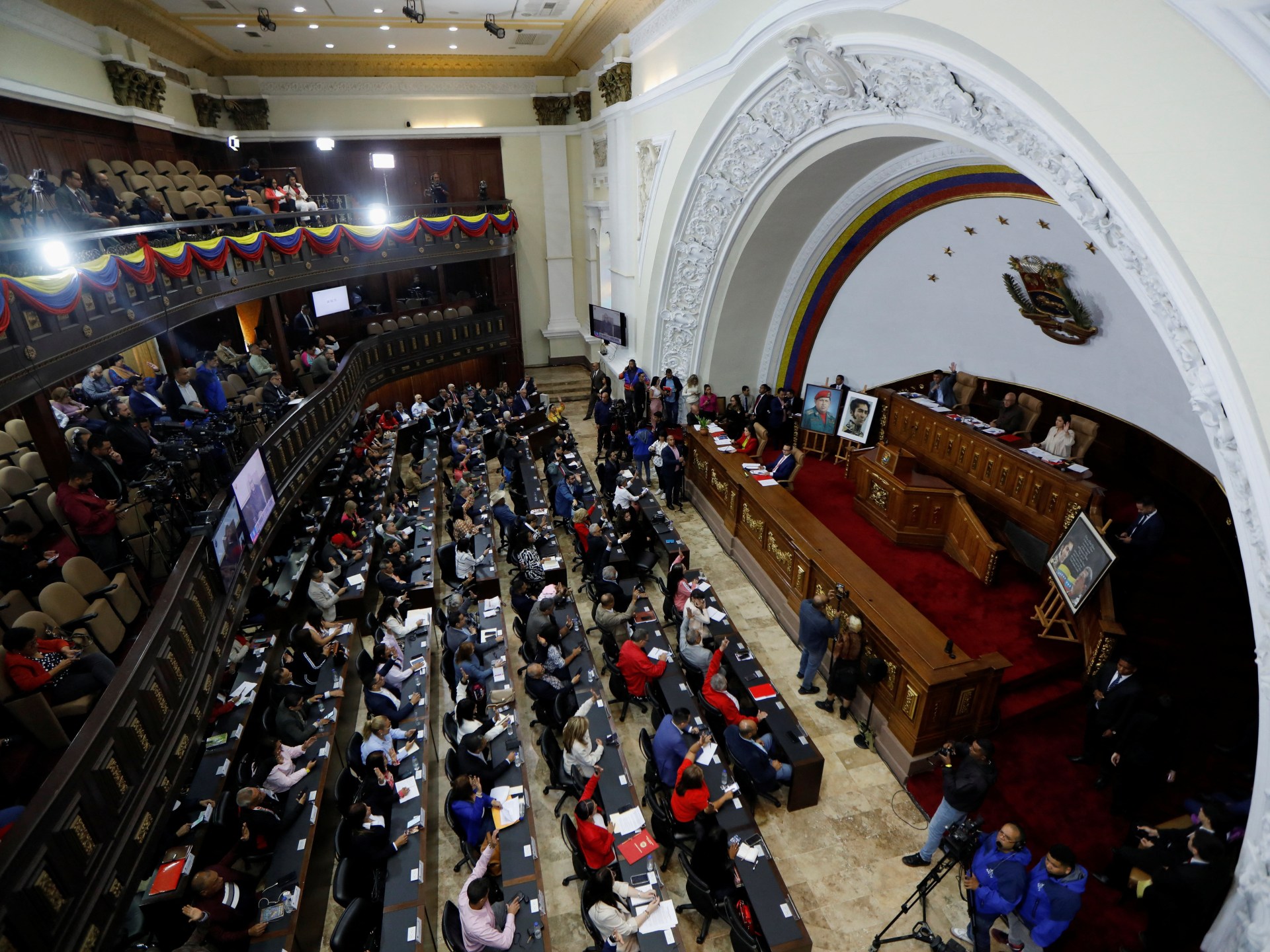
Venezuela’s National Assembly has voted to peel back the South American country’s commitment to the Rome Statute, the international treaty that established the International Criminal Court (ICC).
On Thursday, top Venezuelan lawmakers applauded the vote as a strike against an antiquated institution – one that has sought to investigate alleged human rights violations in Venezuela in recent years.
Recommended Stories
list of 3 itemsend of list
“It is to demonstrate and denounce to the world the uselessness and subservience of an institution that should serve to protect the people,” the president of the National Assembly, Jorge Rodriguez, wrote in a government statement posted online.
Rodriguez is the brother of Venezuela’s vice president and is considered a close ally of President Nicolas Maduro.
In his statement, Rodriguez sought to tie the court’s efforts to those of the United States, a country that has long refused to acknowledge Maduro as Venezuela’s president.
“It only serves the designs of American imperialism,” Rodriguez said of the court.
But the US is not a party to the Rome Statute, and the North American country has repeatedly denounced efforts by the court to investigate allegations of human rights abuses against its citizens and allies.
Just this year, the administration of US President Donald Trump issued multiple rounds of sanctions against officials on the ICC, claiming the judicial body had taken “illegitimate and baseless actions”.
Venezuela, for its part, signed onto the Rome Statute in October 1998, and its legislature ratified the treaty in June 2000, bringing the law into force.
Maduro is expected to sign Thursday’s legislation to revoke the ratification.
Under investigation
The South American country has itself rejected the accusations brought before the court against its leadership.
In November 2021, for example, the ICC opened an investigation into the Maduro government for allegedly carrying out crimes against humanity, including torture, sexual violence and other instances of inhumane treatment.
It cited the violent treatment and even killing of political dissidents, particularly during the 2017 antigovernment protests.
That investigation was paused, however, to allow Venezuela to address the allegations internally. But the court ultimately allowed the probe to proceed in June 2023, finding Venezuela’s efforts insufficient.
According to court filings, Venezuela has maintained that “there was no systematic attack on the civilian population, and that no crimes were committed”.
Multiple human rights organisations, however, have accused the Maduro administration of extrajudicial executions, unlawful imprisonments and violent crackdowns against members of Venezuela’s opposition.
Advocates have also questioned whether Venezuela’s National Assembly can be considered an independent branch of government, given Maduro’s firm grip on its membership.
What is the Rome Statute?
The Rome Statute counts among its members 125 countries, including Venezuela. As the foundational document for the ICC, the statute outlines the court’s jurisdiction.
The judicial body is tasked with the prosecution and adjudication of major international crimes: war crimes, crimes against humanity, genocide and aggression.
But critics have long accused the ICC of lacking the teeth to enforce its mandate. Major powers, including the US, China and Russia, are not members.
Israel is also not a party to the treaty: Its prime minister, Benjamin Netanyahu and former Defence Minister Yoav Gallant both face arrest warrants that have yet to be carried out, for war crimes against Palestinians.
In the 23 years since the ICC opened its doors, a total of 61 arrest warrants have been issued – but only 22 people have been detained. Eight have died before charges could be brought, and 32 people have evaded the court’s arrest.
The court claims 13 convictions so far, and four acquittals.
Thursday’s vote came, in part, as a reaction to a recent decision by the court to close an office in the Venezuelan capital of Caracas.
The office was established in 2024 to help with the probe into crimes against humanity.
But the ICC announced it would close the bureau on December 1, with prosecutor Mame Mandiaye Niang telling an assembly of state parties that achieving “real progress” in the investigation had been a “challenge”.
“Being aware of the need to manage our limited resources effectively, we have decided to close our office in Caracas,” he said.
Venezuela’s Ministry of Foreign Relations quickly responded in a statement, denouncing the office’s closure.
“Regrettably, the ICC Prosecutor’s Office showed not the slightest commitment or spirit of cooperation,” its statement said.
“Its agenda in the country was very clear: to disengage and do nothing in order to later instrumentalise justice for political ends.”
The 2023 investigation remains ongoing, with renewed attention on Maduro after a contested 2024 presidential election prompted a violent government response against protesters.
https://www.aljazeera.com/news/2025/12/12/venezuela-seeks-withdrawal-from-international-criminal-courts-rome-statute?traffic_source=rss
