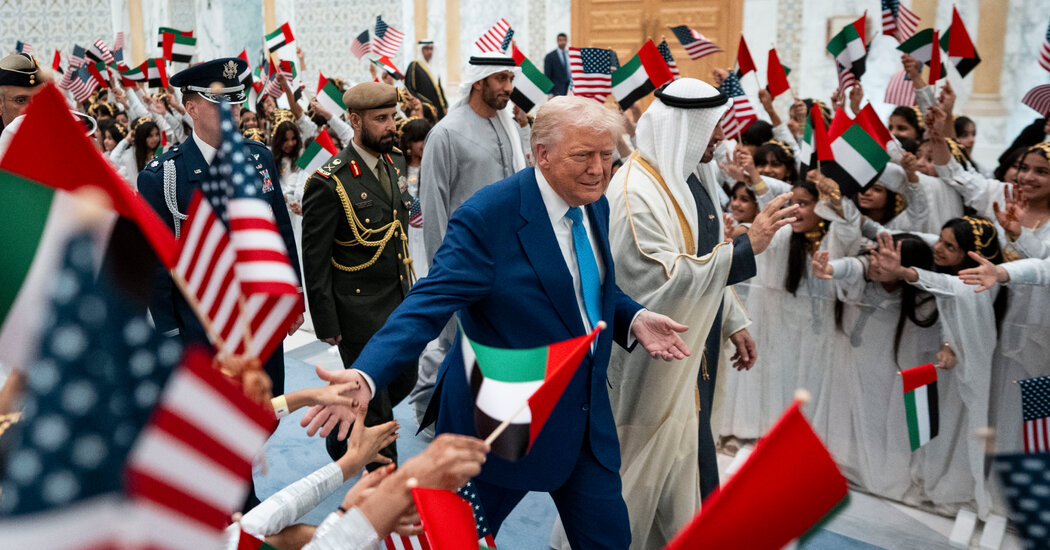
President Trump said on Tuesday that the United States was considering offering financial support to the United Arab Emirates, an oil-rich ally that has been contending with economic fallout from the war in Iran.
The war has damaged oil and gas infrastructure throughout the Middle East, dealing a blow to economies that rely on the Strait of Hormuz to transport crude around the world. The U.A.E. is an unlikely recipient of economic support, and the fact that it has inquired about assistance demonstrates the cascading effects of the conflict.
“It’s been a good ally of ours, and you know, these are unusual times,” Mr. Trump said on CNBC on Tuesday.
Mr. Trump added that the U.A.E. had been hit hard by Iranian retaliation and that it had pledged to make substantial investments in the United States. He noted that the country’s wealth made the need for support surprising.
“I’m surprised, because they are really rich,” Mr. Trump said.
Emirate officials met with Treasury Secretary Scott Bessent in Washington last week on the sidelines of the spring meetings of the International Monetary Fund and the World Bank. The Treasury Department said that in their conversations, officials “emphasized that the United States seeks to deter future attacks and ensure that energy markets are not further impacted by Iran.”
Kevin Hassett, the director of the National Economic Council, said on Monday that he expected the Treasury Department to “make every effort” to help the U.A.E. out. He also suggested, however, that the financial support would probably not be necessary.
Last year, the Treasury Department deployed a $20 billion currency swap through its Exchange Stabilization Fund to provide support for Argentina’s struggling economy as it tried to bolster the political prospects of Argentina’s president, Javier Milei. Mr. Bessent has broad discretion over the use of the fund, which can be deployed to buy another nation’s currency in exchange for dollars.
The Exchange Stabilization Fund had a net balance of about $44 billion as of February. It is not clear how big a lifeline the U.A.E. might need — or even whether it needs one at all.
Some economists have suggested that the request appeared to be a political signal, intended to solicit a demonstration of support from the country’s chief ally, and that it was not a financial necessity. The Emirati currency is pegged to the dollar, and the country’s central bank still has ample reserves, despite the disruption to oil exports that the war has caused.
The Emirati foreign ministry did not immediately respond to a request for comment.
Vivian Nereim contributed reporting from Riyadh.
https://www.nytimes.com/2026/04/21/business/economy/us-uae-financial-support.html