


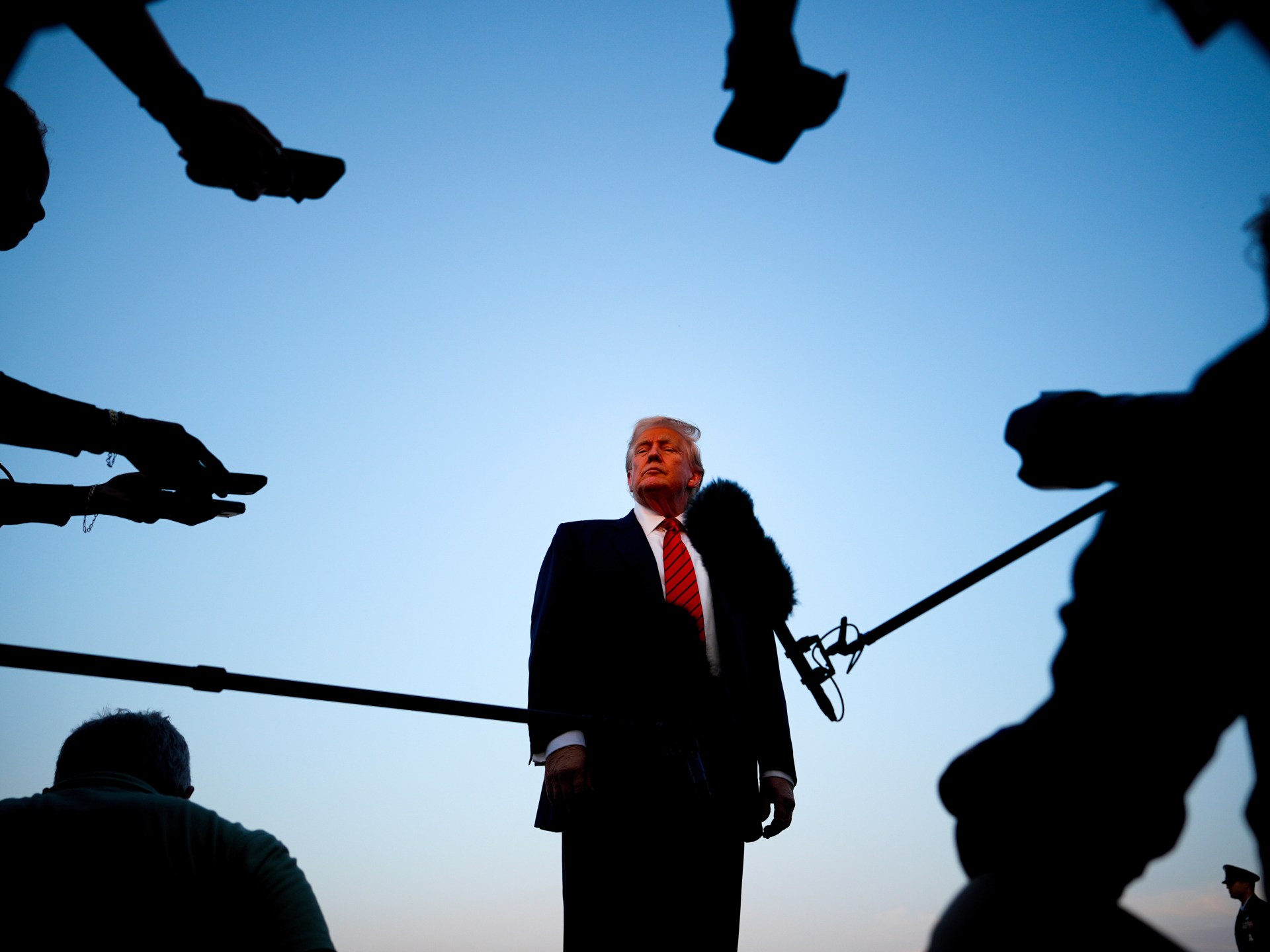
Washington, DC – One year into US President Donald Trump’s second term in office, Democrats hope the Republican president’s campaign pledges – vows to end foreign wars and pivot to “America First” – are coming back to haunt him.
Leaders of the party have long hammered affordability as a key issue in the upcoming 2026 midterms in November, in which the opposition party hopes to reclaim both chambers of Congress from Republicans and, in turn, regain the ability to check the president’s expansive use of executive power.
Recommended Stories
list of 3 itemsend of list
Trump’s military pressure campaign against Venezuela, culminating, to date, in the extraordinary abduction of Nicolas Maduro on January 3, as well as his increasingly caustic effort to take control of Greenland – an autonomous territory of Denmark – have emerged as powerful cudgels on the issue.
Speaking at a news conference in the wake of the Maduro operation, Chuck Schumer, the 75-year-old top Democrat in the Senate, adopted decidedly Trumpian language as he promised “relentless” messaging on affordability in the year ahead.
He added, “We Democrats are fighting to prevent military adventurism in Venezuela and other countries and endless wars.”
“So Democrats in the House and Senate are focusing on lowering your costs, dealing with affordability,” Schumer continued. “Republicans led by Donald Trump seem to be focused – not seem to be, are focused – on spending our treasure and, God forbid, lives in military adventurism overseas.”
Ken Martin, the chairman of the Democratic National Committee – which establishes the party’s platform, national strategy and messaging before elections – took a similar line in a statement following the Venezuela operation.
“Trump promised peace, but has delivered war,” he said. “Now, Trump has committed the United States to running another country for the foreseeable future while Americans foot the bill for regime change”.
Added Sherrod Brown, a former Democratic Senator from Ohio seeking to reclaim his seat in a special election this year, in a post on X: “We should be more focused on improving the lives of Ohioans – not Caracas.”
Campaign promises
To be sure, foreign policy has traditionally been seen as a low-impact issue at the ballot box in the US, often overshadowed by more domestic concerns, such as crime, social issues, and, most pressingly, the economy.
But with Trump’s brand of politics largely relying on pledges to eschew high-concept international manoeuvring in exchange for the lived experience of US voters, any perception of costly initiatives abroad offers a unique opening for Democrats, according to Democratic strategist Arshad Hasan.
“Trump has a vulnerability right now because he cannot connect the things that he’s doing in Venezuela and Greenland to the lives of voters on a daily basis,” Hasan told Al Jazeera.
“Anytime the Democrats want to talk about what he’s doing overseas, they still have to make it relatable to what voters are going to see in their everyday lives,” he said. “This chaos isn’t bad just because it is chaos. It’s chaos because it doesn’t actually serve anyone or anything.”
To critics, Trump has vastly increased his scorecard on international adventurism in the first weeks of 2026, after pursuing bombing campaigns in Yemen, Iran, Nigeria, Somalia and the Caribbean in 2025.
Military assets have remained stationed off the coast of Venezuela in the wake of Maduro’s January 3 abduction, with Trump floating the idea of using US troops to secure the country’s vast oil wealth. Experts have repeatedly warned that the relative stability under interim President Delcy Rodriguez, Maduro’s former deputy, remains tenuous, with the prospect of greater entanglement remaining very much on the table.
While threats against neighbouring Colombia have fizzled, Trump has appeared committed to the White House’s stated goal of establishing US “preeminence” in the Western Hemisphere. In an NBC News interview published on Monday, Trump again refused to rule out military force in seizing Greenland. Forebodingly, Trump told Norway’s leader in a text message on Sunday, “I no longer feel an obligation to think purely of Peace”.
Even Trump’s Republican allies have warned that US military aggression towards Greenland would effectively blow up the NATO alliance, as Democrats have sought to capitalise on the discord between Trump’s campaign messaging and his threats against purported US allies.
“The American people voted for affordability at home, not threats to invade our closest friends abroad,” Democrats on the House foreign affairs committee said in a January 6 post on X.
“Trump is ignoring Americans’ affordability concerns with his foreign escapades, and making things worse with more tariffs. This will only further raise costs for the American people,” the panel wrote earlier this week, referring to Trump’s threats to further tariff European countries over Greenland.
The Trump administration, for its part, has sought to connect both Venezuela and Greenland to cost-of-living issues.
That has included pushing dubious claims over the effect US access to Venezuelan oil will have on markets, and floating far-flung plans to exploit the untapped natural resources of Greenland, ownership of which Trump has maintained is imperative to US national security.
A test for Democrats?
Of course, with the midterms more than nine months away, much is subject to change under an administration that has relied not only on bold, attention-diverting policies, but their rapid and unrelenting deployment.
But several potential signs have emerged of brewing trouble for Trump’s Republican Party, which has so far broadly fallen in line with the president’s agenda, including refusing to exercise congressional oversight of his military actions.
Economists have argued that despite signs of economic growth, a relatively comfortable unemployment rate, and a so-far muted domestic impact of Trump’s wide-ranging reciprocal tariffs, inequality has continued to yawn under Trump.
For many in lower and middle income brackets, there has been little shift in their lived experience and the daily life expenses that inform perceptions of affordability, as reflected in a slate of recent polls. That may dovetail with other public opinion surveys showing discontent over Trump’s actions abroad.
An Associated Press-NORC Center for Public Affairs Research poll conducted January 8 to 11 found 61 percent of US adults disapproved of Trump’s foreign policy approach, with 56 percent saying they felt Trump had “gone too far” on military intervention, even as support for Maduro’s ousting remained relatively high. That was particularly pronounced among independents, a voter segment targeted by both parties, with 63 percent saying Trump had overreached.
A Reuters/Ipsos poll of US residents found particular dismal support for the US acquiring Greenland, with just one in five respondents supporting such a move. A separate CBS poll found that just 14 percent approve of using military force to seize the island.
Democratic strategist Hasan assessed that messaging from both major parties has been inadequate on affordability, with Republicans asking voters “not to believe their own eyes”, and many old guard Democrats offering only “milquetoast” alternative visions.
An “antidote” in the months ahead, he said, could be embracing bold positions that weave US actions abroad and impacts felt at home. He pointed to the recent success of New York City Mayor Zohran Mamdani as a possible blueprint.
“We’re in a place where the Democrats really have a test as to whether or not their messaging can meet the very perilous moment that we’re in,” Hasan said. “They actually have to stand up for something.”
https://www.aljazeera.com/news/2026/1/20/trump-undermined-antiwar-vows-in-first-year-will-democrats-seize-on-this?traffic_source=rss
