


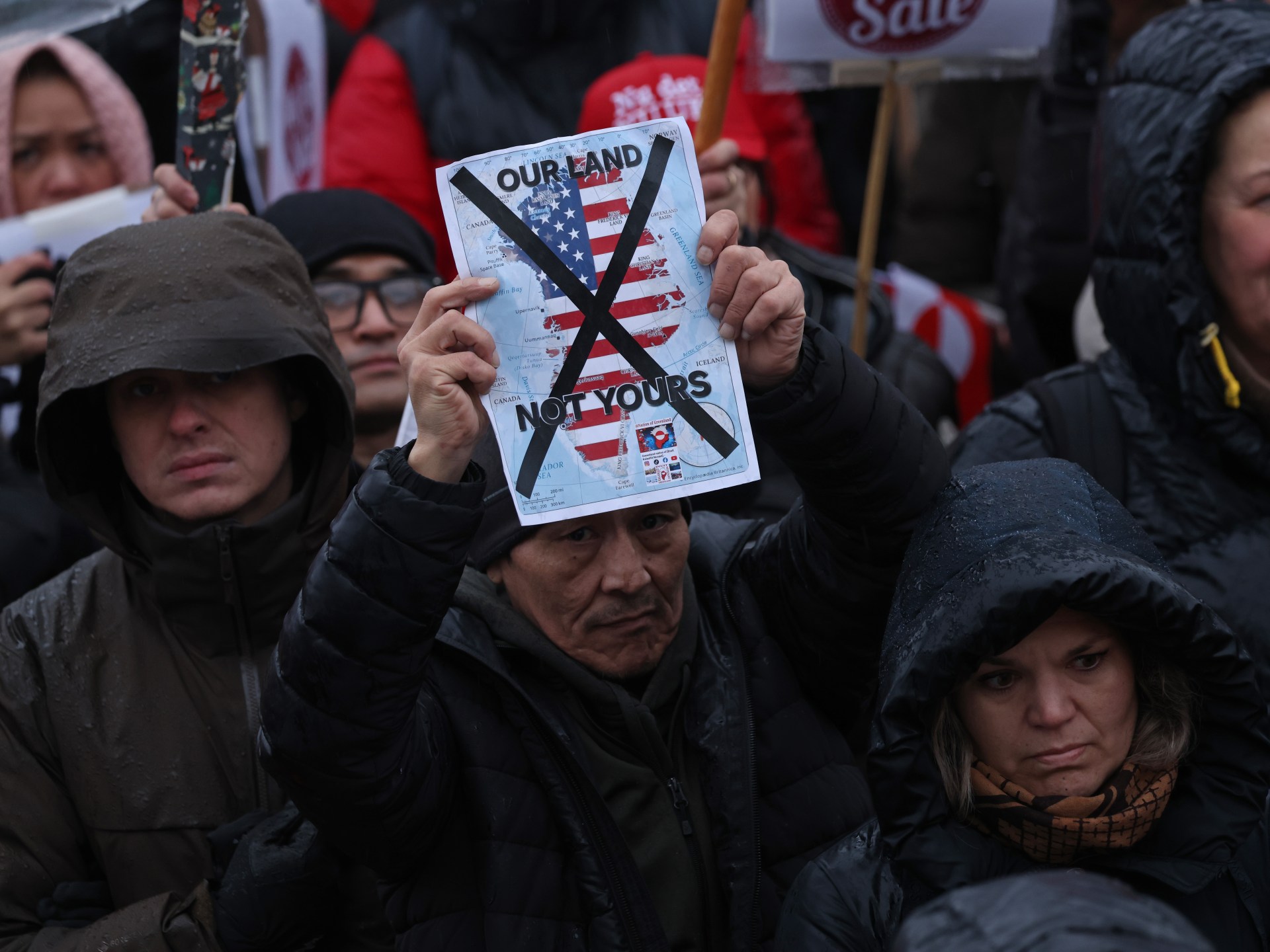
United States President Donald Trump has promised to steadily increase tariffs on European countries that have opposed his move to acquire Greenland, escalating a dispute over the semiautonomous Danish territory he has long coveted.
So what is behind Trump’s push to control Greenland, the world’s largest island, and how have Washington’s NATO allies responded?
What is Trump’s tariff threat over Greenland?
In a post on his Truth Social platform on Saturday, Trump wrote that he has subsidised Denmark and other European Union countries by not charging them tariffs.
“Now, after Centuries, it is time for Denmark to give back – World Peace is at stake! China and Russia want Greenland, and there is not a thing that Denmark can do about it.”
Trump added that “the National Security of the United States, and the World at large, is at stake.”
Trump wrote that starting on February 1, Denmark, Norway, Sweden, France, Germany, the United Kingdom, the Netherlands and Finland will be charged a 10 percent tariff on all their exports to the US.
On June 1, the tariff is to be increased to 25 percent, he said. “This Tariff will be due and payable until such time as a Deal is reached for the Complete and Total purchase of Greenland,” Trump wrote.
Trump additionally wrote: “The United States has been trying to do this transaction for over 150 years. Many Presidents have tried, and for good reason, but Denmark has always refused.”
Is Trump the first US president to seek control of Greenland?
Leaders in Denmark and Greenland have consistently insisted that Greenland is not for sale. In the past few days, Greenlanders have been protesting against Trump’s wishes to acquire Greenland. Yet Trump has pushed for acquiring the Arctic territory since his first term, and he is not the first US president to pursue such a purchase.
After buying Alaska from Russia in 1867, then-Secretary of State William H Seward unsuccessfully sought to buy Greenland. During World War II, the US occupied Greenland after Germany’s invasion of Denmark and built military and radio facilities there. It maintains a permanent presence today at the Pituffik Space Base in the northwest.
In 1946, while Greenland was still a Danish colony, President Harry S Truman secretly offered Denmark $100m for the island, but Copenhagen refused. The proposal became public only in 1991.
American citizens do not support Washington acquiring Greenland, polls have indicated. This week, a Reuters/Ipsos poll of US residents showed less than one in five respondents support the idea of acquiring Greenland.
Why does Trump want Greenland?
The location and natural resources of the island make it strategically important for Washington.
Greenland is geographically part of North America, located between the Arctic Ocean and the North Atlantic Ocean. It is home to 56,000 residents, mostly Indigenous Inuit people.
Greenland’s capital, Nuuk, is closer to New York City – about 2,900km (1,800 miles) away – than the Danish capital, Copenhagen, located 3,500km (2,174 miles) to the east.
It is a NATO territory through Denmark and an EU-associated overseas territory with residents holding EU citizenship.
Its location offers the shortest air and sea routes between North America and Europe, making it strategically vital for US military operations and missile early-warning systems. Washington has also sought more radar coverage around the Greenland-Iceland-UK gap to monitor Russian and Chinese movements.
Greenland is rich in minerals, including most of the EU’s listed “critical raw materials”, but there is no oil and gas extraction, and many Indigenous residents oppose large-scale mining. The economy mainly depends on fishing.
As climate change opens up more of the Arctic, major powers such as the US, Canada, China and Russia are increasingly interested in its untapped resources.
How has Europe responded to Trump’s tariff threats?
All 27 members of the EU will convene for an emergency meeting on Sunday to discuss their response to Trump’s threat.
UK Prime Minister Keir Starmer responded in a post on X on Saturday, saying: “Our position on Greenland is very clear – it is part of the Kingdom of Denmark and its future is a matter for the Greenlanders and the Danes,” Starmer wrote.
“Applying tariffs on allies for pursuing the collective security of NATO allies is completely wrong. We will of course be pursuing this directly with the US administration.”
European Commission President Ursula von der Leyen also responded in an X post, saying: “The EU stands in full solidarity with Denmark and the people of Greenland. Dialogue remains essential, and we are committed to building on the process begun already last week between the Kingdom of Denmark and the US.
“Tariffs would undermine transatlantic relations and risk a dangerous downward spiral. Europe will remain united, coordinated, and committed to upholding its sovereignty.”
European Council President Antonio Costa shared a post identical to von der Leyen’s on his own X account.
EU foreign policy chief Kaja Kallas wrote on X: “China and Russia must be having a field day. They are the ones who benefit from divisions among Allies.”
Kallas added: “Tariffs risk making Europe and the United States poorer and undermine our shared prosperity.”
David van Weel, the foreign minister of the Netherlands, said during an interview on Dutch television on Sunday: “It’s blackmail what he’s doing, … and it’s not necessary. It doesn’t help the alliance [NATO], and it also doesn’t help Greenland.”
https://www.aljazeera.com/news/2026/1/18/trump-announces-new-tariffs-over-greenland-how-have-eu-allies-responded?traffic_source=rss
