








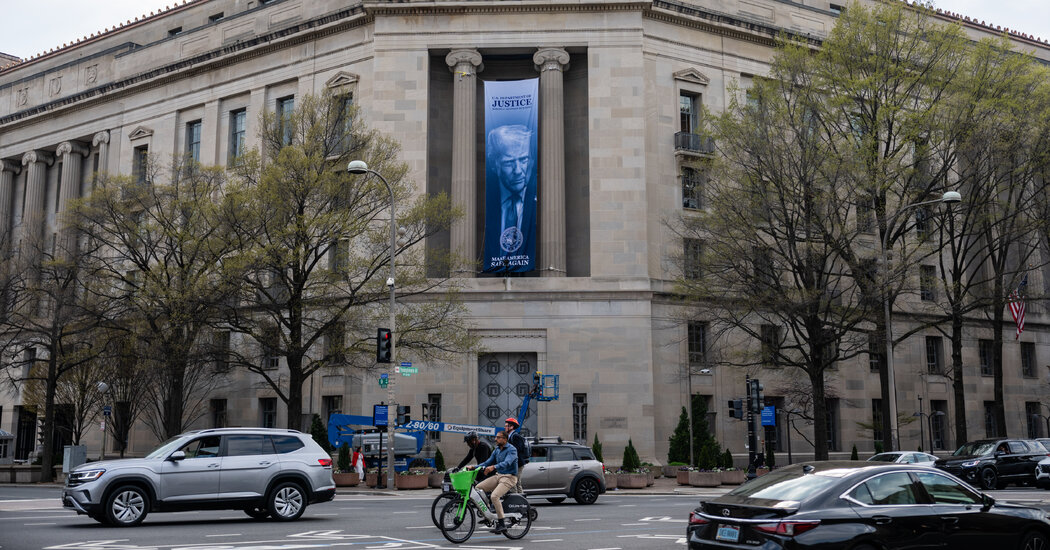
The Trump administration said on Friday that it would allow firing squads and readopt lethal injection as part of a broader push to revive the death penalty.
In an accompanying report, Todd Blanche, the acting attorney general, said that decisions by President Joseph R. Biden Jr. to pull back on capital punishment “inflicted untold damage on victims of crime, and, ultimately, to the rule of law itself.”
The Justice Department, he said, had reauthorized the use of pentobarbital to execute federal inmates and would also permit additional methods of execution, like the use of firing squads.
The 48-page report added that the Bureau of Prisons should follow the example of states that had expanded their execution protocols amid fights over the legality and availability of lethal injection drugs.
“The additional manners of execution that B.O.P. should consider adopting include the firing squad, electrocution and lethal gas — each of which the Supreme Court has found to be consistent with the Eighth Amendment,” the report said, referring to the part of the Bill of Rights that bars “cruel and unusual punishment.”
Senator Richard J. Durbin, Democrat of Illinois, called the moves “a stain on our nation’s history.”
Mr. Durbin accused the Justice Department of “turning back the clock by strengthening the barbaric practice of the federal death penalty — a cruel, immoral and often discriminatory form of punishment.”
President Trump had signaled the moves on his first day in office, signing an executive order to reinstitute capital punishment in the federal prison system. During the first Trump presidency, 13 people were executed on federal death row.
In 2021, Attorney General Merrick B. Garland issued a moratorium on executions of federal inmates and halted the use of a lethal drug protocol using pentobarbital. In his final days in office, President Joseph R. Biden Jr. commuted the death sentences of 37 of the 40 convicted killers on federal death row.
The Trump administration faces one significant hurdle. Under the law, the federal government may only conduct executions in states that allow capital punishment and carry them out according to state protocols.
For years, federal executions have taken place in Indiana, which only allows for capital punishment by lethal injection.
The Justice Department, acknowledging that limitation in its report, recommends the federal government find a new location to conduct executions, in a state that allows other methods. Mississippi, the report states, allows executions by electrocution, or firing squad if lethal injection or other methods are not available.
The report called for the Bureau of Prisons to submit a report “detailing the options to relocate or expand federal death row, or to construct a second federal execution facility in a state that permits additional manners of execution.”
The firing squad has rarely been used in the United States, but has recently been authorized by several states as an alternative method if the states cannot procure lethal injection drugs. Before last year, the only firing squad executions in the country in modern times had been carried out by Utah, in 1977, 1996 and 2010, according to the Death Penalty Information Center, a research group.
But in 2025, South Carolina, which had authorized the firing squad in 2021, executed three prisoners using the method.
In its Friday announcement, the administration said it was working on a regulation intended to cut years off the federal appeals process for state death penalty cases, though ultimately the courts have final say.
The department also said it planned to issue a regulation that would impose new limits on the ability of inmates sentenced to death to seek clemency or pardons from the federal government.
The report also suggested expanding the types of crimes, and the types of criminals, eligible for the federal death penalty in order to “correct gaps and deficiencies” in the current law. Congress would have to pass any such change into law.
The administration should consider proposing legislation, the report said, that would make eligible for the death penalty “murders of law enforcement officers; murders by aliens illegally in the United States; and murders constituted or committed in the commission of hate crimes, stalking, material support, or domestic violence.”
Much of the report centered on creating a new legal and regulatory framework to preserve the availability of the drug most often used to conduct executions.
Robin M. Maher, the director of the Death Penalty Information Center, said the report seemed more focused on grievances with the Biden administration than a straightforward analysis of lethal injection protocol.
“It struck me as rather disingenuous in terms of reflecting the reality of the problems” with the use of pentobarbital in executions, Ms. Maher said.
Pentobarbital was first used in an execution in 2010, in Oklahoma, and soon became a common method by which to execute prisoners.
As with other drugs used in lethal injections, it faced legal challenges from prisoners and their lawyers, who said that it caused prisoners to suffer, but courts have allowed its use, and several states use it as their primary method. Still, some states have had trouble obtaining the drug because of pressure from medical and advocacy groups on drugmakers.
In January 2025, the Justice Department under Mr. Garland issued a memo saying that “there remains significant uncertainty about whether the use of pentobarbital as a single-drug lethal injection causes unnecessary pain and suffering.” The department wrote that federal authorities should not use the drug for executions until its effect was more clear.
https://www.nytimes.com/2026/04/24/us/politics/trump-firing-squad-executions-death-penalty.html


