







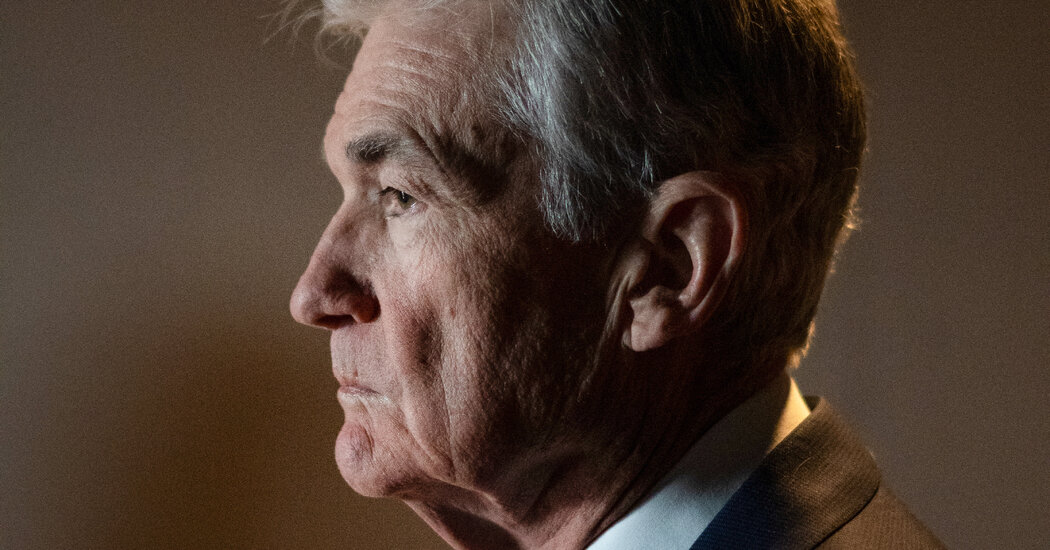
This week’s Federal Reserve meeting is set to be Jerome H. Powell’s last as chair of the central bank. But the “wait and see” policy path that he carefully carved out amid resurgent inflation risks is likely to stay intact long after he leaves the top job.
On Wednesday morning, President Trump’s handpicked successor, Kevin M. Warsh, is expected to take a significant step toward becoming the next Fed chair when Republicans on the Senate Banking Committee clear him for a full Senate vote. Hours later, the Fed will announce its latest rate decision, followed by what looks poised to be Mr. Powell’s final news conference as chair.
New leadership at the Fed will not automatically usher in a sea change in the outlook for interest rates, however. Since December, officials have kept them in a range of 3.5 percent to 3.75 percent, much to Mr. Trump’s chagrin. The president wants substantially lower borrowing costs and has made it clear that he expects Mr. Warsh to deliver them.
But Fed policymakers project no urgency to restart rate cuts, and Mr. Warsh has said he did not promise Mr. Trump to ease policy in order to get the job, even as Senate Democrats have questioned whether he would serve as the president’s “sock puppet.” On Wednesday, the Fed is widely expected to hold rates steady again. In fact, traders in financial markets that track the trajectory of rates predict no pivot toward cuts at all this year.
“The path to cutting is one that is much more fraught now than it seemed a few months ago,” said Nathan Sheets, chief economist at Citi and a former official at the Treasury Department.
The Fed’s caution around rate cuts crystallized in the wake of the war with Iran, which is pushing inflation further from the central bank’s 2 percent target while raising the specter of slower economic growth.
A roughly 50 percent jump in oil prices since the start of the war on Feb. 28 has rippled across the economy, lifting gasoline costs, airfares and shipping fees. Soaring fertilizer prices have prompted concerns about rising grocery bills, which would add yet another expense for Americans who have faced higher prices in the last year because of Mr. Trump’s tariffs. The latest Consumer Price Index report showed that annual inflation was 3.3 percent in March, almost a full percentage point higher than the pace in February.
The longer energy prices remain elevated, “the greater the chances that higher inflation gets embedded across a wide variety of goods and services, various supply chain effects start to emerge, and real activity and employment start to slow,” Christopher J. Waller, a Fed governor who was in the running to replace Mr. Powell, said in a speech this month.
Just a handful of months ago, Mr. Waller was so worried about the labor market that he voted for a quarter-point rate cut in January. Monthly jobs growth has started to pick back up again, and the unemployment rate has steadied around 4.3 percent, indicating a more stable situation.
Against this backdrop, even some of Mr. Trump’s biggest supporters have changed their tune about rate reductions. Treasury Secretary Scott Bessent said this month that the Fed should “wait and see” before lowering borrowing costs. Stephen I. Miran, who consistently called for aggressive rate cuts after Mr. Trump appointed him as a Fed governor last year, has endorsed a slower pace of reductions in light of what he described as “a little bit less favorable” inflation dynamics.
“Energy developments have changed the distribution of risks,” he said in public remarks recently. “They’ve increased the risks of higher inflation.”
For Jon Faust, a fellow at the Center for Financial Economics at Johns Hopkins University and a former senior adviser to Mr. Powell, those comments suggest that “everyone but Trump is resigned, no matter who’s chair, to a sustained hold until things clarify some.”
Support for cuts is unlikely to grow unless the labor market takes a turn and starts to deteriorate more notably. Policymakers will also want to have tangible evidence that inflation from both the war and last year’s tariffs has subsided. Some officials seem willing to acknowledge that the Fed is equally likely to have to consider rate increases, although no one yet thinks that is the most probable outcome.
As chair, Mr. Warsh would have sway over the rate debate but not final say. Decisions are made by a 12-person committee, which also includes the six other members of the board of governors, the president of the Federal Reserve Bank of New York and a rotating set of four presidents from the 12 regional banks.
Among those who could still get a vote is Mr. Powell.
Just days before the Fed’s policy meeting was set to begin on Tuesday, it was not entirely clear if he would step down as chair when his term ended on May 15. A criminal investigation into Mr. Powell and the central bank had held up Senate confirmation of Mr. Warsh. Mr. Powell had pledged to remain chair temporarily if Mr. Warsh was not confirmed in time.
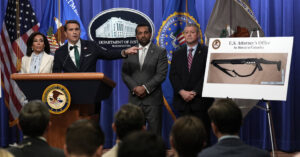
But on Friday, the ground shifted. In an about-face, the Justice Department dropped its inquiry into renovations at the Fed’s headquarters in Washington, but kept open the possibility of restarting it at any point. By Sunday, Senator Thom Tillis of North Carolina, a pivotal Republican on the Banking Committee, said federal prosecutors had given him sufficient assurances that Mr. Powell’s legal threats were over.
Mr. Powell still faces a high-stakes decision on whether to stay on as a governor, which he can do until January 2028. That would prevent Mr. Trump from filling the seat with someone more amenable to his wishes to lower rates and gain more control over the central bank.
Mr. Powell has said he would not leave the board until the criminal investigation was “well and truly over, with transparency and finality.” He added that his decision would depend on what he thought was “best for the institution and for the people we serve.”
Mr. Tillis suggested on Sunday that the Justice Department might still appeal a federal judge’s ruling that quashed the subpoenas against the Fed. He said such a move would be not about pursuing Mr. Powell but about defending the power of prosecutors to issue subpoenas. An appeal, however, is likely to encourage Mr. Powell to stay.
That could make for an awkward transition period for Mr. Warsh, who wants to pursue sweeping changes to the way the Fed operates, including the data it favors to make rate decisions, how it communicates any policy pivots and its footprint in financial markets.
Mr. Warsh’s ability to enact these changes would require broad internal support, something he would have to build while also managing Mr. Trump’s ire if he did not pursue the policy that the president wanted.
“I don’t think he gets much of a honeymoon period,” Mr. Faust said. “He’ll be in the firing line Day 1.”
https://www.nytimes.com/2026/04/28/business/federal-reserve-chair-rates-warsh-powell.html


