






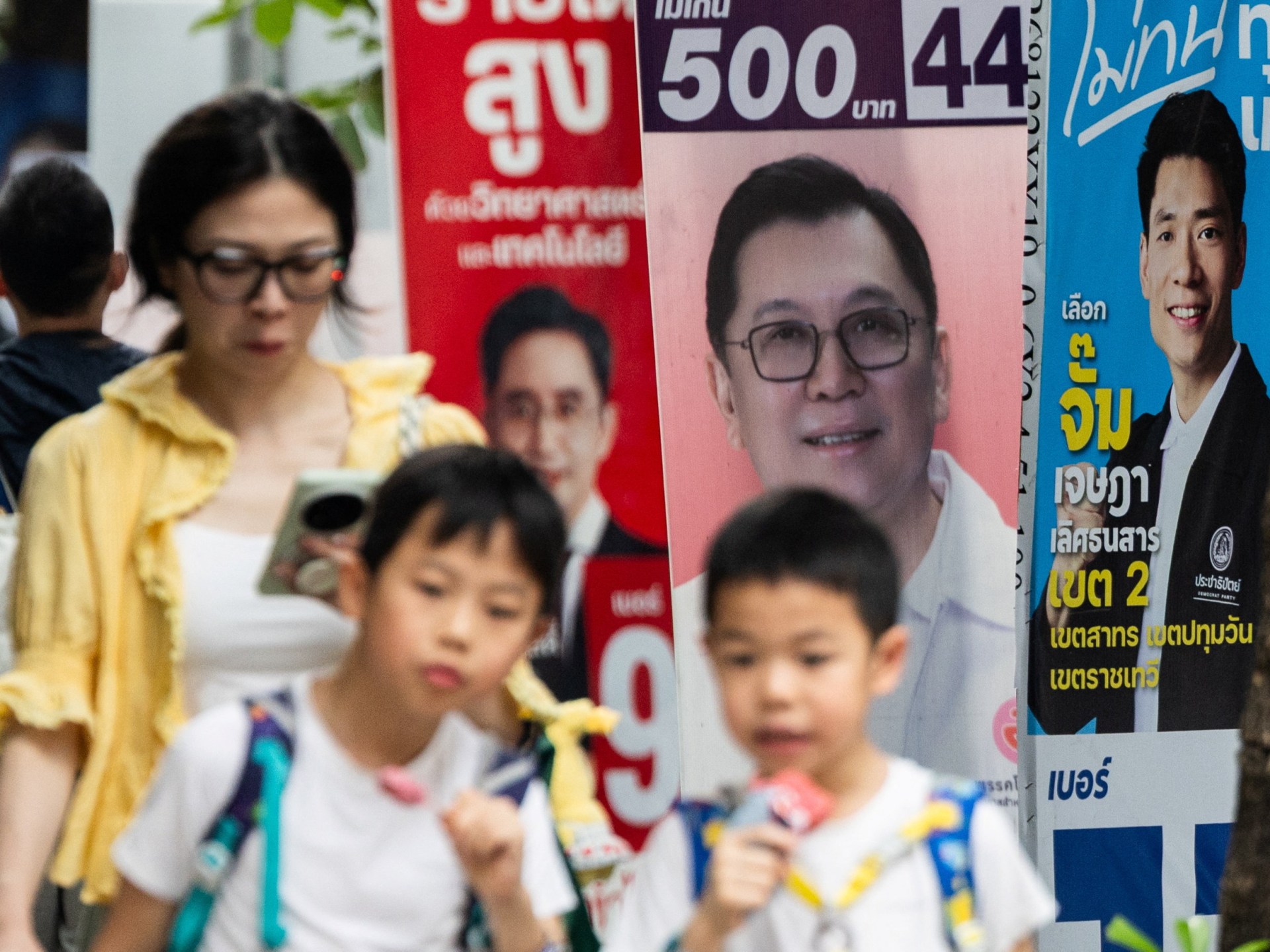
Voters in Thailand will head to the polls on Sunday amid deep political uncertainty, with the country having cycled through three prime ministers in as many years, and amid a tenuous truce with Cambodia following border clashes that killed 149 people.
The snap polls pit Prime Minister Anutin Charnvirakul’s Bhumjaithai party, backed by Thailand’s royalist conservative establishment, against the progressive youth-led People’s Party.
Recommended Stories
list of 4 itemsend of list
The People’s Party is the successor to a group that won the last election but was blocked from power and dissolved by the courts over its proposals to reform the country’s powerful monarchy.
Pheu Thai – which has dominated Thai politics for a quarter century – is also attempting a comeback after a bruising period that saw two prime ministers from the party removed by the courts and its founder Thaksin Shinawatra jailed late last year.
The vote on Sunday is seen as a test of whether Thailand’s long-running cycle of coups, street protests and court interventions can be broken, or whether the paralysis will deepen.
Here’s what you need to know about the pivotal election:
When are the elections?
Voting will take place on Sunday, February 8.
About 53 million people in the kingdom of 71 million are eligible to vote.
The 500-seat House of Representatives will be filled through a mixed system: 400 constituency seats elected by a first-past-the-post system, and 100 seats allocated through proportional representation or on a party-list basis.
The newly elected lower house will then select the next prime minister. Unlike in 2019 and 2023, the appointed Senate, which is dominated by conservative lawmakers, will have no role in choosing the prime minister.
A candidate requires 251 votes in the House to take office as prime minister.
Voters will receive three ballot papers: two for the parliamentary election and one for a referendum on whether to rewrite the constitution.
When will we know the results?
Polling stations open at 8am (01:00 GMT) and close at 5pm (10:00 GMT). Vote counting will begin shortly after, and results will be announced as tallies are completed.
The leading party is likely to become clear by the early hours of Monday.
Turnout is expected to be high. During early voting in the capital Bangkok earlier this week, some 87 percent of registered advance voters turned out to cast their ballots.
Who are the main contenders?
Bhumjaithai
Led by Anutin, Bhumjaithai rose to prominence in 2019 with its support for medical marijuana. It has transformed from a mid-sized kingmaker – winning 51 seats in 2019 and 71 in 2023 – into a conservative force now vying to become one of parliament’s largest parties.
The party formed the current government with the People’s Party’s support, after the country’s top court removed Thaksin’s daughter, Paetongtarn Shinawatra, as prime minister over her handling of Thailand’s border crisis with Cambodia.
Anutin initially promised constitutional reform and elections within four months, but the People’s Party in December accused him of reneging on their deal. Facing the risk of a no-confidence vote, he dissolved the House and called the snap poll.
Bhumjaithai has now rebranded itself as a staunch defender of the monarchy and has been bolstered by defections, attracting 64 of the 91 lawmakers who have switched parties since 2023.
Napon Jatusripitak, director of the Center for Politics and Geopolitics at think tank Thailand Future, said Bhumjaithai is seen as “pragmatic” and has now “claimed the conservative mantle” from political parties run by former generals.
People’s Party
The People’s Party is the third iteration of a reformist movement whose previous incarnations – most recently Move Forward – were dissolved by the courts.
The party campaigns on reducing the political power of unelected institutions such as the military and judiciary.
While it was once outspoken in calling for changes to Thailand’s lese-majeste law – under which defaming or insulting the monarchy is a criminal offence – it has softened its stance during this campaign.
Thitinan Pongsudhirak, a professor of international relations at Chulalongkorn University, described the group as “strange and unprecedented” in Thai politics.
“It was the first party not driven by patronage or money politics, but by reform ideas and policies rather than personalities or provincial bosses,” he said.
Pheu Thai
Pheu Thai and its predecessors dominated Thai politics for 25 years through populist policies that secured working-class support as well as a formidable electoral machinery, particularly in the north and northeast.
Despite Thaksin’s imprisonment and having six of its prime ministers removed by coups and court rulings, the party has prevented mass defections and remains competitive.
It is campaigning on Shinawatra nostalgia, with Thaksin’s nephew Yodchanan Wongsawat as its primary representative.
Thailand Future’s Napon said he expected “a significant decline compared to the previous election”, with Pheu Thai potentially falling to third place. Still, he said the party may regain some seats from the progressive camp in its northern strongholds.
What are the polls suggesting?
A January 30 survey by the National Institute of Development Administration put People’s Party leader Natthaphong Ruengpanyawut in first place for prime minister at 29.1 percent, followed by Anutin at 22.4 percent.
Yodchanan trailed in fourth place.
For party lists, People’s Party led with 34.2 percent, followed by Bhumjaithai at 22.6 percent and Pheu Thai at 16.2 percent.
What are the key issues?
The People’s Party has proposed more than 200 policies, including abolishing military conscription, drafting a new democratic constitution, overhauling the bureaucracy and launching state-backed programmes to support small businesses.
Bhumjaithai has focused on economic stimulus and security, pledging to lift annual growth to 3 percent, expand welfare schemes, build border walls and make military service more attractive through paid volunteer posts.
Anutin has also promised to protect the monarchy, saying at a Bangkok rally that amending lese-majeste laws “will never happen and will never succeed because you have us”.
Pheu Thai has meanwhile centred its campaign on debt relief, as well as income support for low earners and transport subsidies. It has also announced a “millionaire maker” programme that will award nine daily prizes of one million baht ($31,556) each.
How does Cambodia factor in?
The Thai-Cambodian clashes erupted at their contested border in July and ended following a second ceasefire in December. The clashes have stoked nationalist fervour, strengthening Bhumjaithai’s appeal, and highlighted Pheu Thai’s vulnerability.
Paetongtarn of the Pheu Thai was removed as prime minister in September over a leaked phone call with Cambodia’s former leader Hun Sen, in which she was heard pandering to him and criticising a Thai commander.
Punchada Sirivunnabood, associate professor of social sciences and humanities at Mahidol University in Bangkok, said nationalism could boost support for Anutin.
“They use this [nationalism] as a concept for support in these elections, and a lot of legislators from different political parties have moved to Bhumjaithai. This guarantees that they’re going to win a lot of seats from the district level,” she said.
On the other hand, questions over the Shinawatra family’s connections to Hun Sen have dogged Pheu Thai candidates on the campaign trail, she said.
“This border conflict hurt Pheu Thai a lot,” she said.
What about constitutional reform?
Alongside the parliamentary election, voters will also be asked whether to replace the 2017 constitution, which was drafted under military rule following a coup in 2014.
Even if approved, the process would be long and uncertain, requiring parliamentary action, Senate support to amend key clauses, and at least two further referendums.
While polls suggest overwhelming support for the “yes” vote, it will not guarantee a new charter or a democratic one.
“It depends entirely on the post-election balance of power,” said Napon. “A more conservative parliament could still produce a conservative constitution.”
Will this end Thailand’s political turmoil?
With no party expected to win an outright majority, coalition formation will be essential. But any resulting government is “very likely to be unstable”, Napon said, as partnerships between any two of the big three parties would fall short of a majority if one partner withdrew.
Thitinan of Chulalongkorn University, meanwhile, said he was not encouraged by Thailand’s electoral history.
Only once in 25 years have voting results been fully honoured, he said, noting other elections were overturned by military coups or judicial interventions.
“Establishment forces and biases are so entrenched and run so deep that the party of reform and progress would have to win a big, convincing margin of victory to have a chance at governing,” he said.
“Such a large enough margin looks like a slim chance, unless Thai voters are fed up enough to see through all the charade and shenanigans that have kept Thailand backwards and falling increasingly behind its peers,” he added.
https://www.aljazeera.com/news/2026/2/6/thailand-election-2026-what-are-the-main-parties-what-do-polls-suggest?traffic_source=rss


