







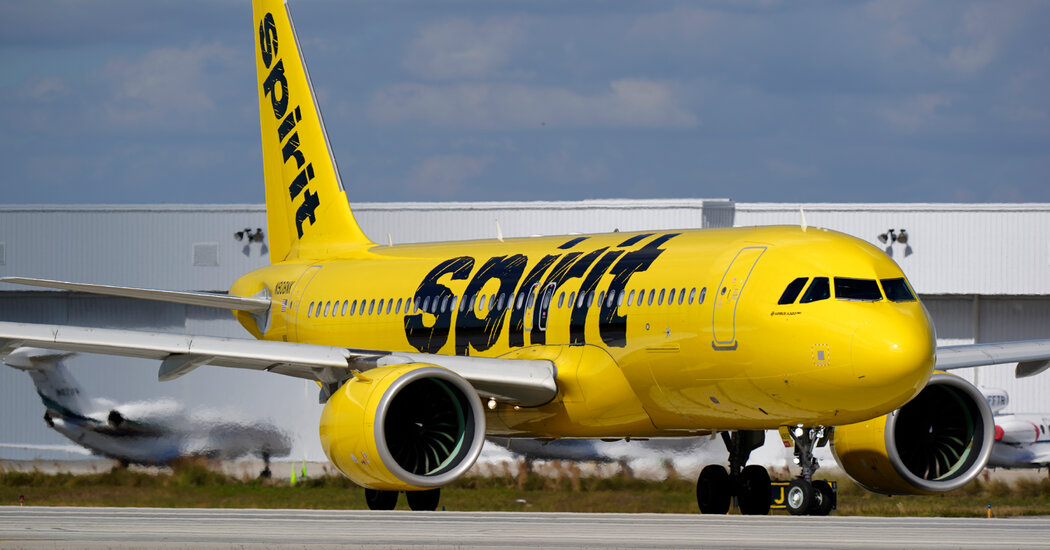
Spirit Airlines is preparing to shut down after failing to strike a deal for a financial lifeline from the Trump administration, two people familiar with the matter said.
The budget airline reshaped aviation in the United States in recent decades by selling cheap tickets and charging fees for everything from printed boarding passes to seat selection. But high fuel prices, competition from larger airlines, the Covid-19 pandemic and an engine defect hobbled the company.
In recent weeks, the airline had been negotiating a $500 million lifeline from the Trump administration. Some of the investors that Spirit owed money to opposed the terms of the bailout, under which the government could have ended up owning 90 percent of Spirit, because it would have left them in a worse financial position if the airline eventually failed. Some Republican lawmakers were also opposed to a government bailout of Spirit.
The airline had filed plans in March to emerge as a leaner business from its second bankruptcy in recent years. But a spike in the price of jet fuel set off by the war in Iran strained that effort.
A Spirit spokeswoman declined to comment, but said that the airline was operating normally.
Representatives for the Transportation and Commerce departments and the White House did not immediately respond to requests for comment.
Asked about Spirit Airlines on Friday, President Trump told reporters “We’re looking at Spirit and we’ll help them if we can but we have to come first. America comes first.”
The Wall Street Journal earlier reported that Spirit was preparing to shut down.
It was not immediately clear when the company would stop flying and what an end to operations would mean for Spirit’s customers. In the past, other airlines have offered free or discounted tickets to travelers stranded by companies that abruptly shut down.
Over the past couple of years, Spirit’s footprint had shrunk a lot. It flew about 12,000 flights in April, down from about 25,000 two years earlier, according to Cirium, an aviation data firm.
Spirit last reported an annual profit in 2019 and has lost several billion dollars since then. The airline had struggled to recover from the pandemic amid intense competition in its biggest markets. Spirit also wrestled with rising costs, a failed attempt to sell itself to JetBlue Airways and engine defects that grounded many planes in its fleet for long stretches.
But many aviation experts said that it was hard to see how Spirit could survive even with a federal bailout. Some administration officials expressed similar concerns. “The question will be: Can we do anything to save Spirit and make it viable? Or would we be putting good money into a company that inevitably is going to be liquidated?” the transportation secretary, Sean Duffy, said in an interview with CBS last month.
In an interview this week, Scott Kirby, the chief executive of United Airlines, said that Spirit’s problems predated the current rise in fuel prices since the war in Iran began on Feb. 28. “They were in trouble well before this and well-run airlines are able to be profitable even in this environment,” he said.
At one point, budget airlines like Spirit generated huge profits, earning more per dollar of sales than larger airlines like United, but Mr. Kirby said their business model was flawed because it was based on treating customers poorly by, among other things, charging lots of fees.
The proposed federal bailout for Spirit faced resistance from investors in part because the Trump administration had demanded that the government have the first claim to Spirit’s assets if the airline ultimately failed. That would have left other investors that had lent money to the airline with little or nothing.
The investors that objected most strongly to the bailout had made Spirit what is known as a debtor-in-possession loan. Such financing allows distressed companies to keep going while they resolve their financial problems in bankruptcy court. These debts have high interest rates and the investors who own them get paid back before other creditors. The investors also have the right to object to changes, including new loans, that could hurt their interests.
Robert Lawless, a professor of bankruptcy law at the University of Illinois Urbana-Champaign, compared the rights of these lenders to an oft-cited metaphor of hikers standing on a hill. “The new lender says, ‘We’re on this mountain trail and there’s plenty of room for you to go out and stand out there closer to the edge of the cliff,’” Mr. Lawless said. “And the existing lender has a good response, which is that if there’s so much room, why don’t you go stand out there?”
The lenders had put forward their own counterproposal that would have the government lend on terms that were better for the investors, the people familiar with the situation said.
Talking to reporters on Friday outside the White House, Mr. Trump implied that any terms that did not put the government first were unacceptable.
After the Trump administration began talks with Spirit, other budget airlines asked the federal government for assistance, too. In a letter this week, a trade group representing those carriers requested a $2.5 billion “liquidity pool” to help offset higher fuel prices.


