


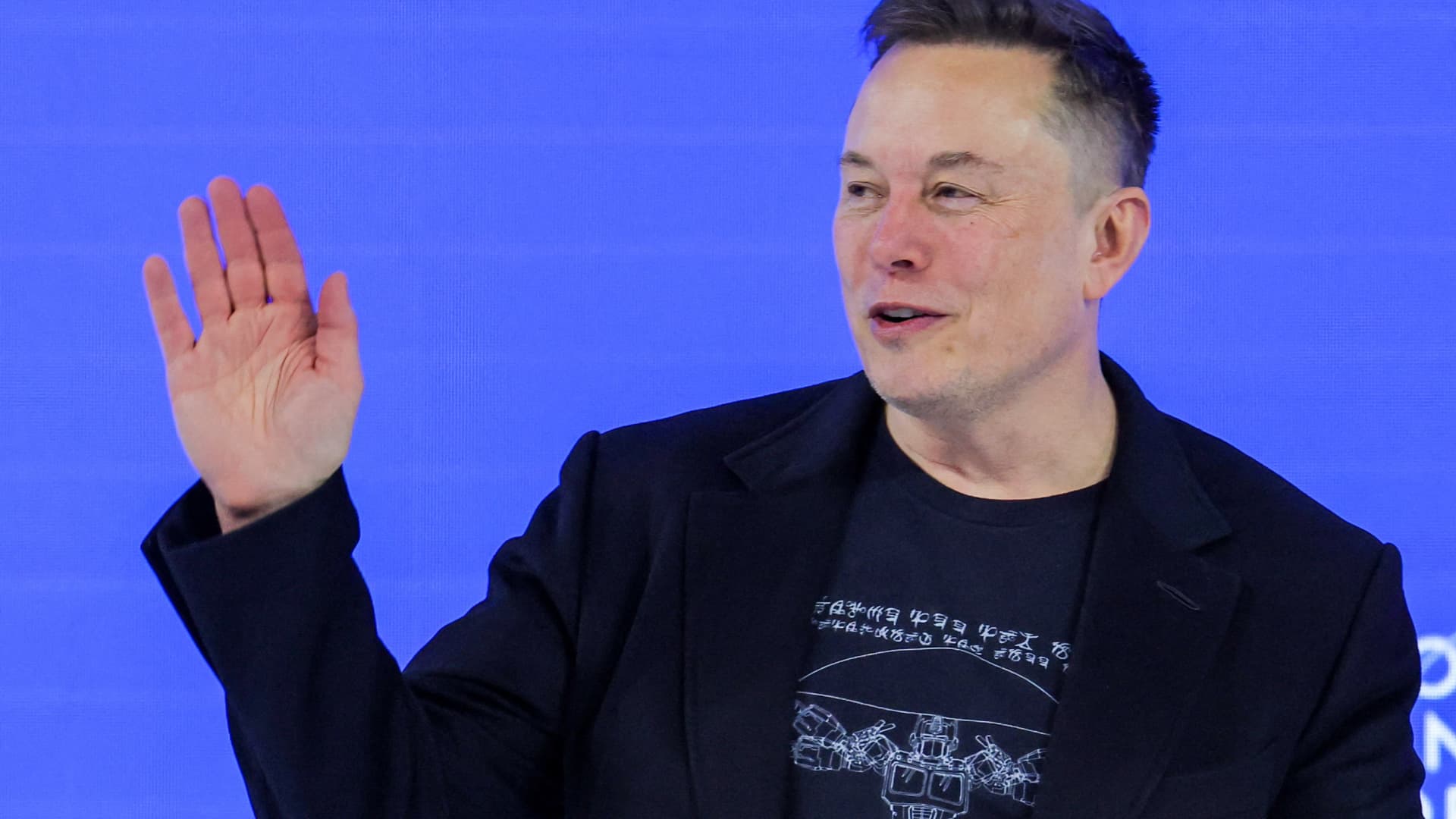
Elon Musk waves to the crowd during the 56th annual World Economic Forum (WEF) meeting in Davos, Switzerland, January 22, 2026.
Denis Balibouse | Reuters
Elon Musk’s move to combine SpaceX with his cash-burning artificial intelligence venture xAI signals a changing of the guard within his corporate empire.
Tesla has been the source of Musk’s liquid wealth, and much of his fame. But following Monday’s merger, Tesla’s market cap of about $1.58 trillion is only 26% higher than SpaceX’s stated private market valuation of $1.25 trillion.
Musk owns an estimated stake of 43% in SpaceX, compared to his 13% ownership of Tesla. That means SpaceX represents more than half of Musk’s paper wealth, which has ballooned past $852 billion, according to the Forbes Real Time Billionaires index.
And Tesla’s value has been on the decline to start the year, with the stock down 6% so far in 2026. In early January, Tesla reported a 16% year-over-year drop in vehicle deliveries, and later in the month announced that total revenue fell 3% in 2025, the first annual decline on record.
Tesla’s core auto business has been struggling of late due to a swarm of competition from electric vehicle makers in China and Europe and the recent elimination of a federal tax incentive for EV purchases in the U.S. The brand has also been hurt by Musk’s foray into politics, including his work with the Trump administration and support of far-right figures in Europe.
As Tesla’s EV sales weaken, Musk has been shifting the focus of the company to its Robotaxi ride-hailing efforts and Optimus humanoid robots, markets where Tesla faces hefty competition and currently has no real business.
Last week, Musk told analysts that Tesla is ending production of its Model S and X vehicles as it realigns its priorities. Those older models made up less than 3% of Tesla’s annual vehicle deliveries in 2025, and the company now plans to use the lines where they were assembled for Optimus.
A SpaceX Falcon 9 rocket is prepared for launch carrying NASA’s IMAP mission, which will study the boundary of the sun’s heliosphere and other scientific payloads, at the Kennedy Space Center in Cape Canaveral, Florida, Sept. 23, 2025.
Joe Skipper | Reuters
At SpaceX, Musk has a much stronger market position.
The rocket maker is the leader leading provider of orbital launch services through contracts worth billions of dollars a year with NASA and the Department of Defense. SpaceX also owns and operates the Starlink satellite internet service, which has more than 9,000 satellites in orbit and roughly 9 million customers, and even runs the company town of called Starbase, Texas.
With SpaceX reportedly pursuing an IPO this year, the company is in a particularly favorable position, especially with Jared Isaacman, a business associate and former SpaceX investor, at the helm of NASA.
The merger announced on Monday values SpaceX at $1 trillion and xAI at $250 billion, according to documents viewed by CNBC. The deal follows an earlier tie-up of two Musk entities last year, when xAI acquired social media platform X, formerly known as Twitter, in a stock transaction.
Musk’s legions of fans and institutional backers along with retail shareholders who have come to own Tesla through platforms like Robinhood, have referred to the intertwined collection of companies as the “Muskonomy.”
Musk said SpaceX was acquiring xAI to develop data centers in space, escaping what he views as energy constraints on Earth.
In a note on Tuesday, Moffett Nathanson analysts wrote that the prospect of the specific orbital data center SpaceX proposed in a filing with the Federal Communications Commission would entail capital needs that are “simply enormous.” SpaceX has sought permission to launch up to 1 million satellites as part of that initiative.
“At a bare minimum, one can safely conclude that a full-fledged build is not happening anytime soon, given the requisite operational maturity, supply chain development, and financial requirements,” the analysts wrote.
Making it work would require technical solutions not yet developed to manage radiation and cooling in space, even beyond the costs of launching and assembling high volumes of heavy equipment.
Political headwinds
Despite the lofty valuation that SpaceX now commands — only eight U.S. companies are worth more — the merger could bring added headaches to shareholders.
In addition to redirecting SpaceX profits to fund xAI’s hefty infrastructure costs, there’s a bevy of legal risks and regulatory concerns that come with the new company.
XAI is being investigated by authorities in markets including Europe, India, Malaysia, and in the U.S. by the California attorney general, after its Grok image generator let users create and share “deepfake” explicit images of children and women.
On Tuesday, French investigators raided X’s offices and Musk was ordered by prosecutors to face questions tied to a suspected abuse of algorithms.
On X, Musk called the raid a “political attack.”
Eric Talley, a law professor at Columbia University, said some regulatory risks facing xAI may have to be shouldered by SpaceX investors. While SpaceX’s defense contracting business is focused in the U.S., much of its Starlink business is international.
“Different regulatory entities may say you have to be in good standing overall as an organization,” to keep doing business in their jurisdiction, Talley said. Even if SpaceX subsidiaries don’t create liability for each other, they can affect one another’s “regulatory standing,” he said.
Such complications may be manageable for Musk as long as SpaceX remains privately held, and he maintains control without having to worry about wild stock price swings. But whether SpaceX could command and keep a public market valuation at high levels, while absorbing new xAI-related risks, is a much different conversation.

According to Reuters, SpaceX generated about $15 billion in revenue last year and $8 billion in profit. Tesla, meanwhile, reported sales in 2025 of almost $95 billion, with adjusted earnings of about $5 billion, which marked a steep decline from 2024.
For Musk to get liquid on his SpaceX holdings, he would need Wall Street to buy into his company’s proclaimed valuation.
Tesla shareholders have at least some vested interest in a positive outcome. The EV company said last week that it agreed to invest $2 billion in xAI as part of a funding round that closed earlier this month.
“Tesla’s recent xAI investment is now a SpaceX investment,” Ann Lipton, a law professor at the University of Colorado and former corporate and securities lawyer, said in an email. The merger is just “more proof that Musk is willing to engage in transactions across his empire, but we already knew that.”
For Tesla investors worried about Musk focusing too much of his attention outside of the company, they can hope that the prospect of a $1 trillion long-term payout is enough to keep him from straying too far.
The pay package for Musk, approved by shareholders in November, consists of 12 tranches of shares to be granted if Tesla hits certain milestones, including market cap gains and operational achievements, over the next decade. The first tranche of stock gets paid out if Tesla hits a market capitalization of $2 trillion, about $400 billion more than the current valuation.
— CNBC’s Robert Frank, David Faber and Ari Levy contributed to this report.
WATCH: Why Elon Musk is pivoting

https://www.cnbc.com/2026/02/03/muskonomy-shakeup-spacex-valuation-after-xai-merger-nears-tesla.html
