






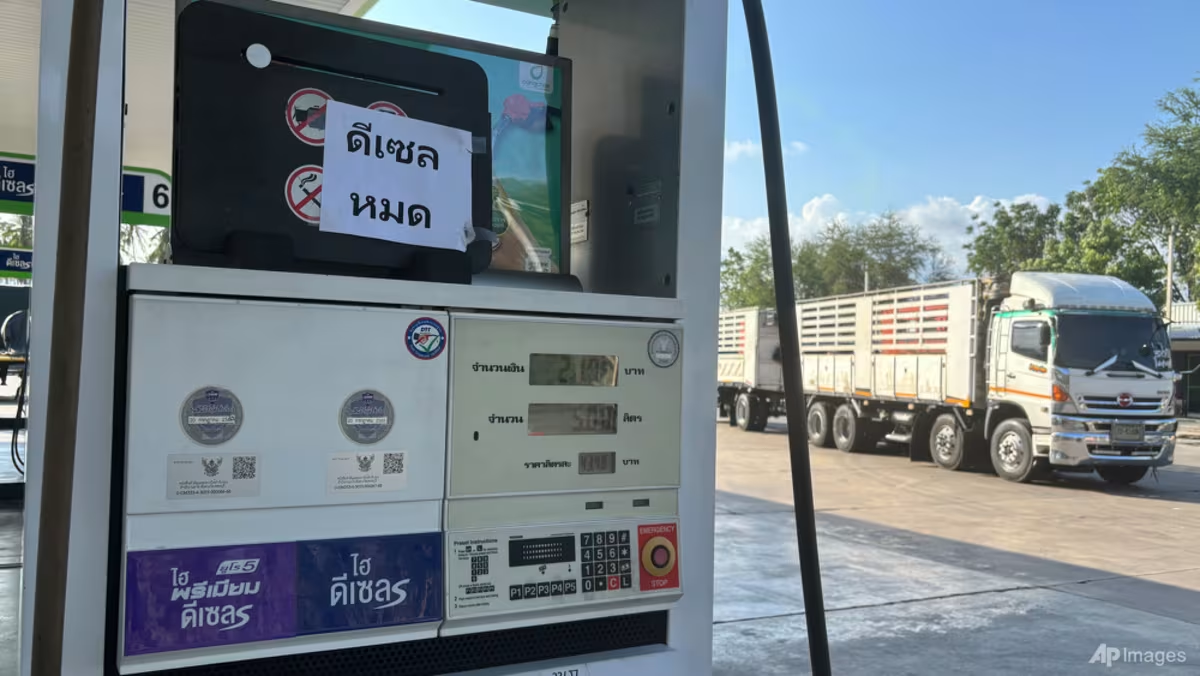
BANGKOK: Asian nations are increasingly competing for Russian crude oil as an energy crisis mounts amid the month-old war by the United States and Israel against Iran, which has choked off roughly a-fifth of the world’s oil supply.
Much of the oil from the mostly shut Strait of Hormuz was headed for Asia, hit hardest by recent energy shocks. Over the weekend, Iran-backed Houthi rebels entered the conflict, further threatening shipping.
To shore up global crude oil supplies, the US has temporarily eased sanctions on Russian oil shipments already at sea — first for India, then for the rest of the world.
Demand is rising in Asia while Russia is raking in billions of dollars. But experts say there is a limit to how much Moscow can boost its exports of crude oil, which is unrefined petroleum needed to make fuels like gasoline and diesel, and it is already exporting at a level close to its previous peak.
In addition, Russia’s four-year-old full-scale invasion of Ukraine and recent drone attacks on its energy facilities by Kyiv are hurting its export capabilities.
For desperate countries in Asia the opportunity is short-lived and shrinking, said Muyu Xu, a senior crude oil analyst at the global trade data firm Kpler.
“The real problem is how much cargo is still available in this market,” she said.
A FLURRY OF INTEREST
Before the Iran war, China, India and Turkey were the main importers of Russian oil, flouting Western sanctions for a healthy discount.
US and European Union sanctions were meant to economically hinder Russia after its invasion of Ukraine.
But the US sanction waiver sent energy-hungry Southeast Asia into a flurry. This month, the Philippines, Indonesia, Thailand and Vietnam signalled new interest in Russian oil.
Manila, a long-time US ally, imported Russian crude for the first time in five years — days after it declared an energy emergency.
Others may follow, but will compete with China and India for roughly 126 million barrels still at sea, according to Kpler.
India alone typically needs 5.5 million to 6 million barrels of oil per day.
Analysts say Russia is unlikely to boost exports sharply. In March, flows were about 3.8 million barrels a day, above February’s 3.2 million but still below the mid-2023 peak of 3.9 million.
Xu said the crisis was a reminder of how quickly geopolitics can shift — sometimes driven by just a few decision-makers — making it hard for countries to plan ahead. She said “right now, really the priority is to ensure your supply and all the other considerations are secondary.”
Southeast Asian countries competing for the dwindling amount of Russian crude oil at sea are likely hoping the US extends its sanction waiver beyond April, Xu added.
The options are limited for these nations, and safer bets — like crude oil from the US, South America or West Africa — are too far for Asia, meaning shipments won’t arrive for months. That leaves poorer nations scrambling.
https://www.channelnewsasia.com/asia/asia-countries-competing-russian-crude-oil-iran-middle-east-war-6027176


