






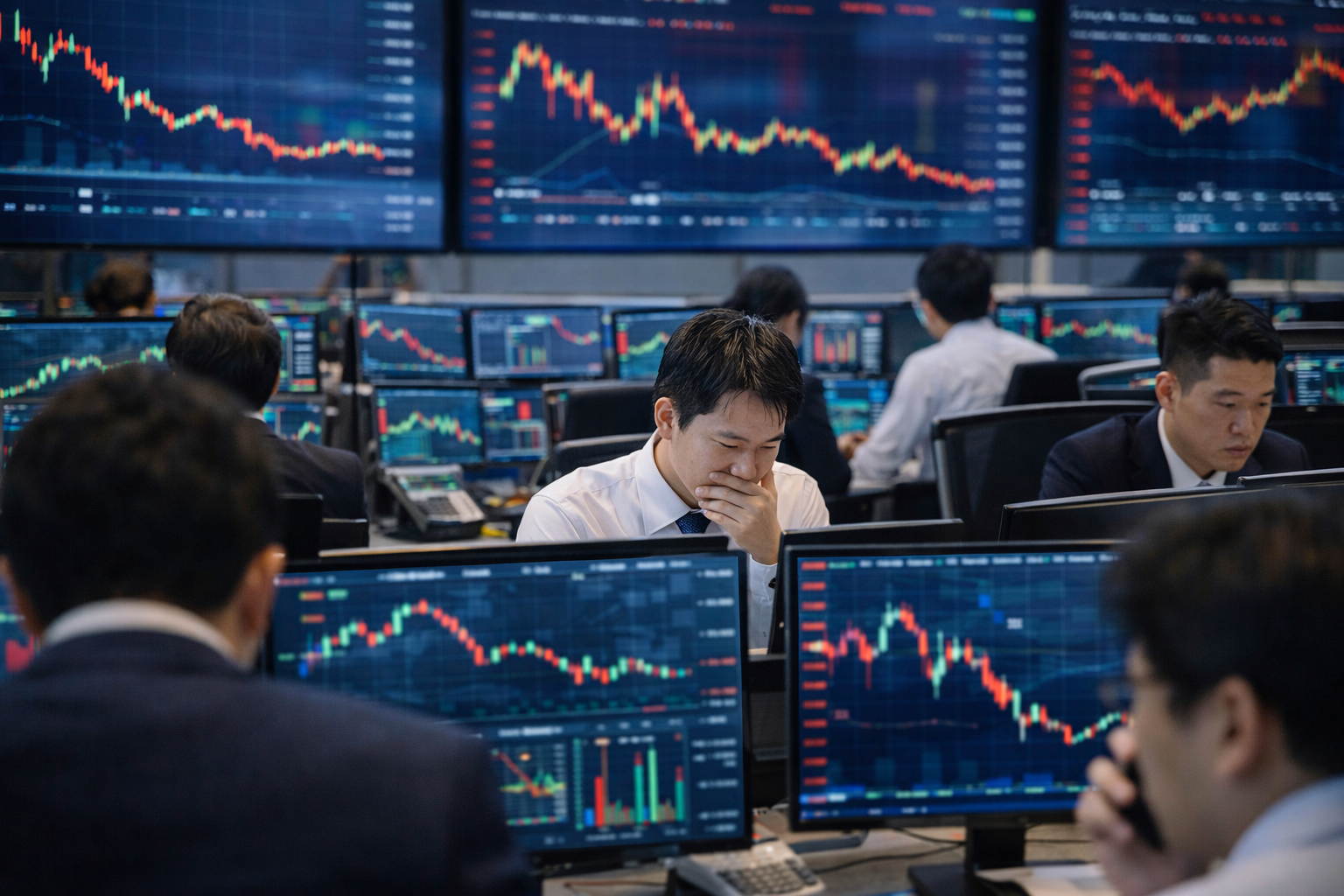
Asian markets opened mixed on Wednesday after President Donald Trump said he would indefinitely extend the Iran ceasefire.
The announcement provided some support to risk sentiment, even as investors remained wary of the still-closed Strait of Hormuz and elevated oil prices.
Japan’s Nikkei 225 climbed to a fresh record on the back of domestic trade data, while other regional markets slipped as traders locked in recent gains and weighed how durable the latest truce signal really was.
The uneven start captured the current mood across Asia.
Investors were encouraged enough by Trump’s ceasefire extension to continue buying selectively, but not convinced enough to push the whole region higher while energy disruptions remain unresolved and the diplomatic path remains uncertain.
Japan leads as regional markets split
Japan’s Nikkei 225 rose to a new record of 59,691 after the release of the latest trade data, extending its leadership role in Asian equities.
The index was trading around record territory in early dealing, underscoring the market’s strong momentum even after recent gains.
The move suggests investors remain willing to reward Japan’s combination of earnings strength, reform momentum and a still-competitive currency backdrop.
Elsewhere, the picture was weaker.
South Korea’s Kospi fell 1.02% amid profit-taking after hitting a record high on Tuesday, while the small-cap Kosdaq dropped 1.57%.
Mainland China’s CSI300 slipped 0.11%, Hong Kong’s Hang Seng lost 1.08%, and Australia’s S&P/ASX 200 fell 0.98%.
That mix points to a market in consolidation rather than retreat.
Several Asian benchmarks have rebounded sharply this month as hopes for de-escalation in the Middle East and firmer global earnings have revived risk appetite.
Ceasefire hopes support sentiment
The geopolitical backdrop remains central to that cautious optimism.
President Donald Trump said he would indefinitely extend an Iran ceasefire, a move that helped sustain risk appetite in early trading, though it was not immediately clear whether Iran or Israel would formally support such an extension.
That uncertainty matters because the market has been willing to price in peace headlines quickly, but it has become more selective about how much credit it gives to unilateral statements.
The bigger unresolved issue is Hormuz.
The US Navy would continue its blockade of Iran’s ports and coast, while Tehran has effectively kept the Strait of Hormuz shut.
Oil, currencies and the regional read-through
Crude prices held their recent gains, with US West Texas Intermediate near $90 a barrel, a level not seen in more than a year.
Oil’s resilience is an important signal because it tells equity investors that geopolitical risk is still carrying a price, even as ceasefire hopes improve sentiment.
Currencies reflected a similarly nuanced picture.
The euro traded around $1.1748, sterling firmed to $1.35195, and the yen edged slightly stronger to about 159.26 against the dollar.
Those moves suggest the dollar’s haven bid has softened somewhat, but not enough to trigger a broad relief trade across all regional assets.
https://invezz.com/news/2026/04/22/nikkei-hits-record-high-as-asian-markets-open-mixed-on-ceasefire-extension/


