


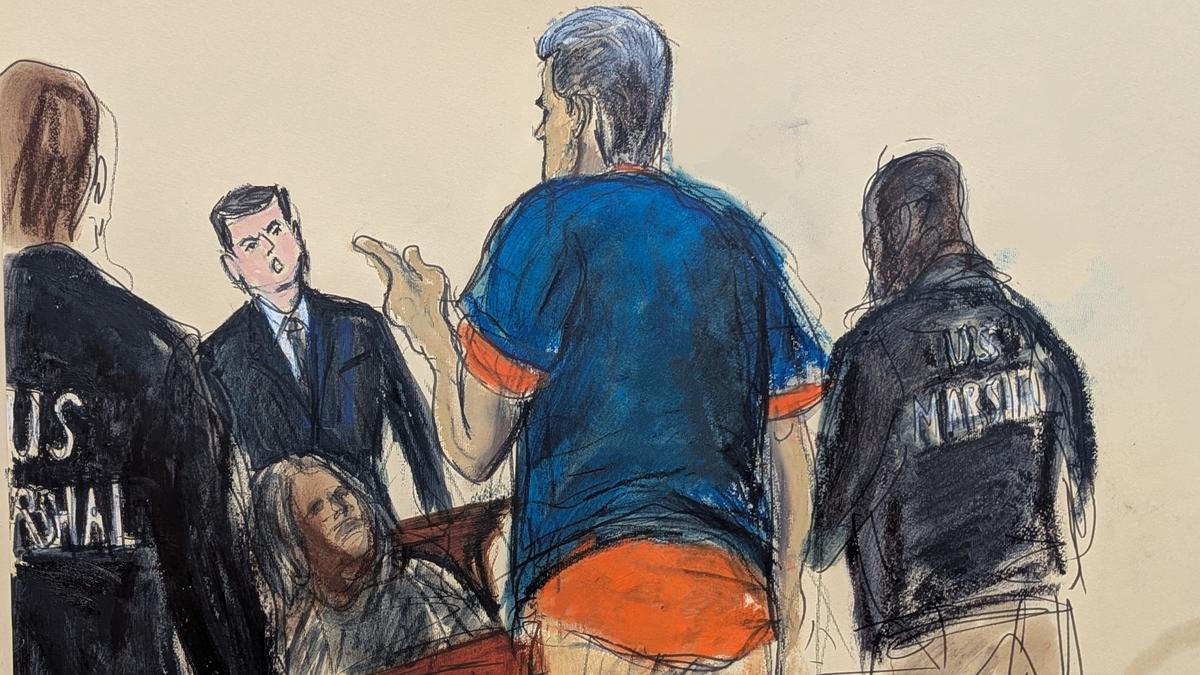
Two days after being ripped from a compound in Caracas, Venezuela, Nicolás Maduro, the captive president of Venezuela, appeared in a New York City courthouse and pleaded not guilty to federal charges, declaring himself a “prisoner of war.”
Maduro, who was seized by Army Delta Force commandos Saturday and transported to the United States, wore a navy shirt over orange prison garb and headphones for translation. He blinked in the bright lights of the courtroom as he was asked for his plea.
“I’m innocent. I’m not guilty. I am a decent man. I am still the President of my country,” he said in Spanish, formally entering a plea of not guilty to narco-terrorism, cocaine importation and machine gun charges.
When he tried to keep speaking, saying he had been “kidnapped,” Judge Alvin K. Hellerstein interrupted.
“I only want to know one thing,” Mr Hellerstein said. “Are you Nicolás Maduro Moros?”
“I am Nicolás Maduro Moros,” the defendant responded.


It was a collision with a new reality for the ousted Venezuelan leader, an autocrat who was compelled to conform to the rules of the courtroom, where the judge is the highest authority.
His expression remained neutral, but his hands were restless — sometimes holding rigid on his chair’s armrests, sometimes clasped prayer-like below his chin.
After his capture Saturday along with his wife, Cilia Flores, who was also indicted, Maduro was brought to the United States to face charges, leaving the future of his country in question.


Secretary of State Marco Rubio has said that Maduro, who was indicted in New York five years ago before fresh charges were issued this weekend, was a fugitive from US justice and said that his rendition was “largely” a law enforcement operation.
But Maduro, who took office in 2013 after the death of Hugo Chávez, is expected to challenge the legality of his arrest and the Trump administration’s refusal to recognise him as a legitimate head of state.
A lawyer for Maduro, Barry Pollack, said at the Monday hearing that he might file motions concerning Maduro’s role as the head of a sovereign government, adding that there were also “questions about the legality of his military abduction.”
Leaders of foreign countries are typically granted immunity under international law, a norm that the United States has long observed. But Maduro has been accused by Venezuelans and many in the international community of having stolen the 2019 election that kept him in power.
The United States refused to recognise him as the country’s legitimate leader after that election, or the July 2024 elections that he again purported to have won.
Maduro entered the courtroom promptly at noon, escorted by US marshals, his black hair streaked with grey. He took slow, deliberate steps as he walked in, smiling slightly and surveying a sea of roughly six dozen lawyers, reporters and spectators packed into the gallery.
“Buenos dias,” he told the crowd.

He was seated two chairs away from Flores, the couple separated by one of her lawyers, Mark Donnelly. Flores, whose face was bruised and bandaged, spoke less frequently than her husband, but echoed his defiance.
“I am the first lady of the Republic of Venezuela,” she said, when asked by Mr Hellerstein to identify herself. She also pleaded not guilty.
This article originally appeared in The New York Times.
© 2026 The New York Times Company
https://thewest.com.au/news/world/nicols-maduro-yanked-into-the-us-justice-system-says-he-was-kidapped-c-21219644
