






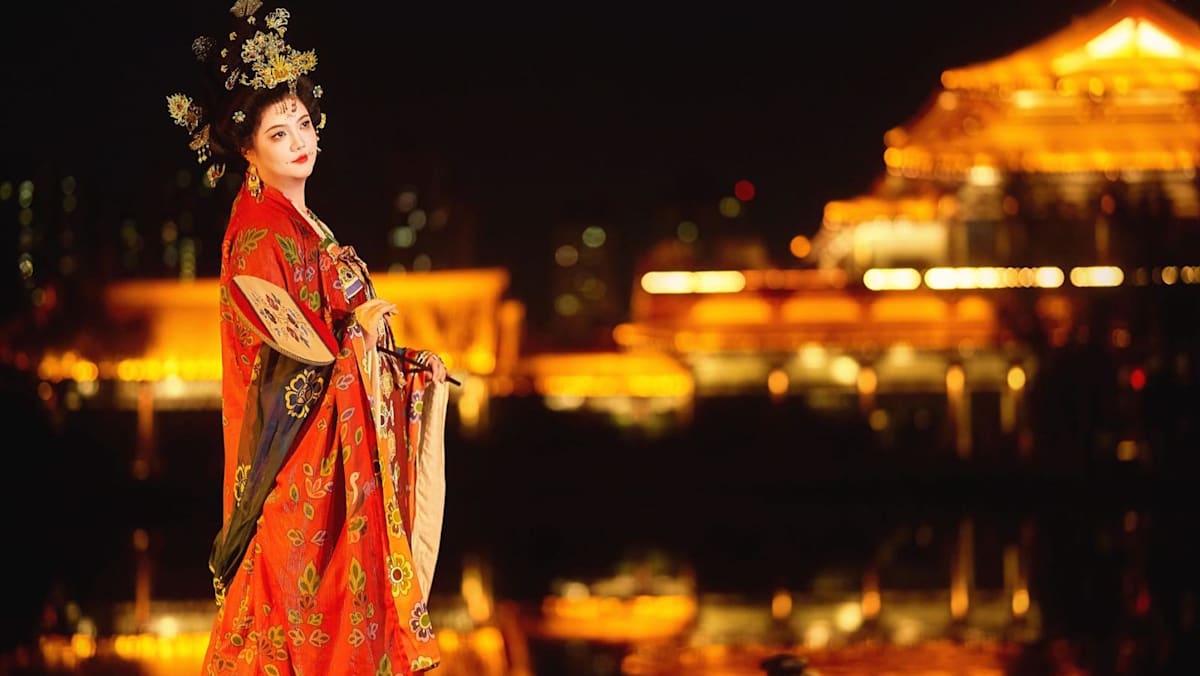
But while its rapid commercialisation has turned it into a full-fledged service industry, it now risks becoming formulaic in some cities, Zhong added.
“As the novelty fades, some consumers are beginning to show signs of fatigue.”
A countertrend is emerging, with some enthusiasts seeking more “historically informed and academically grounded experiences”, Zhong observed.
“They pay closer attention to historical accuracy, including makeup, garment structure, and ritual elements and this deeper engagement is encouraging broader interest in China’s textile and dress history.”
ANOTHER WIN FOR CHINESE SOFT POWER
The rise of hanfu experience studios mirrors the popularity of kimono and hanbok rentals in tourist hubs across Japan and South Korea.
And as China sees strong growth in foreign arrivals – boosted by expanded visa-free policies – hanfu has quickly become a “must-do” activity for international travellers.
When asked whether hanfu could be seen as a “modern-day” example of China’s soft power, Zhong said: “If we define soft power as the ability to influence others through cultural attraction, then the hanfu boom certainly represents a new form of soft power.”
“The traditional aesthetics, garment styles and cultural symbolism embodied in hanfu, combined with the massive amount of content created by young Chinese people online, create a highly visible, engaging and participatory form of cultural appeal.”
Domestically, she said, the movement reinforces cultural identity among young people.
Internationally, it also introduces Chinese culture “in a natural, spontaneous, and lifestyle-driven way”.
The growing number of foreign visitors trying hanfu shows the trend “has already moved beyond China’s borders and is generating genuine influence”, Zhong said.
“Compared with panda diplomacy – a highly institutional and state-led soft power tool – the spread of hanfu is far more decentralised and grassroots-driven,” she said.
Its momentum comes largely from young people, social media and cultural tourism.
“In this sense, hanfu represents a softer, more organic and everyday form of soft power – closer to lived culture than to formal diplomacy.”
And it holds further potential, said Zhu.
“Although China has invested heavily in cultural diplomacy and global branding, institutionalised frameworks specifically leveraging hanfu are still limited,” he said, pointing to opportunities such as international hanfu workshops and cultural exchange programmes.
For now, the global promotion of hanfu relies primarily on grassroots communities, diaspora groups and commercial influencers rather than national-level strategies.
Because hanfu experiences intersect naturally with tourism and social media sharing, visually striking user-generated content travels quickly.
“These visually appealing narratives can organically amplify China’s soft power by circulating positive representations of Chinese cultural heritage on global platforms,” Zhu said.
https://www.channelnewsasia.com/east-asia/china-hanfu-experience-cultural-confidence-new-face-popularity-5653586


