





Fiancés Shane Boucher and Makenna Westlake were thrilled when Westlake found out she was pregnant with their first child earlier this year.


But when Westlake’s water broke back in September, at only 22 weeks gestation, the couple rushed to their local hospital in Yarmouth, N.S.
They say they were told by staff at Yarmouth Regional Hospital that due to the extreme pre-maturity of their son, they would have to give birth at the IWK Health Centre in Halifax — the only health facility in the province with a Neonatal Intensive Care Unit (NICU).
Westlake says they put in both a LifeFlight and an ambulance request, but were denied both.
Instead, the couple and Westlake’s mother ended up driving hundreds of kilometres to Halifax.
“The entire time, I was talking to our son in her stomach,” Boucher says. “Telling him, ‘Listen kid, it’s far too early, you can’t come out yet.’ So, he listened to us, he turned himself around — he tried his hardest to stay inside.”
Once they got to the IWK, Westlake says the baby’s heartbeat was still strong. She says they waited more than three hours before getting brought to the Birth Unit.
“The entire time…she (Westlake) was continuing to throw up,” Boucher recalls. “We were asking the nurses and doctors if she could have water or food or something…they pretty much suggested that she shouldn’t take anything in case of an emergency C-section, which obviously never happened.”
Westlake says a doctor-nurse duo performed the delivery, but she didn’t feel supported throughout the process.


Get weekly health news
Receive the latest medical news and health information delivered to you every Sunday.
“This was my first pregnancy, plus it’s a traumatic birth experience, and they were not coaching me — nothing,” she says. “We should have given birth in a NICU room, so then there’s an incubator and stuff right there to be able to transfer him over and stuff to proper care.”
Their son, Alakai Vincent Boucher, was born at 1:01 a.m., weighing one pound, three ounces.
“And I remember looking at mom, and I’m like, ‘He’s just so perfect,’ and I was in tears,” Westlake says.
The couple says he was fully formed, with all his fingers and toes, as well as opaque skin.
They say an autopsy conducted post-mortem determined Alakai’s organs were fully developed as well.
But post-birth, Boucher and Westlake say they didn’t see hospital staff check their son’s vitals.
“I focus on his chest, and I can see movement,” Boucher says, stifling tears. “And I say, ‘I think he’s breathing!’ That’s when they come over. The nurse with her stethoscope, places it on his chest, looks up, says nothing, shakes her head and walks away.”
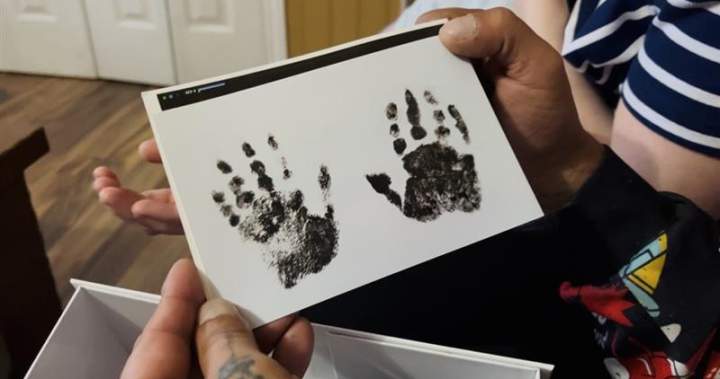
Boucher and Westlake signed papers declaring Alakai deceased later that night and spent the remaining time they had with him cuddling in Westlake’s hospital bed.
The couple returned home, heartbroken, only to receive a call from someone at the IWK later that week, who was unaware Alakai had died.
“She goes, ‘I see when you guys were released from the hospital, they never checked Alakai’s hearing and breathing before you guys left — when would you like to make an appointment to bring your son in to make sure his hearing and breathing is up to date?’” Westlake says.
“And I was like, ‘How do you test a dead kid’s hearing and breathing?’ And she said, ‘What? There’s no record here that he’s dead,’ …and I lost it. I had to go.”
She says the woman apologized, but following the mistake, Westlake and Boucher would like to see better communication across hospital departments following the loss of a child.
The IWK declined Global News’ request for an on-camera interview, but when provided with the details of the couple’s case, responded with a statement.
It says, “We understand this is a very difficult time for the family, but due to patient privacy, we are unable to comment on specific cases.”
The statement adds, “patient care is our top priority and concerns of this nature are taken seriously and thoroughly reviewed by our established feedback and patient experience process.”
But the couple can’t help but wonder if their son would have stood a chance had he received immediate NICU care.
Boucher and Westlake are calling for changes across the health care system — specifically in units specializing in labour and delivery — including better communication with parents of micro-preemies regarding viability.
They would also like to see Nova Scotia require high-risk premature births, or births that happen over the 20-week mark but not yet full-term, happen in the NICU.
“Those types of births? It shouldn’t just be a nurse and a doctor — there should be a whole team in there,” Westlake says.
Overall, Boucher says they felt disrespected throughout much of the birth process and would like to see more compassionate care overall — especially for families going through trauma.
They still want to be parents, but when that chapter comes, the couple says they plan to have the baby in his home province of Alberta.
N.S. couple grieves baby after ‘traumatic’ birth, calls for more sympathetic care